
The T.C. Jacoby Weekly Market Report Week Ending August 6, 2021
Even as cheese production has slowed, balancing operations continue to press forward at a steady clip.
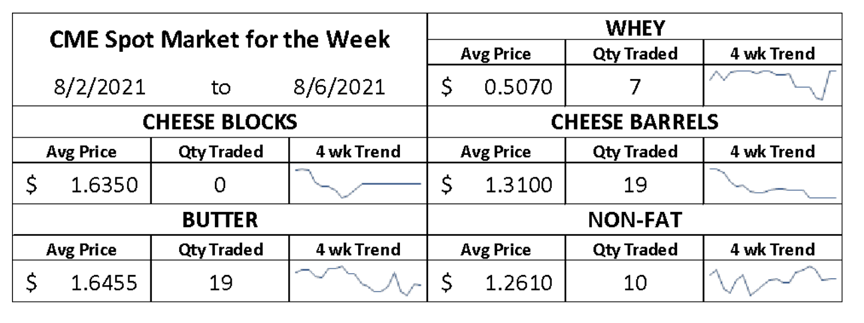
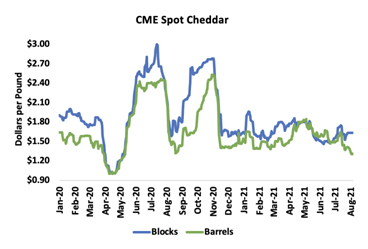
While the world’s best athletes showcase their athletic prowess in the final days of the Tokyo Olympics, the dairy markets are also experiencing their share of flips, climbs, and dives. In the cheese markets, barrels made the biggest headlines this week with the CME spot prices taking a tumble on Monday. Barrels finished the week at $1.31 per pound, down
8¢ compared to last Friday. Meanwhile, the block market was quiet, holding unchanged at $1.635 per pound with no loads trading hands over the course of the week. The block-barrel spread gaped as wide as 32.75¢ this week, the largest difference since mid-March.
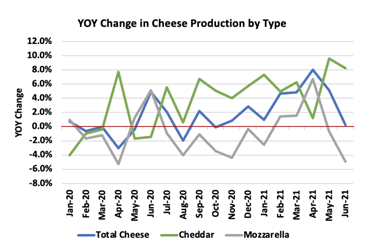
 Cheese production grew year over year for the eighth consecutive month in June, according to USDA’s Dairy Products report, released earlier this week. However, with total cheese output totaling 1.124 billion pounds, the increase was a mere 0.2% compared to June 2020. Augmented cheese production was driven by growth in American styles, and especially Cheddar production which was up 8.2% year over year and likely reflected the expansion of processing capacity which has occurred over the past year. Production of Italian varieties fell by 2.6% against the same month last year.
 Anecdotal reports indicate that cheese demand remains steady from both domestic and international sources. An announcement of Section 32 cheese purchases on Thursday breathed some air the market but stakeholders don’t expect the amounts to be substantive.
The whey markets have softened considerably over the last week. At the CME, the spot market slipped, testing depths as low as 47.5¢ per pound on Wednesday, the lowest price 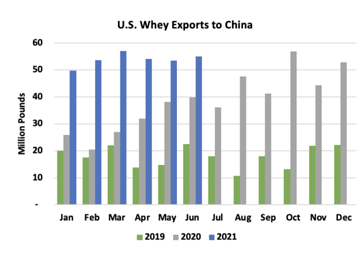 since the early January. However, this figure was quickly rejected with the market rebounding and ultimately closing Friday’s session at 54¢ per pound, an increase of 3.75¢ compared to last week. Nevertheless, comments in USDA’s Dairy Market News suggests that market tones have shifted with buyers now boasting more negotiating power and demanding lower prices from suppliers
Whey production has eased with most whey products seeing lower figures in June. Dry whey production for human consumption slipped by 0.9% year over year while output of whey protein isolates also fell by 7.0% versus June 2020. Only whey protein concentrates were able to eke out an increase, rising by 0.2% to 40.3 million pounds for the month.
Whey exports stayed strong through June, with insatiable demand from China driving year over year growth of 11.7% for the month. In recent weeks, however, market participants 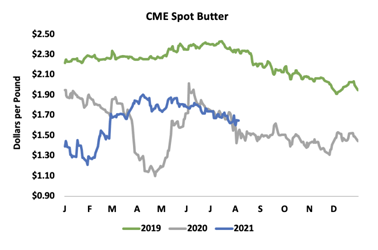 comment that international interest has been more mixed with the commodity hit particularly hard by ongoing logistical constraints.
Even as cheese production has slowed, balancing operations continue to press forward at a steady clip. Cream supplies are plentiful and butter churns are working through available supplies. Butter production surged upward by 7.8% year over year in June, posting the largest volume for the month in decades. Plentiful butter supplies have weighed on prices. Spot prices slipped as low as $1.605 per pound on Wednesday before bouncing back. Today’s spot session closed at $1.6475 per pound with 19 loads changing hands over the course of the week. Butter prices perked up at this week’s Global Dairy Trade (GDT) auction, one positive note as the 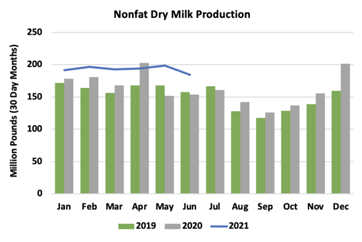 auction’s index lost ground for the eighth consecutive session. At current prices, GDT butter holds a 38¢ per pound premium to U.S. spot prices after adjusting for fat content, potentially creating some additional opportunity for butter exports.
Dryers have also continued to run solidly, absorbing available condensed skim. As a result, supplies of nonfat dry milk (NDM) are plentiful but demand from both domestic and international sources has kept tension in the market. NDM spot prices have been unsettled, starting the week by rising to $1.275 per pound before giving up two pennies and closing Friday’s trade at $1.255, down 1.25¢ from last week. Dryers have shown a strong preference toward producing milk powder for use domestically and for certain Mexican buyers. While NDM production rose by 19.8% year over year in June, skim milk powder production, typically destined for customers further afield, tumbled by 46.1%. NDM
Milk production continues to dissipate seasonally but volumes remain plentiful overall. As schools prepare to open in the coming weeks demand from bottlers has ticked upward. Higher Class I demand and lower overall milk supplies has reduced the availability of milk for manufacturers and slashed discounts on spot milk loads. Milk futures staged mixed performance over the week with most nearby Class III contracts losing value early in the
Oscillations in the grain markets persisted this week. Corn futures appreciated across the board on Monday before slipping on Tuesday and Wednesday. Nevertheless, they found traction on Thursday and Friday. DEC21 corn futures settled on Friday just 2.75¢ per bushel lower than on Monday. Meanwhile, soybean and soybean meal futures bottomed out on Tuesday before recouping some value later in the week. Volatility in the grain markets and elevated feed costs continue to cause anxiety for producers, with little indication that prices are poised to relax coming weeks.
Original Report at: https://www.jacoby.com/market-report/dairy-markets-experience-flips-climbs-and-dives/


Be the first to comment