

I keep seeing/hearing references to inflation and how, or if, it will impact dairy prices. It feels like the prices for nearly everything are going up, so what would stop dairy prices from also rising? From a very long-run perspective, there isn’t much connection between consumer prices in the U.S. and the farm gate milk price. Between 1950 and 2019, the consumer price index (CPI) was up 962%, but the milk price was only up 372%. How can that be?

Assuming a free market, the equilibrium price for a good should equal the cost of production. If the price is above the cost of production, there is an incentive to increase production to capture that extra profit and production will continue to increase until the price comes down to match (or drops below) the cost of production. So, what really matters for a commodity in the long-run is not the inflation rate in the economy, but the cost of producing the commodity and whether the market is “free”.
So, the question really becomes, how is inflation impacting the cost of production for dairy farmers? From here on, I’m not going to use the word “inflation” because I think it is a loaded word. The biggest expense for dairy farmers is feed, and feed prices fluctuate wildly depending on weather and government policies. Feed costs are up sharply this year, and they will likely stay high next year, but eventually crop production will rebound and feed costs will come back down. The same is true for energy costs. However, there are costs that are increasing and will probably not come back down again, like labor. Well, even that might be wrong. Maybe robotic milkers will be perfected and some of the costs will shift from labor to capital, but I’m getting off-topic.
I dug through the USDA’s estimated cost of production data for milk. The data has some limitations, but it is the best publicly available data that I know of. I chose to analyze the costs and revenues for farms in the 500-999 cow range because data for this size category is available for the past 10 years and this size farm represents a rough balancing point between large and smaller farms. I tried to tie line-item costs to broader indices, like the cost of energy for the farms back to crude oil. For costs that there isn’t a good index for (like bedding, or custom services), I assumed costs would increase by 4% this year and next year, which is roughly the pace that the core CPI has been running at in recent months.

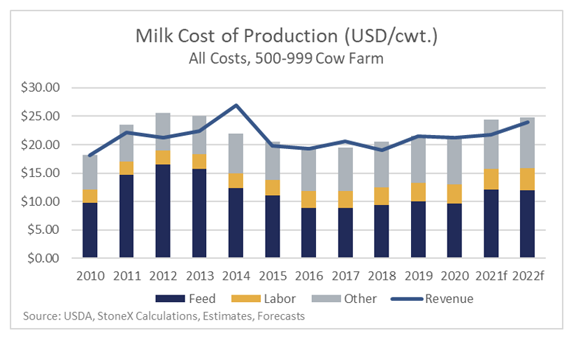
From a short-term perspective, the higher costs raise the cost of production by 16% this year, mostly driven by feed, and about 2% next year. That will keep some financial pressure on dairy farmers and limit the milk production growth, which should be supportive for dairy prices as well. Eventually, feed costs and energy costs will pull back and lower the cost of production a bit. And from a longer-term perspective farmers will find more efficient ways to run their farms, which will lower the cost of production. But short-term, higher costs will crimp production and help to boost dairy prices.
This material should be construed as market commentary, merely observing economic, political and/or market conditions, and not intended to refer to any particular trading strategy, promotional element or quality of service provided by the FCM Division of StoneX Financial Inc. (“SFI”) or StoneX Markets LLC (“SXM”). SFI and SXM are not responsible for any redistribution of this material by third parties, or any trading decisions taken by persons not intended to view this material. Information contained herein was obtained from sources believed to be reliable, but is not guaranteed as to its accuracy. Contact designated personnel from SFI or SXM for specific trading advice to meet your trading preferences. These materials represent the opinions and viewpoints of the author, and do not necessarily reflect the viewpoints and trading strategies employed by SFI or SXM.


Be the first to comment