
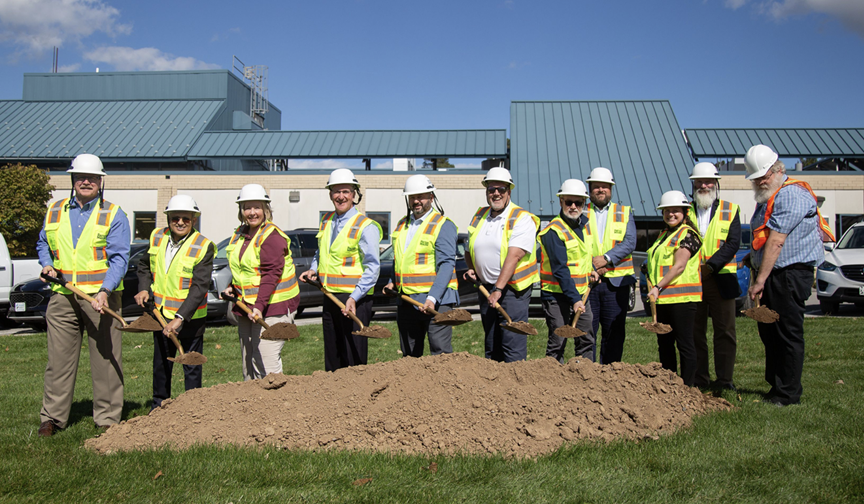
Penn State and the Pennsylvania Department of Agriculture broke ground Oct. 5 on a nearly 46,000-square-foot, two-story addition to the University’s Animal Diagnostic Laboratory at University Park, a project that will expand the laboratory’s capacity to provide critical diagnostic services, respond to emerging animal health threats, and support Pennsylvania’s livestock and poultry industries.
With support from the Pennsylvania Department of Agriculture and the state Department of General Services, the $65 million project will expand and modernize the Animal Diagnostic Laboratory, or ADL, while strengthening its ability to serve livestock and poultry producers, veterinarians, researchers, food producers, and other partners across the commonwealth. Construction is expected to be completed in late 2028.
“Supporting cutting-edge research, diagnostic testing and agricultural education at our land-grant universities like Penn State is critical to our nation’s economy, food security and public safety, and one of America’s most important and enduring public policies,” Pennsylvania Agriculture Secretary Russell Redding said. “The investments Pennsylvania is making — not just today, but year-round — strengthen our capacity to detect and prevent disease, respond quickly in crisis, and protect and grow the industry that feeds our economy and our families.”
The new addition will increase laboratory capacity and provide modern infrastructure for diagnostic operations, including new biosafety level 3 (BSL-3) space. The enhanced containment capabilities will give the laboratory greater flexibility to conduct higher-risk testing within the facility, including testing associated with diseases such as highly pathogenic avian influenza and African swine fever.
The expansion also will connect the new and existing portions of the laboratory, creating a more cohesive and functional environment for faculty, diagnostic personnel and support staff. Improvements will address aging infrastructure while enhancing biosecurity, security, access and wayfinding throughout the facility. Additional space will allow the laboratory to accommodate future growth and evolving diagnostic needs.
“The improvements will make a significant difference for the people who work in the laboratory every day,” said Ernest Hovingh, clinical professor of veterinary and biomedical sciences and director of the University Park laboratory. “We are doing diagnostic testing all day, every day, so having a safer, more functional and modern work environment is important. The additional space also will give us greater capacity to grow and provide the diagnostic services that Pennsylvania needs.”
“Having a modernized, secure facility that supports the complex nature of our work is absolutely critical,” said Sandeep Prabhu, head of the Department of Veterinary and Biomedical Sciences. “This project provides the advanced infrastructure we need to safely handle emerging pathogens, advance our One Health initiatives, and ensure our laboratory continues to serve as a vital pillar of support for Pennsylvania’s food supply and agricultural industries.”
The lab at University Park complements three other laboratories in the Pennsylvania Animal Diagnostic Laboratory System: the Keystone Animal Diagnostic Center at Penn State Beaver in Monaca, the Pennsylvania Department of Agriculture’s Pennsylvania Veterinary Laboratory in Harrisburg, and the New Bolton Center at the University of Pennsylvania School of Veterinary Medicine in Kennett Square.
“The Pennsylvania Animal Diagnostic Laboratory System is a critical resource for Pennsylvania agriculture and for protecting the health of animals, people and the environment,” said Troy Ott, Peter and Ann Tombros Dean of the College of Agricultural Sciences. “This project represents a long-term investment in the infrastructure needed to support our ADL’s broad diagnostic mission and its role in advancing a One Health approach. We are grateful to the Pennsylvania Department of Agriculture for its significant investment in this project and its continued partnership in strengthening animal health and protecting Pennsylvania’s agricultural economy.”

Be the first to comment