
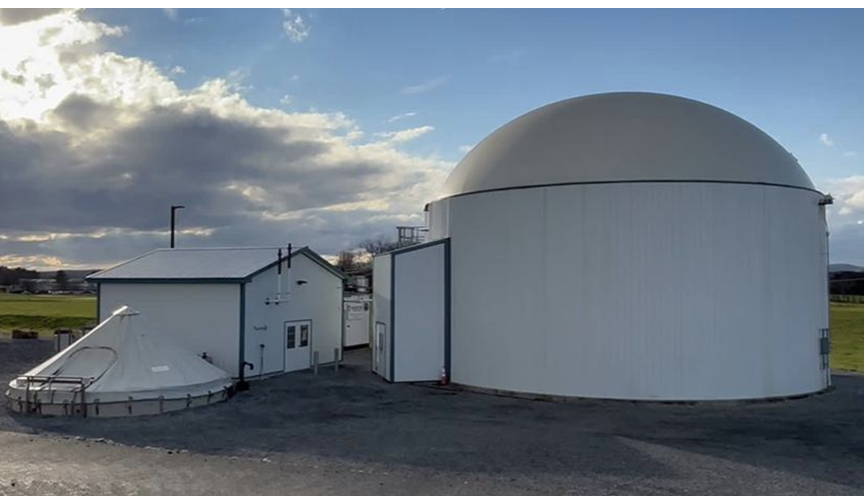
Researchers find ‘grass-to-gas’ strategy could make method of reducing pollution and generating energy cost effective on large dairy farms.
The U.S. dairy industry is a major contributor to agricultural greenhouse gas emissions, with manure storage and handling representing a significant source of methane. Anaerobic digestion — a biological process in which microorganisms break down biodegradable organic matter — of cow manure has been widely studied as a strategy to mitigate manure-related emissions while producing renewable energy. That energy comes in the form of biogas that can be used to generate electricity or make renewable natural gas. But adoption of the strategy has been constrained by costs. Now, a team led by researchers at Penn State may have found a way to make the process profitable.
But anaerobic digester projects remain highly dependent on financial incentives, so they carry substantial investment risk for farmers, noted study senior author Juliana Vasco-Correa, assistant professor of agricultural and biological engineering in Penn State’s College of Agricultural Sciences. The problem, she explained, is that building and operating a digester is expensive, while the revenue from selling electricity or gas may not be high enough.
“Anaerobic digestion can help dairy farms manage manure while producing renewable energy, but many projects struggle economically,” she said. “A key question is whether adding crop residues or dedicated biomass to manure can make these systems more financially viable. The results of our study demonstrate that co-digestion with plant material can enhance the economic performance of manure-based anaerobic digestion.”
In the study, the researchers modeled a 1,000-cow dairy farm in the Northeast and compared manure-only anaerobic digestion with co-digestion using switchgrass, winter rye and corn stover — a strategy called grass-to-gas. They included switchgrass because it is a perennial grass that is good for the soil and can grow on marginal land; winter rye because it can grow in between cash crops, so it does not need additional land; and corn stover because it is an agricultural residue.
Instead of looking at one “best-case” economic scenario, the researchers combined detailed process modeling with engineering design, performance metrics and financial realities to evaluate whether the technology could succeed at farm scale. They evaluated how feedstock choice, methane yield, system scale, biomass cost and market conditions interacted, and found that co-digestion can substantially improve project economics. For example, the capital support — usually from grants or loan guarantees — needed to break even on the building and operating of a digester decreased from about 47% for manure-only digestion to as little as 4% in the best-performing co-digestion scenario.
One of the more interesting systems-level findings, according to study first author Camila Valderrama, who graduated from Penn State with a master’s degree in agricultural and biological engineering earlier this year, was that increasing scale did not improve every pathway.
“Larger systems improved the economics of renewable natural gas but could make electricity production less attractive, showing that scale and end use need to be considered together,” she said.
“The study shows that improving agricultural bioenergy deployment is not simply a matter of maximizing methane production,” she said. “Technical performance, farm scale, biomass supply, energy markets and policy incentives all have to work together for a project to succeed.”
Elmin Rahic, research scientist with the Bioeconomy Institute, Iowa State University; and Hunter Porcano, who graduated from Penn State in 2025 with a bachelor of science degree in biological engineering, contributed to the research.
This work was supported in part by the Agriculture and Food Research Initiative Sustainable Agricultural Systems program, project award number 2020-68012-31824 from the U.S. Department of Agriculture’s National Institute of Food and Agriculture, through the Consortium for Cultivating Human And Naturally reGenerative Enterprises, or C-CHANGE. This content is solely the responsibility of the authors and does not necessarily reflect the views of the funders.

Be the first to comment