
The T.C. Jacoby Weekly Market Report Week Ending August 27, 2021
Heat, humidity, and smoke are sapping milk yields around the nation. Higher Class I sales from coast to coast, coupled with sweltering temperatures, has tightened milk supplies noticeably. Meanwhile, students are back in school and all are eligible for free lunches with a carton of milk on the side.
Heat, humidity, and smoke are sapping milk yields around the nation. Meanwhile, students are back in school. Most are learning in person, and all are eligible for free lunches with a carton of milk on the side. On Monday, USDA announced that it will spend another $400 million to donate produce, meat, and dairy products through the Emergency Food Assistance Program. Last week, the agency changed the formulas used to calculate the 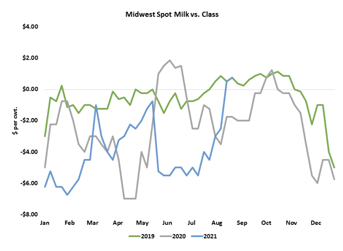 amount of Supplemental Nutrition Assistance Program (SNAP) benefits, effectively raising monthly food stamp payments 27% from pre-pandemic levels. Congress had already boosted food stamp payments by 15% during the pandemic, but this pandemic aid is set to expire next month. The 27% increase is permanent.
The back-to-school rush and government generosity have clearly boosted demand for milk. USDA’s Dairy Market News cites higher Class I sales from coast to coast. This, coupled with sweltering temperatures, has tightened milk supplies noticeably. In the Southwest, “balancing is active, but not stressed.” In the Midwest, driers are running on fumes, and “cheese makers are selling spot milk back into bottlers” for the first time in two years. Spot milk in the region is trading at a premium to Class III, up from a $5 discount for most of the summer. The shift in milk supplies was most startling in the Mountain States. Dairy Market News reports, “Idaho spot milk, which was ubiquitous and discounted as recently as last week, is no longer available.”
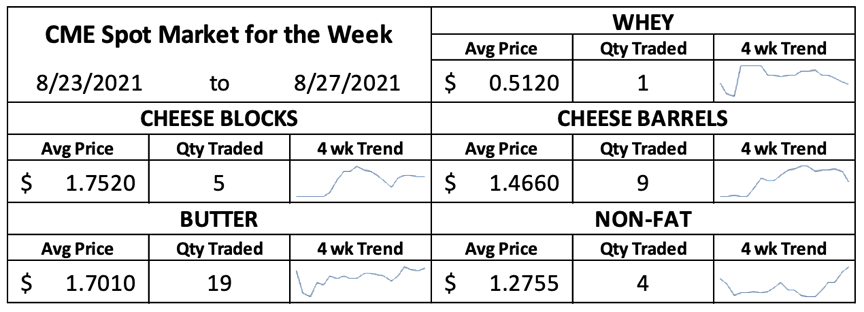
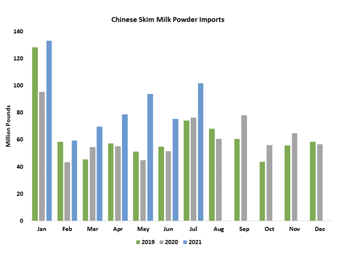 Tighter milk supplies may trim cheese production at the margins. If fresh cheese becomes tight, it could create some fireworks in the spot cheese market, a hot, bright flash that quickly fades. The lasting impact – more akin to the glow of a fire with a steady supply of new wood – will warm up the milk powder markets. Nearly every pound of milk lost to the heat or poured into a school milk carton will reduce dryer volumes in the United States. Skim milk powder (SMP) inventories in Europe are already lean, and New Zealand has sent most of its milk powder abroad. Stocks are growing in China, but the Chinese are still buying. They’ve purchased more SMP and whole milk powder (WMP) this year than in any other, and July imports shattered previous records for the month. Closer to home, cheese makers are adding NDM to their vats, because there is no cheap milk available. Prices are rising accordingly. CME spot NDM jumped 4.25ȼ this week to $1.2925 per pound, the highest price since early June.
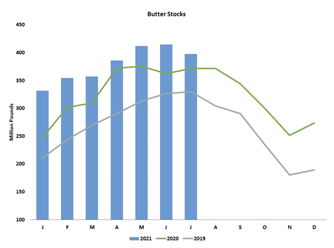 Spot butter also gained some ground, climbing 4.5ȼ to $1.7075. Cream supplies are tightening, and manufacturers continue to face headaches as they seek to source inputs, run their plants, and move goods out in an extremely tight labor market. Butter output is beginning to slow, but there is plenty on hand to last a while. There were 397 million pounds of butter in cold storage warehouses on July 31, up 7% from a year ago and the highest July total since 1993. The bulls were cheered to see that stocks declined more than 17 million pounds from June to July, an earlier-than-typical start for the seasonal drawdown.
Demand is on the rise as restaurants reportedly step up butter orders despite an acute staffing shortage. Black Box Intelligence estimates that full-service restaurants are operating with 6.2 fewer employees in the kitchen and 2.8 fewer wait staff than they had, on average, in 2019. The quality of restaurant service has suffered, but it beats doing the dishes. Americans are clearly tired of eating at home, and they’re willing to wait for a table.
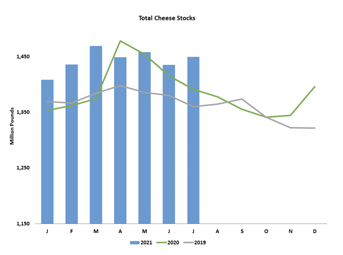 Amid heavy production, cheese piled up last month, and stocks reached 1.45 billion pounds, an increase of 4.1% from July 2020. Domestic demand is steady, and exporters are booking new sales. However, they struggle to get the cheese from warehouses to ports and out to sea. CME spot Cheddar prices diverged this week. Blocks rallied 5.75ȼ to $1.75. Barrels slumped 7.5ȼ to $1.4025.
Spot whey fell 3ȼ this week to a half-dollar. Buyers are getting pickier about price, and the market is softening just a little. With both barrels and whey in decline, Class III futures took another step back. The September and October contracts settled well below $17 per cwt. The November contract dropped to $17.04, its lowest price so far this year. In contrast, Class IV futures rallied, reducing the odds of depooling and a punishing producer price differential. Most Class IV contracts added roughly 30ȼ and stand in the mid-$16s. Those prices are uninspiring – especially given higher feed costs – but the trend is encouraging.
The market will continue to debate the size of the crop until every bin is full and every field is bare. The consensus calls for a corn yield that is a little below trend, with huge crops in the East offsetting some of the losses in the Northern Plains. Regular rains this week and into next week will likely help corn to finish well, and the moisture could offer a big boost to bean yields
Brazilian farmers will begin planting next month, and they’re expected to plant more corn than last year. They’re also expected to spend more on inputs in hopes of higher yields. The trade is watching carefully to see whether the predicted La Niña will negatively impact Brazil’s corn crop as it did last year, but it’s simply too soon to tell.
Original Report at: https://www.jacoby.com/market-report/back-to-school-rush-and-government-generosity-boost-milk-demand/


Be the first to comment