

Warming climate worsens nutrient pollution but lengthens growing season
That’s the conclusion of a team of researchers, led by Penn State agroecologists, whose new study evaluated whole-farm production and the environmental and economic impacts of adopting these practices on a representative dairy farm in central Pennsylvania under recent historical and projected mid-century climate.
The research is important, according to Heather Karsten, associate professor of crop production/ecology in the College of Agricultural Sciences, because dairy farms — especially in the Northeast — are increasingly subject to more stringent regulations to reduce nutrient losses. With expected warmer conditions that will result in increased ammonia volatilization from manure and more frequent and more severe storms that will cause more soluble phosphorus runoff, new strategies are needed to limit nitrogen and phosphorus losses from crop fields.
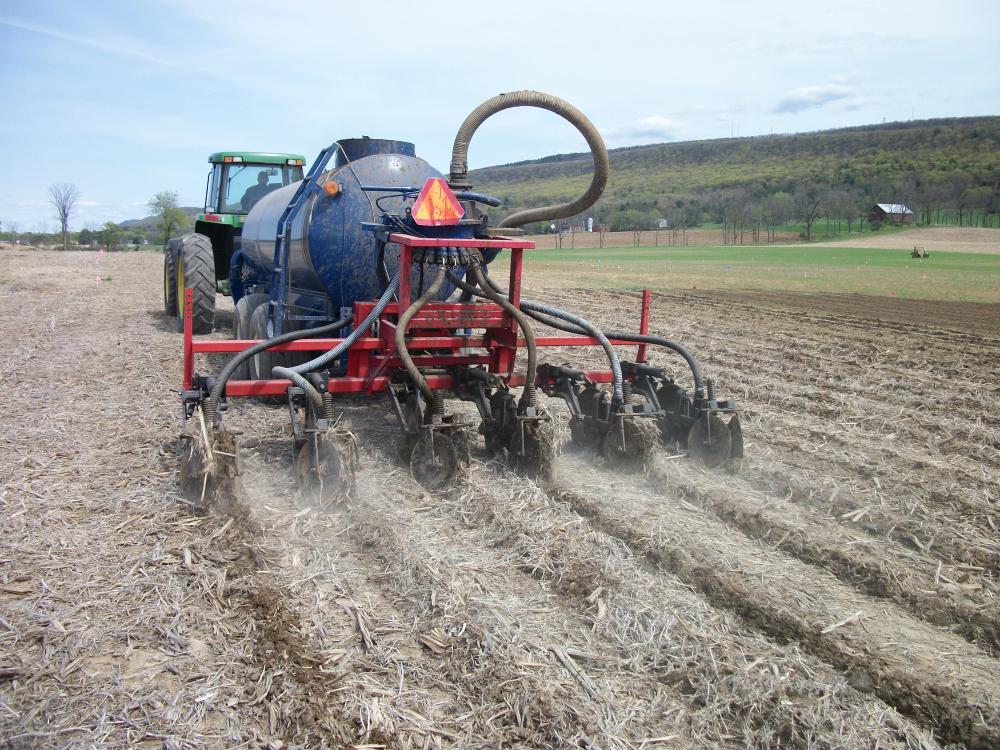
Double cropping offers the added benefit of keeping soil continuously covered by vegetation, reducing nutrient runoff, erosion and sedimentation. Winter small grains are seeded after corn for silage is harvested in September, and they germinate and grow until cold temperatures make them go dormant for the winter. They begin to grow again in late March and continue to develop until they are harvested in May, just before the corn crop is planted.
The researchers found that double cropping increased and stabilized the farm’s feed production by providing forage from a winter rye crop with less dependency on the summer crops of corn silage and perennial cool-season grasses. Summer crops are susceptible to summer droughts, Karsten explained, which are expected to increase in this region due to warmer temperatures and increased evapotranspiration.
To reach their conclusions, researchers simulated farm management strategies using the Integrated Farm System Model developed by C. Alan Rotz, an agricultural engineer with the U.S. Department of Agriculture’s Agricultural Research Service. The strategies were informed by a long-running dairy cropping systems experiment at Penn State’s Russell E. Larson Agricultural Research Center, supported by the USDA. That simulation enabled the scientists to determine the effects on crop yields, feed production, nitrogen losses, sediment erosion, sediment-bound and soluble losses of phosphorus, greenhouse gas emissions, fossil energy use, and production costs.
Significantly, these benefits can be achieved while maintaining and potentially reducing total farm-production costs, Karsten pointed out.
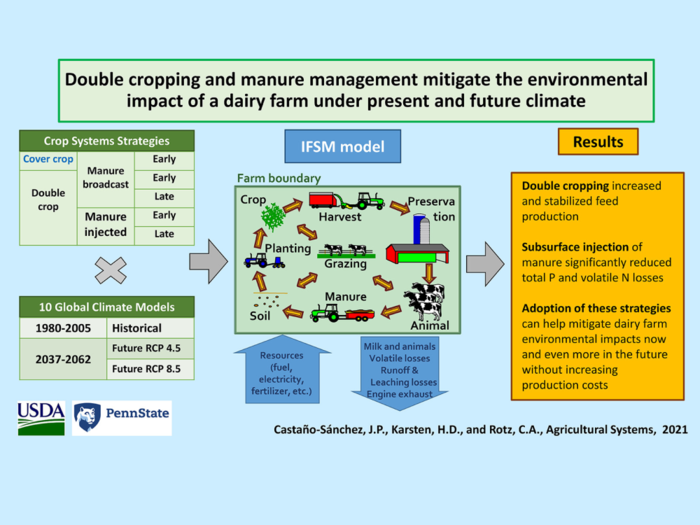
“There’s a lot of interest in double cropping among Northeast dairy farmers,” she said. “I think farmers are realizing they have a longer growing season, and there are more precipitation events in spring that make getting into the field to do any operation more challenging. Our results demonstrate that adoption of these strategies can help mitigate dairy farm environmental impacts now and even more in the future.”
José Castaño-Sánchez, former postdoctoral researcher in the Department of Plant Science at Penn State, currently a postdoctoral research associate at New Mexico State University and the USDA, and Rotz contributed to the research.
The U.S. Department of Agriculture’s Agricultural Research Service mostly funded this study, with partial support from USDA’s National Institute of Food and Agriculture.


Be the first to comment