
The T.C. Jacoby Weekly Market Report Week Ending January 21, 2022
At the Global Dairy Trade (GDT) auction on Tuesday, the GDT Index jumped 4.6% to its highest price since March 2014, led by a 5.6% increase in the price of whole milk powder (WMP). GDT butter and cheese both scored all-time highs, while SMP climbed to prices not seen in nearly eight years.
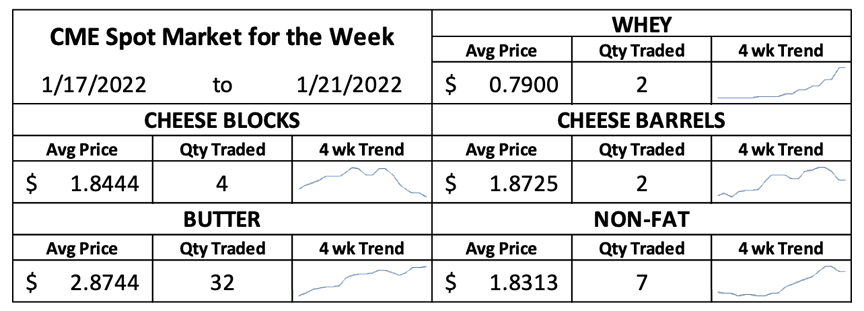
From Warsaw to Wellington, and Canberra to Chicago, the dairy markets are forging multi-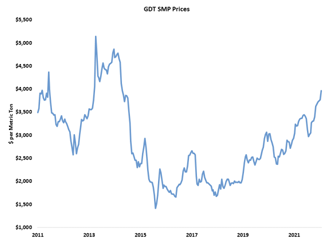 year highs all around the world. At the Global Dairy Trade (GDT) auction on Tuesday, the GDT Index jumped 4.6% to its highest price since March 2014, led by a 5.6% increase in the price of whole milk powder (WMP). GDT skim milk powder (SMP) and butter values climbed 5% from the previous auction. GDT butter and cheese both scored all-time highs, while SMP climbed to prices not seen in nearly eight years. Adjusted for protein, GDT SMP is equivalent to nonfat dry milk (NDM) at $1.92 per pound. The strong showing initially boosted CME spot NDM to $1.85, but the spot market faded Thursday and closed at $1.815, unchanged from last Friday.
Lower milk output in the U.S., Europe, and Oceania slowed milk powder production, and strong global demand trimmed stocks. China’s appetite for foreign milk powder seemed insatiable throughout much of last year, but the December data hint that China may finally 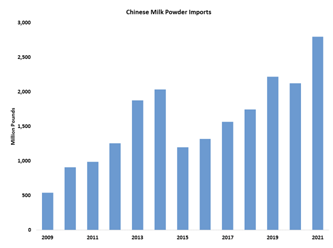 have enough powder on hand to pause its purchases. China brought in 44.4 million pounds of SMP and 69.9 million pounds of WMP last month, down 22% and 38%, respectively, from December 2020. Despite lighter December arrivals, Chinese milk powder imports reached astounding totals in 2021. The world’s largest dairy importer bought 27% more SMP in 2021 than the prior year, and 24% more than the previous record set in 2019. Chinese WMP imports were 34% greater than 2020 volumes and topped the 2014 record by 22%.
Similarly, Chinese whey powder imports reached all-time highs last year, but December shipments faltered. At just 87 million pounds, they were down 32% from a year ago and the 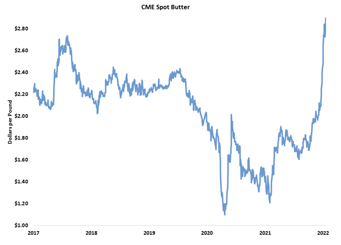 lowest monthly tally in nearly two years. The Daily Dairy Report explained, “The simultaneous slowdown in imports of storable dairy commodities hints that Chinese merchants might have bought ahead for much of the year due to concerns about shipping delays, and that on-hand inventories are now high enough to forestall any shortages.” This suggests that China could slow imports, especially at today’s prices. However, Chinese consumers are still hungry for dairy, and once merchants draw down milk powder and whey stocks, they will likely return to the market. In the meantime, China’s absence could make room for dairy buyers in other nations who were sidelined by China’s aggressive buying last year.
Chinese imports of consumer-facing dairy products remained strong. China imported more butter and cheese in December than it did the year before. Chinese imports of ultra-high 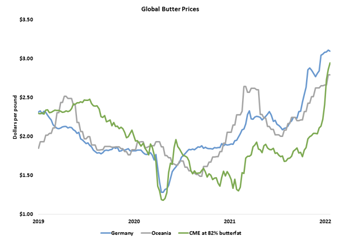 temperature fresh milk fell short of prior-year volumes, but they were the largest monthly total since June. On an annual basis, all three categories shattered previous records. There is no sign that Chinese consumers plan to eat less dairy, so Chinese cheese, butter, and milk imports will likely stay high. However, China’s birth rate has plummeted to a 72-year low, and the stagnating population may result in slower growth going forward.
Like the milk powder market, butter is sprinting past historic milestones, exploring ground it has not trod in many years. CME spot butter leapt 21ȼ in just four trading sessions this week and closed today at $2.935, the highest price since 2015. Spot butter is nearly 50ȼ higher than it was when the year began. For months, high cream multiples and a shortage of trucks and
There is plenty of cheese, and prices are under pressure. CME spot Cheddar blocks fell 11.25ȼ to $1.8075. Barrels dropped 14.75ȼ to $1.8125. Grocers are moving plenty of cheese, but sales to foodservice are hit or miss. Waves of Covid infections have swamped restauranteurs, who can’t count on their staff or their patrons to show up.
The whey market continues to climb. Exercise fiends and health-conscious consumers are lapping up high-protein products regardless of price. Lower-protein whey powders are moving to end users seeking an alternative to pricey NDM. Demand is strong and stocks are tight. Spot whey rallied another 3ȼ this week to 80ȼ, another record high.
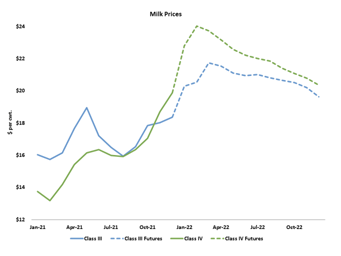 The fading cheese market weighed heavily on Class III prices. The February contract plunged $1.54 to a still-high $20.54 per cwt. March through December lost an average of 45ȼ, and most contracts held above $21. Nearby Class IV futures continued to climb, and the February contract rallied 55ȼ to $24.04. The market assumes that high milk prices will quickly remedy the milk production deficit, and there was a bit of red ink for deferred contracts. Still, the futures forecast historically high prices through the end of the year.
Rains arrived in Argentina. Crops there perked up, and the soybean meal market fell accordingly. March soybean meal settled at $392.70 per ton, down nearly $13 from last Friday. However, it’s still hot and dry in southern Brazil, and concerns about the Brazilian crop kept a firm bid under the corn and soy markets. Higher interest rates and a stock market selloff pushed investors from Wall Street to LaSalle Street, as they sought to capitalize on the commodity market boom. March corn pushed convincingly over $6 this week and closed at $6.1625 per bushel, up 20ȼ. March soybeans closed at $14.1425, up 44.5ȼ.
Original Report located at: https://www.jacoby.com/market-report/dairy-markets-forge-multi-year-highs-across-the-globe/


Be the first to comment