
The T.C. Jacoby Weekly Market Report Week Ending February 24, 2023
Rested up after a long weekend, the cheese markets came charging out of the gates but they gave it all back later in the week. Milk remains cheap in the cheese states which should result in higher cheese production. Weather issues, labor shortages, and mechanical problems have slowed cheese production all year, creating a chicken-and-egg conundrum.
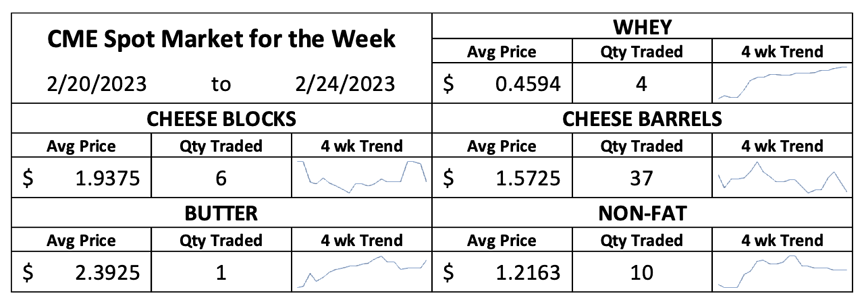
Rested up after a long weekend, the cheese markets came charging out of the gates. CME spot Cheddar blocks leapt 8ȼ on Tuesday. But they gave it all back later in the week and closed today at $1.88 per pound, right where they started. Barrels followed a similar path. They finished at $1.54, down 0.75ȼ. Milk remains cheap in the cheese states, with some spot loads selling at $10 discounts for a 10th straight week. This should, in theory, result in higher cheese production, but severe weather forced some plants to take downtime. Indeed, weather issues, labor shortages, and mechanical problems have slowed cheese production all year, creating a chicken-and-egg conundrum. These reductions to processing capacity help to explain why there is so much cheap excess milk in the first place.
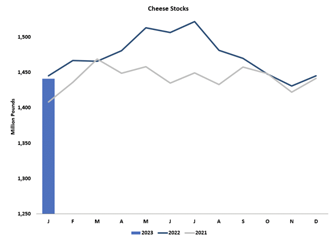 The Cold Storage report also hints that slower cheese production is contributing to all the milk sloshing around the Midwest. Cheese stocks declined unexpectedly in January, slipping to 1.44 billion pounds, down 0.3% from a year ago. January 31 inventories of American-style cheeses, including Cheddar, were down 2.2% year over year. The Cold Storage report was clearly bullish of cheese values, and it landed after the closing bell today, so it is likely to give the Class III markets a little boost next week.
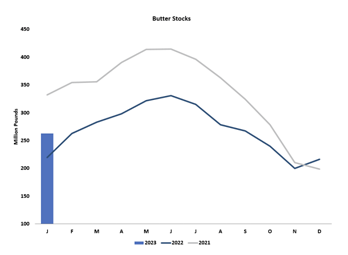 But the Cold Storage report is likely to weigh on butter prices. USDA reported January 31 butter stocks at 262.7 million pounds. That’s up a whopping 19.7% from the unusually low volumes of a year ago. Stocks grew at a typical rate in January, but the trade had penciled in a much smaller increase. Cheap cream incentivized churns to run hard last month, while pricey butter likely continued to weigh on demand. Nonetheless, spot butter gained 5.5ȼ this week and reached $2.43.
Driers are running hard, which is sure to boost U.S. milk powder supplies. Exports to Mexico remain strong, and trade between China and Oceania remains robust. But suppliers around the 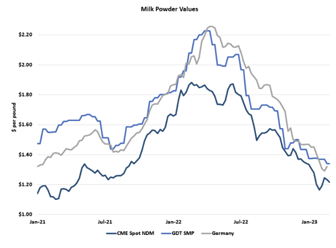 world are dropping prices to keep product moving. Milk powder values fell back at the Global Dairy Trade (GDT) auction on Tuesday, with whole milk powder down 2% and skim milk powder off 2.4%. In Chicago, spot nonfat dry milk (NDM) slipped a half-cent to $1.215.
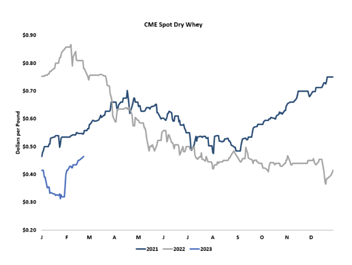
Whey continued to gain ground, confirming that proteins simply got too cheap in January. Spot whey powder climbed 1.5ȼ this week to 46.5ȼ, the highest price in nearly four months. That helped March Class III futures to hold their head above water. They settled at $17.72 per cwt., up 7ȼ. But the other Class III contracts lost about a dime. Most Class IV futures finished higher. March held steady at $18.80, while April added 12ȼ and closed at $18.97.
 U.S. milk production reached 19.3 billion pounds in January. That was 1.3% greater than the very poor showing in January 2022, when milk output dropped 1.6% year-overyear. Muddy pens pushed milk yields slightly lower in the Golden State. Although California milk production was steady with last year, it was still 1.9% lower than in January 2021. The weather also took a toll on milk production in the Pacific Northwest. But output continued to climb in the Plains and the Midwest.
While the milk production numbers did not surprise, USDA’s changes to cow numbers were unexpected. The agency lowered its estimate of the fourth quarter milk-cow herd but reported a 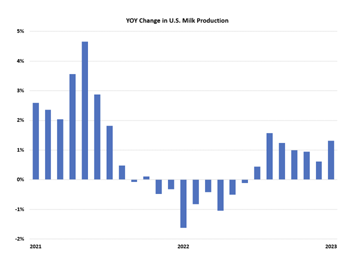 9,000-head increase in January. That’s a sizeable jump given hefty dairy cow slaughter last month. There are now 9.405 million cows in U.S. milk parlors, 38,000 more than there were a year ago. But that’s likely to change soon as dairy producers are selling out at a steady clip. At the annual Agricultural Outlook Forum, USDA’s dairy and livestock analyst called for cow numbers to slip below year-ago levels in the second quarter, with accelerated contraction in the back half of the year. High feed costs and tight heifer supplies are setting the stage for another year with only modest growth in U.S. milk production.
At its annual Outlook Forum, USDA called for farmers to plant more wheat this year than in any
Original Report At: https://www.jacoby.com/market-report/cheese-markets-charge-out-of-the-gates/



Be the first to comment