
A new Journal of Dairy Science® comparative study demonstrates that the milk powder fueling our ancestors is remarkably similar to the milk powder we enjoy today
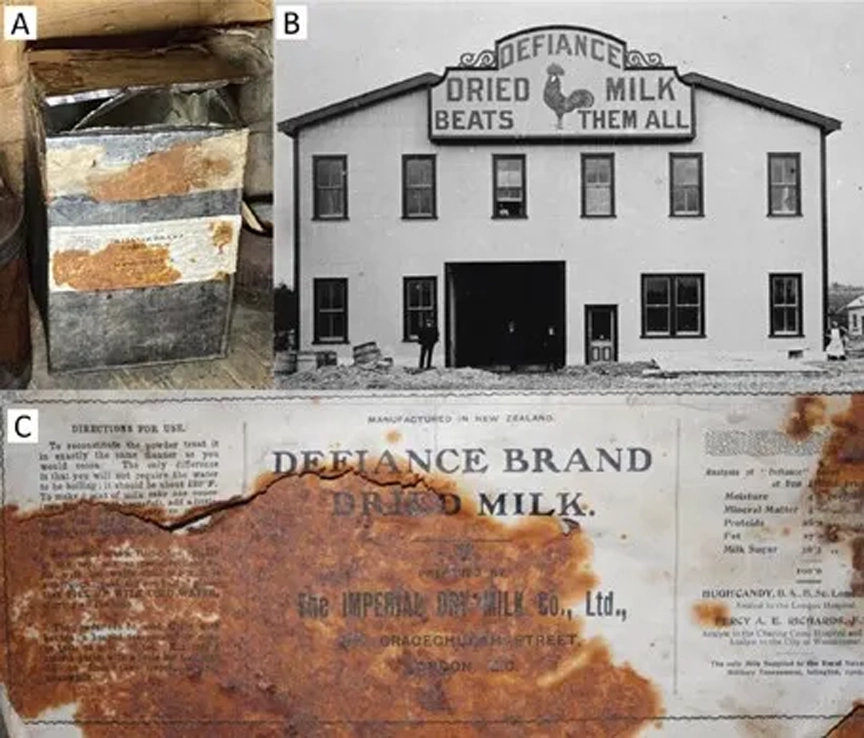
In a remarkable discovery, whole milk powder manufactured in New Zealand in 1907 and transported to Antarctica with explorers seeking the South Pole was unveiled after more than a century. The find has allowed dairy researchers to answer the question: Is the milk we enjoy today different from the milk consumed in previous generations? Now, a new comparative study(opens in new tab/window) in the Journal of Dairy Science(opens in new tab/window), published by the American Dairy Science Association and Elsevier, has peered back in time to demonstrate that—despite advancements in selective breeding and changes to farm practices—milk of the past and milk today share more similarities than differences and are still crucial building blocks of human nutrition.
A century later, one remaining container of Defiance brand whole milk powder was discovered during the Antarctic Heritage Trust restoration project(opens in new tab/window), having been frozen at Shackelton’s base camp for the past 100 years.
Lead investigator Skelte G. Anema, DPhil, principal research scientist with Fonterra Research and Development Centre(opens in new tab/window) in Palmerston North, New Zealand, explained the discovery’s significance: “The Shackleton dried milk is possibly the best-preserved sample manufactured during the pioneering years of commercial milk powder production, and its discovery gives us a once-in-a-lifetime chance to understand the similarities and differences between a roller-dried milk powder manufactured over 100 years ago with modern spray-dried counterparts.”
We know these early milk powders weren’t as sophisticated as they are today, but what other differences existed?
With the help of the Antarctic Heritage Trust, Dr. Anema and an interdisciplinary team of scientists with the Fonterra Research and Development Centre were able to study a few hundred grams of Defiance milk. They set out to compare it with two modern-day commercial, noninstantized spray-dried whole milk powder samples from Fonterra. Their analysis involved comparing the major component composition, major and trace mineral composition, protein composition, fatty acid composition, phospholipid composition microstructural properties, color analysis, and volatile component analysis of the different whole milk powder samples.
The results proved surprising and contrary to claims of changes in milk over time.
Dr. Anema elaborated, “Despite more than a century between the samples, the composition of bulk components and detailed protein, fat, and minor components have not changed drastically in the intervening years.”
The fatty acid composition, phospholipid composition, and protein composition, including casein and whey protein genetic variations, were, in general, remarkably similar.
The major mineral components were also alike between samples, except for high levels of lead, tin, iron, and other trace minerals found in the Shackleton whole milk powder—likely from the tin-plated can it was stored in and the equipment and water supply of the day.
Dr. Anema clarified, “These issues have been essentially eliminated from modern milk powders through the use of stainless steel and quality water services.”
Another notable difference was the presence of oxidation-related volatile aroma compounds in the Shackleton samples.
Dr. Anema said, “Perhaps from less-than-ideal collection and storage of the raw milk before drying, but it’s much more likely that—even in frozen conditions—being stored in an open tin for a century is going to result in continued oxidation.”
Overall, this Antarctic time capsule provides a rare and important glimpse into the evolution of dairy food production and highlights the improvements the dairy sector has made as well as its enduring influence.
Dr. Anema noted, “The Shackleton samples are a testament to the importance of dairy products—which are rich in protein and energy as well as flexible enough to be powdered for easy transport, preparation, and consumption.”
Whether at the turn of the twentieth century or today, these results underscore the fact that dairy products serve as an essential foundation for human nutrition—fueling our discoveries past and present.
The Journal of Dairy Science® (JDS), an official journal of the American Dairy Science Association® (ADSA), is co-published by Elsevier and ADSA. It is the leading general dairy research journal in the world. JDS readers represent education, industry, and government agencies in more than 70 countries, with interests in biochemistry, breeding, economics, engineering, environment, food science, genetics, microbiology, nutrition, pathology, physiology, processing, public health, quality assurance, and sanitation. JDS has a 2022 Journal Impact Factor of 3.5 and five-year Journal Impact Factor of 4.2 according to Journal Citation Reports™ (Source: Clarivate™ 2023). www.journalofdairyscience.org(opens in new tab/window)
The American Dairy Science Association (ADSA) is an international organization of educators, scientists, and industry representatives who are committed to advancing the dairy industry and keenly aware of the vital role the dairy sciences play in fulfilling the economic, nutritive, and health requirements of the world’s population. It provides leadership in scientific and technical support to sustain and grow the global dairy industry through generation, dissemination, and exchange of information and services. Together, ADSA members have discovered new methods and technologies that have revolutionized the dairy industry.www.adsa.org(opens in new tab/window)
As a global leader in scientific information and analytics, Elsevier helps researchers and healthcare professionals advance science and improve health outcomes for the benefit of society. We do this by facilitating insights and critical decision-making with innovative solutions based on trusted, evidence-based content and advanced AI-enabled digital technologies.
We have supported the work of our research and healthcare communities for more than 140 years. Our 9,500 employees around the world, including 2,500 technologists, are dedicated to supporting researchers, librarians, academic leaders, funders, governments, R&D-intensive companies, doctors, nurses, future healthcare professionals and educators in their critical work. Our 2,900 scientific journals and iconic reference books include the foremost titles in their fields, including Cell Press, The Lancet and Gray’s Anatomy.


Be the first to comment