
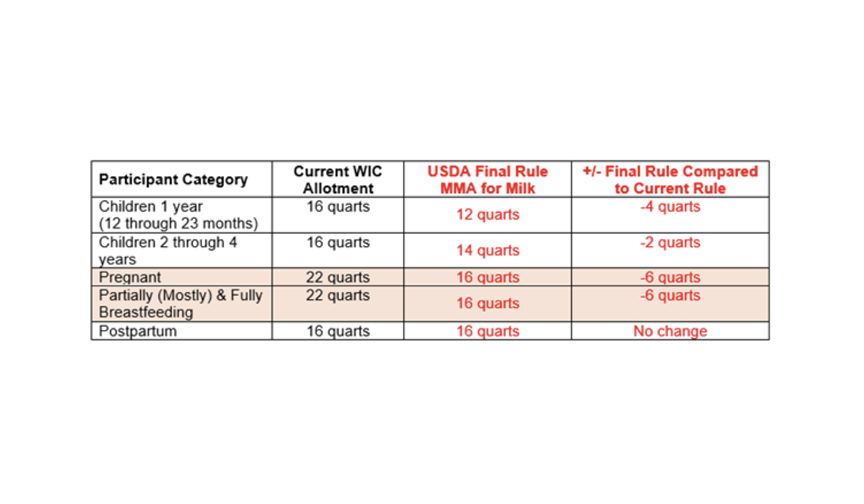
Yesterday, President Biden’s administration cut milk and dairy benefits for pregnant and breastfeeding mothers and children under the age of 5. The U.S. Department of Agriculture released its final rule updating the Special Supplemental Nutrition Program for Women, Infants and Children, also known as WIC. WIC supports the nutrition and grocery shopping of low-income women and children under the age of 5. It often works in tandem with SNAP (food stamps) to ensure mothers and young children have full, adequate nutrition. It was deeply disturbing then that, in their final rule, USDA cut the benefits that 6.3 million WIC moms can use to purchase fluid milk (1% and non-fat milk). USDA’s changes will reduce the amount of milk by up to six quarts per month for pregnant or breastfeeding mothers, as much as four quarts for a child 12 to 23 months, and up to two quarts for children between 2 to 4 years of age.
USDA’s Arguments Easily Refuted with Their Own Data
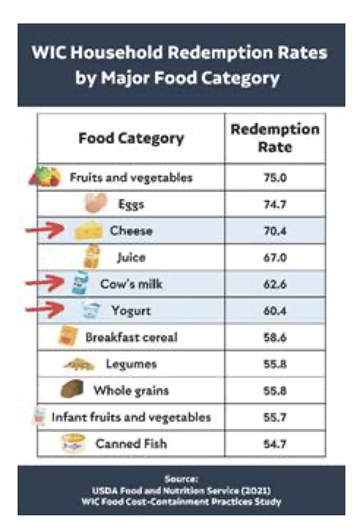 To explain the cuts, USDA is talking about “redemptions”. USDA argues that milk is not fully redeemed in the program, and therefore it should be cut. However, milk is one of the most redeemed foods in the WIC food package. In fact, according to USDA’s own data, it ranks fifth as the most redeemed category (USDA WIC Food Cost-Containment Practices Study, 2022, Table 9.2, page 89). No single food item is redeemed at 100%. Mothers participating in WIC prize their access to milk through WIC because it allows them to use SNAP dollars on other food items.
USDA is also arguing that other changes announced yesterday in the WIC rule will increase spending on dairy products by $400 million per year. However, there is no evidence for this hypothetical claim, and it is beside the point. A mother buying nutritious milk for herself and her child is only focused on putting healthy food on the table.
Why WIC Is Important
USDA’s cuts do not recognize the reality that low-income people live in daily. Food price inflation as high as 13% has been destroying family budgets, especially for low-income Americans. Hunger rates have steadily crept back up after federal COVID relief dried up in March 2023, especially among women, who are more likely than men to be food insecure according to the NIH. More than 49 million people living in the United States rely on food assistance and 13 million children are food insecure, according to Feeding America.
WIC Should be Aligned with Dietary Guidelines Recommendations
This USDA final rule is inconsistent with the Dietary Guidelines for Americans. Nearly 9 in 10 adults do not consume the recommended amount of dairy foods (or the recommended amount of fruits or vegetables), according to the 2020 Dietary Guidelines for Americans (DGA) report. Rules in WIC related to dairy foods, along with other nutrient-rich foods that are recommended for increased consumption by the DGA, should be fully aligned with the recommendations of the DGA. Rather than seeing this WIC rule change as an opportunity to increase redemptions for the nutritious dairy products that are popular among WIC participants, USDA has instead opted to discourage WIC participants from obtaining the products they value most. How much do WIC participants value milk and dairy products? According to Morning Consult, dairy foods are purchased by 83% of WIC participants (according to their survey) and they are the most popular foods provided in the WIC food package.
Conclusion
The Biden administration’s misguided decision will harm the food security of millions of low-income mothers and children at a time of high food prices, stubborn inflation, and rising hunger rates.
International Dairy Foods Association represents the nation’s dairy manufacturing and marketing industry, which provide most of the milk, cheese, ice cream, yogurt and cultured products, and dairy ingredients to consumers in the United States and throughout the world.
Be the first to comment