
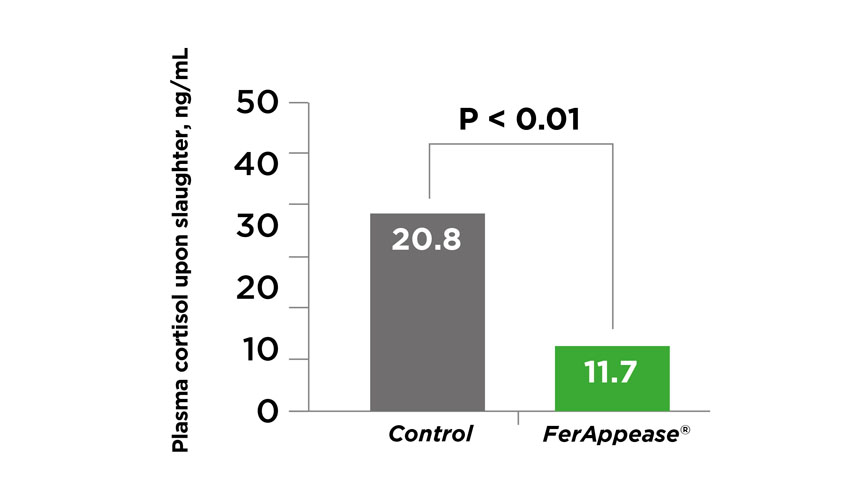
In a two-part Texas A&M University research study by Cooke et al. (2024)*, researchers administered FerAppease to finishing cattle and evaluated its impact on carcass characteristics. Results showed that FerAppease, a unique analogue of the naturally occurring Maternal Bovine Appeasing Substance (MBAS), lowered plasma cortisol concentration upon slaughter and improved carcass dressing percentage. The study was recently published by Oxford University Press on behalf of the American Society of Animal Science (ASAS) in the journal Translational Animal Science.
“Feedlot cattle are exposed to several stressors during processing for slaughter, such as handling, transport and exposure to new environments, and that stress can directly impact carcass and meat quality traits,” said FERA Diagnostics and Biologicals founder and CEO Rodrigo Bicalho, D.V.M, Ph.D. “That’s where the industry can benefit from research-proven strategies to mitigate stress in feedlot cattle prior to and during slaughter. FerAppease is a patent-pending mixture of fatty acids that replicate the composition of the original bovine appeasing pheromone. Research has shown that it alleviates the physiological consequences elicited by stressful management procedures.”
In the two-part study, researchers used self-treatment devices (oilers) to apply FerAppease, eliminating the need to handle cattle. “Administration of MBAS to cattle on feed should be passive and without physical handling or processing; otherwise, the stress elicited by these events could offset the benefits,” said Dr. Reinaldo Cooke, professor at Texas A&M Animal Sciences Department and lead investigator of the research. “Oilers are commonly added to feedlot pens as self-treatment devices for insecticides and can also be used to deliver MBAS to cattle prior to slaughter.”
In Experiment 1, researchers evaluated the use of oilers with FerAppease on carcass characteristics of finishing cattle in a large-pen commercial feedyard. The study included 954 Angus-influenced finishing steers housed in six original pens with each pen split into a pair of experimental groups so that the number of steers and average pen body weight were similar. The oiler was added to one of the experimental pens seven days prior to slaughter, while the control pen did not contain an oiler. The oiler delivered 120 mL of FerAppease per steer during the seven-day period. Results showed that carcass dressing percentage was greater (P = 0.02) in the FerAppease-treated steers compared to the control steers (65.9% vs. 64.2%). The proportion of carcasses classified as dark cutters was also decreased by 3-fold in the FerAppease-treated steers. There were no differences observed for carcasses that graded Choice or Prime, and researchers did not expect carcass marbling to differ because of the short length of FerAppease administration (final seven days on feed).
“MBAS increased carcass dressing by 1.7 and 1.0 percentage points in experiments 1 and 2, respectively,” said Dr. Cooke. “Steers that received MBAS in Experiment 2 also had less plasma cortisol concentrations upon slaughter compared with steers in the control group. The results show that MBAS administration to finishing cattle using oilers during the last seven days on feed alleviated the adrenocortical stress response elicited by the process of slaughter, which likely resulted in increased carcass dressing. Results from these studies also demonstrate the potential benefits of MBAS in mitigating the incidence of dark-cutting carcasses.”
FERA Diagnostics and Biologicals combines innovation and science to bring practical products, such as FerAppease, to the animal health field that will enhance the health, productivity and welfare of pets and production animals. A FerAppease treatment costs about $3 per head for adult cattle and $1.50 per head for calves. FerAppease use doesn’t require a veterinarian’s prescription or a Veterinary Feed Directive plan, and there are no meat withholding requirements. For more information and study data, and to order product, visit www.FERAah.com.


Be the first to comment