
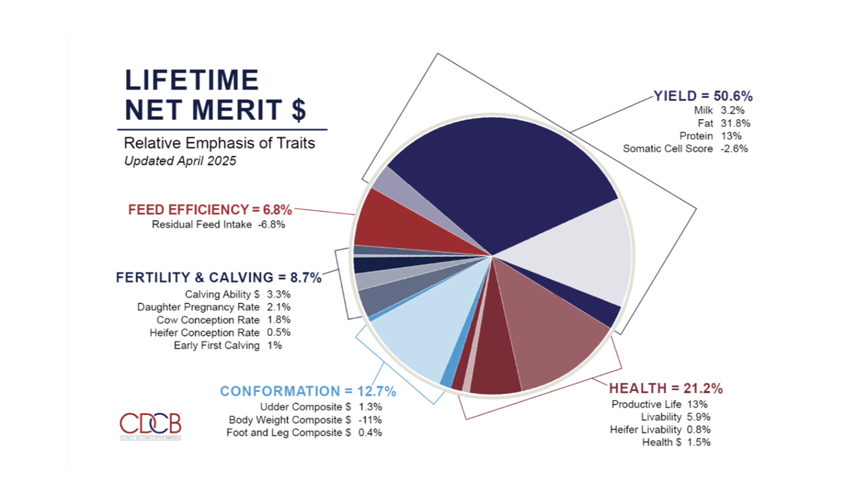
The 2025 NM$ update revises some methods to estimate trait values and many income and cost variables, such as milk prices, feed requirements, and reproductive options. The weights placed on individual traits and composite indices are adjusted due to changes in the economic values of traits. There are no new traits included in this 2025 index revision.
April 2025 Changes
The most notable changes in 2025 Net Merit $ are:
- More emphasis on butterfat and less emphasis on protein due to recent price trends.
- Cow livability and heifer livability receive more emphasis, and productive life has less emphasis due to higher cull cow and heifer calf prices.
- Body Weight Composite gets more negative emphasis because of higher maintenance costs estimated from actual feed intake data. Residual Feed Intake receives more emphasis due to its higher reliability and standard deviation, because more feed intake records are now available.
The 2025 and 2021 NM$ indexes are correlated by 0.992 for young Holstein bulls and 0.981 for recent progeny-tested bulls. This means there will be some reranking of bulls when the index is changed in April 2025; most changes will be modest.
Merit Index Options
It is impossible to design a single selection tool that reflects how every farmer in the U.S. is paid for their milk. This means that you might look at NM$ and conclude that the formula over-values one trait and under-values another based on your situation. Rather than focus on one number or another, it’s more helpful to look at the big picture. USDA provides the expected genetic progress in each trait from selection on NM$, and it’s better to see if the trends for the traits most important to you are in the desired direction.
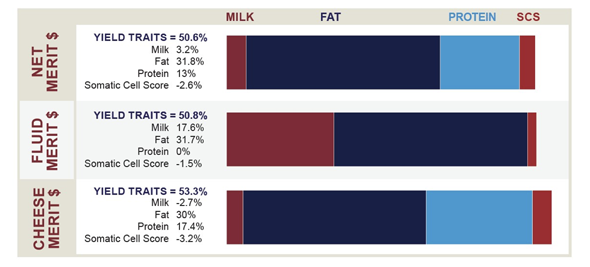
- Cheese Merit (CM$) is designed for those selling milk to a cheese plant or processor that wants lots of protein and less carrier. CM$ includes more emphasis on protein and somatic cell score, less emphasis on fat, and negative emphasis on milk.
- Fluid Merit (FM$) is intended for use by producers who are selling their milk to a bottling plant. FM$ includes much more weight on milk volume and butterfat than other CDCB indices.
- Grazing Merit (GM$) is intended for those producing milk in a seasonal, pasture-based system. It includes much more weight on fertility and much less weight on productive life.
The weighting of traits for fertility, calving, conformation, health, and feed efficiency look similar across NM$, CM$ and FM$. They stand apart from each other due to how the yield traits are balanced.
Please share the CDCB article “Introducing Net Merit 2025” with producers, industry professionals and others interested in the April 2025 index revision.
The U.S. genetic base will also be updated with the CDCB evaluations on April 1, 2025, as previously reported. The CDCB merit index values, along with the 49 individual selection traits and composites produced by CDCB, will be expressed on an updated genetic base relative to dairy cows born in 2020. In the U.S., this update occurs every five years to best align selection tools with the current dairy herd.
Watch for additional resources on the base change from CDCB in February. The final base change values will be shared with the April 2025 evaluation release. Preliminary estimations of the changes in Predicted Transmitting Ability (PTA) values were outlined in the December announcement.
A great farmer and industry resource was developed and shared by NAAB on this topic. If you are looking to better understand genetic base changes, watch their video on LinkedIn.


Be the first to comment