
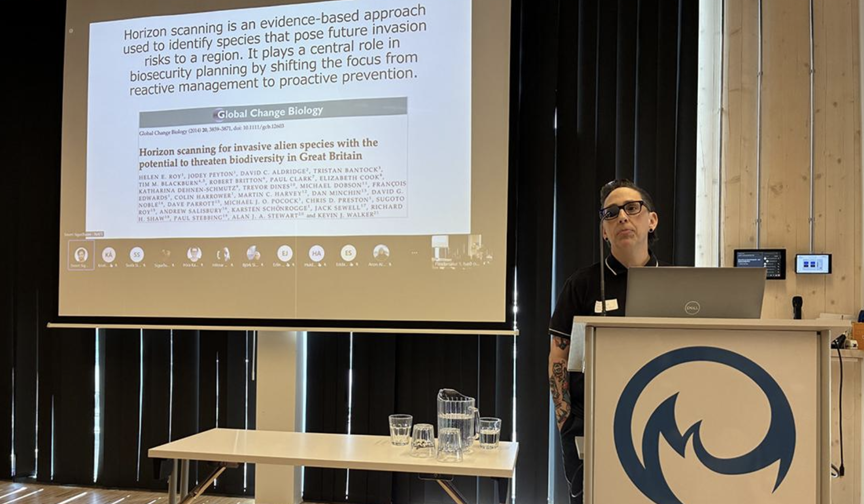
Deah Lieurance, assistant professor of invasive species biology and management in Penn State’s College of Agricultural Sciences,
Lieurance’s keynote presentation introduced horizon scanning as a proactive, evidence-based framework for identifying species likely to invade a region before they arrive. She walked attendees through the full workflow — from building candidate species lists and assembling expert panels to scoring arrival likelihood, establishment potential and ecological impact.
Her presentation highlighted recent methodological innovations that are expanding the approach’s efficiency and applicability across sectors and geographies. The talk, Lieurance noted, offered both a conceptual foundation and a practical roadmap for biosecurity planners and land managers.
The other three keynote addresses at the workshop focused on risk assessment and marine and forest invasions.
“By the end of the workshop there was broad agreement that Iceland would benefit from a comprehensive national biosecurity strategy on invasive species that spans both public and private sectors,” Lieurance said. “That strategy should integrate prevention, early detection, rapid response, management and communication.”
The workshop demonstrated strong momentum for building a more coordinated national response to alien species in Iceland, Lieurance noted.
“By convening national and international expertise, the meeting created an important foundation for future collaboration, policy development and scientific investment,” she said.


Be the first to comment