
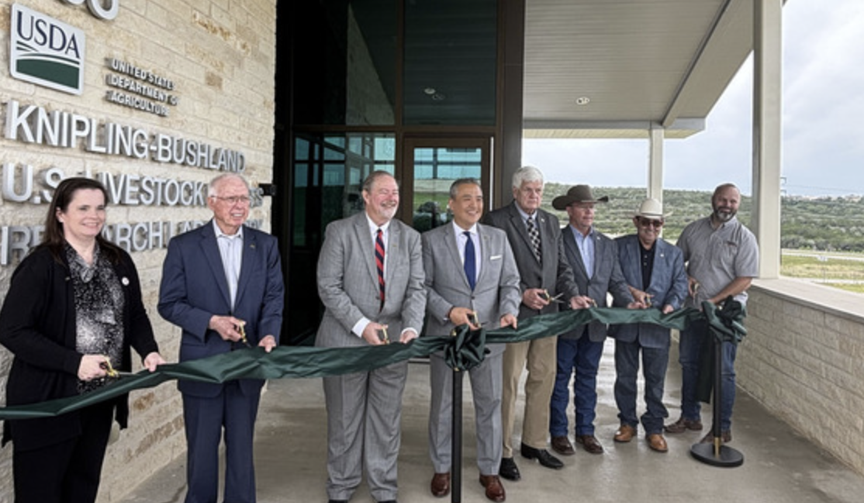
The United States Department of Agriculture’s (USDA) Agricultural Research Service (ARS) opened the Knipling-Bushland U.S. Livestock Insects Research Laboratory, a state-of-the-art laboratory facility today that will provide the U.S. cattle industry with innovative tools and advanced technologies to manage and eliminate the invasive fly and tick pests that threaten the U.S. cattle industry.
“For the last 250 years, our nation has relied on research leading to science-based innovation as a means to overcome some of America’s greatest agricultural challenges, including the exclusion of New World Screwworm from the United States with novel Sterile Insect Techniques,” said USDA Under Secretary for Research, Education, and Economics Dr. Scott Hutchins. “The Knipling-Bushland U.S. Livestock Insects Research Laboratory — named after ARS pioneers that every entomologist and entomology student knows of through their breakthrough work — will build on their legacy by protecting livestock health, ensuring that America’s ranches remain productive, safe, and profitable for generations to come.”
The facility also houses two ARS research units: the Livestock Arthropod Pest Research Unit and the Veterinary Pest Genetics Research Unit. Collectively, these units improve the health, sustainability, and profitability of U.S. livestock production and protect the U.S food supply from devastating arthropod pests, including biting flies, ticks, and the New World Screwworm. On-site research also plays a role in critical research to eradicate other ticks and blood feeding flies that can harm, infect, and kill cattle.
This is a full circle moment due to the 80 years of historic research done at previous ARS laboratory facilities in the Kerrville area. This includes:
- Research on the biology of control of New World Screwworm that led to its eradication from the United States in the 1970s.
- Development and evaluation of novel pesticides like macrocyclic lactones for controlling biting flies and ticks on cattle and wildlife.
- Sequencing the genome of over 25 important livestock arthropod pest species.
The laboratory is named after two influential and pioneering USDA researchers: Drs. Edward F. Knipling and Raymond C. Bushland. In 1937, Knipling first developed the theory that screwworms could be controlled using the sterile male technique. In the early 1950s, Bushland successfully demonstrated that the theory worked, that viable sterile male screwworms could be produced and used to control screwworm populations. This biocontrol technique, known as Sterile Insect Technique (SIT), became the keystone component of the strategy that eventually led to the eradication of the screwworm from the United States, Mexico, and Central America. Nearly 80 years later, SIT is still being employed to fight New World Screwworm in Mexico and Central America, in an effort to keep the devastating insect from reestablishing itself once again in the United States.
The Agricultural Research Service is the U.S. Department of Agriculture’s chief scientific in-house research agency. Daily, ARS focuses on solutions to agricultural problems affecting America.



Be the first to comment