
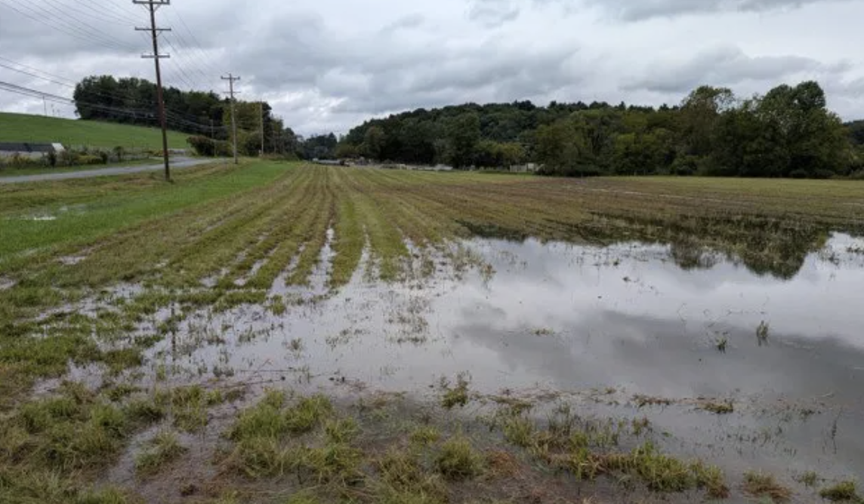
High precipitation in recent weeks caused localized flooding in parts of Pennsylvania. Another clear call for the critical importance of soil management to improve infiltration and reduce runoff.
This summer has brought significant precipitation to Pennsylvania, especially in the western part of the state. In the last month, Erie recorded more than 9 inches of precipitation, while other western stations recorded up to 8 inches of precipitation (see table). Average precipitation is typically 4inches per month.
| Station | County | Last 30 Days (in) | Last 7 Days (in) |
|---|---|---|---|
| Penn State Grape Research | Erie | 9.57 | 0.94 |
| Penn State Beaver | Beaver | 7.19 | 0.7 |
| Penn State Fayette | Fayette | 4.93 | 1.6 |
| Penn State Shenango | Mercer | 6.69 | 1.24 |
| Penn State Dubois | Clearfield | 8.2 | 1.43 |
| Penn State Main Campus | Centre | 5.38 | 1.26 |
| Penn State Rock Springs | Centre | 4.87 | 1.05 |
| Penn State Altoona | Blair | 5.12 | 1.15 |
| Penn State Fruit Res | Adams | 1.88 | 0.37 |
| Penn State Landisville Ctr | Lancaster | 2.91 | 0.06 |
| Penn State Berks | Berks | 4.98 | 1.09 |
| Penn State Schuylkill | Schuylkill | 4.68 | 1.8 |
| Forest City School | Susquehanna | 4.72 | 1.54 |
Source: PEMN Daily Data Viewer, The Pennsylvania State Climatologist
Localized events caused severe flooding recently, such as in northern Centre County on September 2nd and 3rd due to more than 4 inches of precipitation in one day. This event caused Centre County Commissioners to issue an emergency declaration for the area. While monthly or daily totals and regional averages give us good information, it is often the localized, high intensity rainfall that causes most damage to life and goods. Unfortunately, we never know where and when these events will hit us. Farmers manage hundreds of thousands of acres of land in Pennsylvania, and the balance between infiltration and runoff on this land contributes to the amount rushing off overland versus that soaking into the ground and being released gradually through groundwater flow.
Farmers can increase infiltration on their land by using these types of practices:
Keeping soil covered at all times.
The importance of soil cover cannot be overstated. The large raindrops, falling at high velocity, destroy surface soil aggregates if the soil is not covered, sealing up the soil, which quickly loses its infiltration capacity. Keeping soil covered at all times with mulch or living cover is therefore paramount to reduce runoff from farmland. This can be achieved by:
- Using no-till practices where crop residue is left on the soil surface.
- Using cover crops after low-residue crops such as corn silage, soybeans, snap beans, and vegetables
- Grow perennials in crop rotations. Perennials provide continuous cover, even in the wintertime.
Improving continuous macoporosity and soil aggregation.
Water can follow large, open pores that are connected into the subsoil. This can be achieved by:
- Promotion of nightcrawler activity. These are large earthworms that live in open, permanent burrows in the soil that penetrate 3-4 feet deep. These earthworms need crop residues at the soil surface and therefore suffer greatly from clean tillage.
- Grow deep, tap-rooted crops in the rotation or in association with other crops. Examples are alfalfa and tillage radishes. The latter need to be planted in late summer to develop a deep root before they winter-kill.
- Leave macropores intact by not tilling the soil.
Improving soil aggregation by increasing soil organic matter and stimulating continuous root growth.
- Grow sod in the crop rotation as the most fool-proof method to increase soil organic matter content and improve aggregation and soil porosity. The grass roots have an amazing ability to improve aggregate stability and macroporosity, while legumes and forbs further enhance these with their taproots.
- Reduce tillage intensity.
- Promote photosynthesis at all times of the year. Some crop rotations leave the soil without growing vegetation for 7 months. By using other crops in the rotation, or growing cover crops, we can fix more solar energy and convert it into sugars, carbohydrates, proteins, and fiber that form the basis of soil organic matter.
- Add organic matter in the form of compost, solid manure, or liquid manure with high quantities of fiber (such as dairy manure).
Reduce soil compaction.
Driving equipment with high axle load and high contact pressure on moist soil destroys soil aggregation and smashes pores shut, thus reducing infiltration capacity. Refer to other Penn State publications on methods to avoid compaction, make soils resist compaction better, and, as a means of last resort, use deep tillage to break up compaction.
Use Management Intensive Grazing practices.
MIG includes practices such as always leaving a 3-inch minimum stubble, resting pastures between grazings, and using a diversity of plant species in the pasture.
Because farmers manage so many acres of land, they can play an important role in flood mitigation by using methods that improve infiltration capacity on working farmland.

Be the first to comment