
The T.C. Jacoby Weekly Market Report Week Ending October 23, 2026
The dairy markets are awash in a tidal wave of milk. USDA’s latest Milk Production report showed that August milk output was notably higher than previously thought, and the agency pegged September milk production at 19.4 billion pounds, up 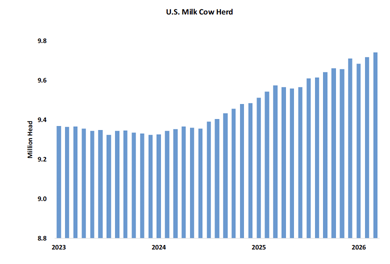 2.6% year over year, far higher than LaSalle Street expected. The recent ups and downs in the dairy markets did not diminish dairy producers’ appetite for growth. They added 26,000 cows last month, lifting the dairy herd to 9.74 million head. That is 169,000 head greater than September 2025 and an astounding 390,000 head higher than it was just two years ago. Slaughter rates, springer prices, and orders for milking equipment all point to continued growth in the dairy herd into next year.
The growth was generally widespread. However, cows are starting to leave the Southwest for greener pastures. Compared to September 2025, there were 10,000 fewer cows in Arizona, 3,000 fewer in Utah, and 1,000 fewer in New Mexico. Dairy producers continue to expand elsewhere in tandem with regional growth in processing capacity. Milk cow numbers and milk production were significantly higher than the prior year in Idaho, New York, Kansas, South Dakota, Texas, and the Great Lakes states.
 Major investments in processing capacity are easily absorbing all the new milk. This week, processors paid par to $4 over class for spot milk in the Central region, the highest late-October premiums in at least a decade.
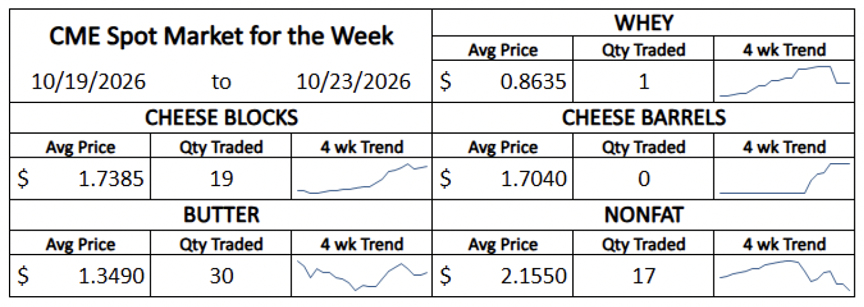
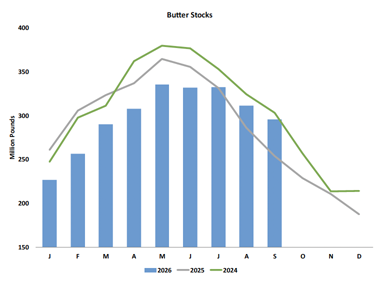
But new processing does not create new markets, and some dairy commodities are starting to pile up. USDA estimated September 30 butter stocks at 296 million pounds, up 16% from the prior year. We’re heading into the holiday baking season and the larders are full. It’s no wonder that butter values are languishing. This week CME spot butter dropped 2.5ȼ to $1.34 per pound.
Cheese inventories tallied 1.429 billion pounds, down seasonally from August but up 2% from September 2025. Inventories 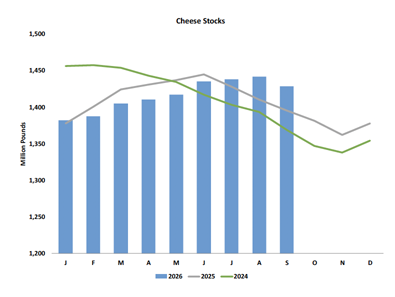 of American-style cheeses, including Cheddar, were 2% lower than last year. And much of the Cheddar in storage is more than four to 30 days old, making it ineligible for delivery to the CME spot market. The fresh cheese squeeze spurred the recent spike in spot cheese values. USDA’s Dairy Market News confirmed reports of “quality issues” for a major cheese producer in the Central region. Customers who had planned to purchase this cheese have scrambled to source it elsewhere, including at the CME spot market. They bid spot Cheddar blocks to $1.80/lb. on Tuesday, the highest price in nearly a year and up an astounding 53ȼ from the low forged on Sept. 30. Spot Cheddar closed today at $1.735, up 5.25ȼ for the week and up 37% from where it began the month.
 Protein demand remains strong, but buyers are not willing to step in at any price. CME spot whey powder fell 5.25ȼ to 84.25ȼ. While values are off about a nickel from the highs, they are still lofty, delivering real revenue for cheese processors and Class III producers.
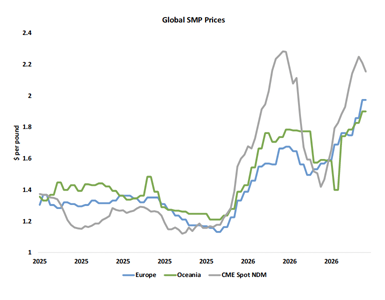
CME spot nonfat dry milk (NDM) rallied back toward the highs Tuesday, on the heels of a strong Global Dairy Trade (GDT) auction. But GDT skim milk powder (SMP) at $1.92 per pound couldn’t deliver a lasting boost to a CME spot NDM market that traded in the $2.20s earlier this week. And the bearish milk production report suggests that trucks will start to line up eventually. The rally quickly faded, and spot NDM closed at $2.095, down 6.75ȼ from last Friday.
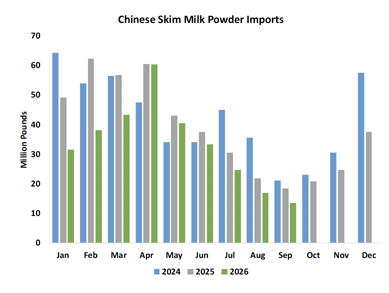 Global demand for SMP is strong, but one key buyer remains largely on the sidelines. Chinese consumers are reining in spending amid a tepid economy and a falling housing market. And China is digging into its milk powder reserves, further reducing the need for imports. Chinese SMP imports fell to just 13.5 million pounds in September, their lowest level since October 2010, down 27% from last year. Chinese whey imports also dropped below year-ago levels last month, and Chinese imports of U.S. whey powder fell 7.1% compared to September 2025. But China bought significantly more whole milk powder in September, catching up after several slow months. And Chinese cheese imports also improved.
The cheese market rally lifted November Class III prices 40ȼ this week to $17.74 per cwt. But all other Class III and IV contracts lost ground thanks to the bearish Milk Production report. Class III futures are trading in the high $16s and low $17s, while Class IV is hovering near $19.
The feed markets succumbed to harvest pressure, as combines rolled throughout the Corn Belt. Rains in central Brazil also alleviated some fears about the impact of the super El Niño on South American crop production, although there is a lot of weather yet to contend with. December corn futures closed at $4.56 per bushel, down another 18.25ȼ since last Friday. December soybean meal fell $10.60 to $346.50 per ton.
Original Report At: https://www.jacoby.com/market-report/tidal-wave-of-milk/



Be the first to comment