
October brings something Texas dairy producers and cows alike have been waiting for: cooler temperatures. After months of managing heat, it can be tempting to turn off the soakers, enjoy the cooler mornings and put another Texas summer behind us. But before we move on, now is a good time to ask an important question:
What did this summer actually cost?
Start With Reproduction
Reproduction should be one of the first places to look. The negative relationship between heat stress and dairy cow fertility has been documented for decades. Heat stress can reduce estrous expression (heat), alter follicular development and ovarian function, impair oocyte quality, interfere with fertilization and early embryonic development, and ultimately decrease reproductive efficiency (Jordan, 2003; Negrón-Pérez et al., 2019).
More recent research continues to demonstrate that the reproductive consequences may extend beyond the immediate period of heat exposure. Ortega et al. (2026) described how heat stress can compromise the follicular environment and oocyte competence, with effects potentially persisting across subsequent follicular waves. Early embryos are also particularly susceptible to elevated temperatures before developing greater thermotolerance later in development. In other words, cooler weather does not necessarily mean reproductive performance immediately returns to normal. When reviewing summer reproductive performance, consider examining:
-
Pregnancy rate
- Conception rate
- Service or insemination rate
- Pregnancy loss
- Services per conception
- Days open
- Estrus detection or activity data, if available
It is also important to recognize that reproductive performance measures may not immediately reflect improvements in environmental conditions. For example, even if heat stress subsides in September or October, pregnancy rates may not reflect improved fertility until November or December because of the time between insemination and pregnancy diagnosis. Therefore, producers should continue monitoring reproductive performance throughout the fall and into early winter to better understand the lasting effects of summer heat stress.
Rather than looking at one month’s number, graph these measures across the year. Compare June through September with spring performance and, when possible, with the same months in previous years. The question should not simply be, “Did pregnancy rate decline?” Instead, ask when it declined, how much it declined, how long it remained depressed, and whether particular groups of cows were affected more than others.
What Happened to Milk?
A recent meta-analysis of 35 independent studies also found an overall negative association between heat stress and milk yield, as well as reductions in milk fat, protein and lactose concentrations (Ortega et al., 2026). However, herd averages alone can hide important differences.
When reviewing records, consider looking at milk production by:
- Lactation number
- Days in milk
- Pen
- Fresh versus established cows
- Month or week
Then compare these trends with periods of elevated environmental heat load. If one pen experienced a much greater decline than another, ask why. Differences in fan performance, soaker coverage, stocking density, water availability, time spent in the holding pen or other management factors may help explain the difference.
Look Beyond Milk and Pregnancy
Milk and reproduction are important, but they do not tell the entire story. Cow behavior can provide another window into how well cows coped with summer conditions. Heat stress can alter standing and lying behavior as cows attempt to increase heat dissipation. Reviews of the scientific literature have also highlighted the importance of maintaining adequate lying time because prolonged standing may contribute to hoof health and lameness concerns. If your dairy uses activity-monitoring technology, examine changes in:
- Lying time: Did cows spend more time standing during periods of high heat load?
- Rumination: Were reductions evident during particularly hot periods?
- Activity: Did normal activity or estrous expression patterns change?
- Body temperature: If internal or external temperature monitoring is available, how quickly did cows recover overnight?
Researchers have suggested that combining environmental measurements, such as the temperature-humidity index (THI), with physiological and behavioral measurements, including body temperature and activity, can provide a more complete assessment of heat stress than relying on environmental conditions alone. Technology does not replace walking pens and observing cows, but it can help identify patterns that would otherwise be difficult to detect.
Don’t Forget the Dry Cows and Heifers
One group that deserves particular attention during the post-summer evaluation is the dry cow pen. Cooling dry cows isn’t simply about keeping them comfortable. Research has demonstrated that heat stress during the dry period can negatively affect subsequent performance. Recent work continues to demonstrate that cows exposed to heat stress during the dry period can experience reduced production in the subsequent lactation. A cow does not need to be standing in the high pen producing 100 pounds of milk to benefit from effective heatabatement strategies. Therefore, when evaluating summer heat abatement, don’t limit the assessment to the highest-producing pens. Ask whether cooling was adequate for:
- Close-up cows
- Far-off dry cows
- Fresh cows
- Hospital cows
- Replacement heifers
Give Your Cooling System a Report Card
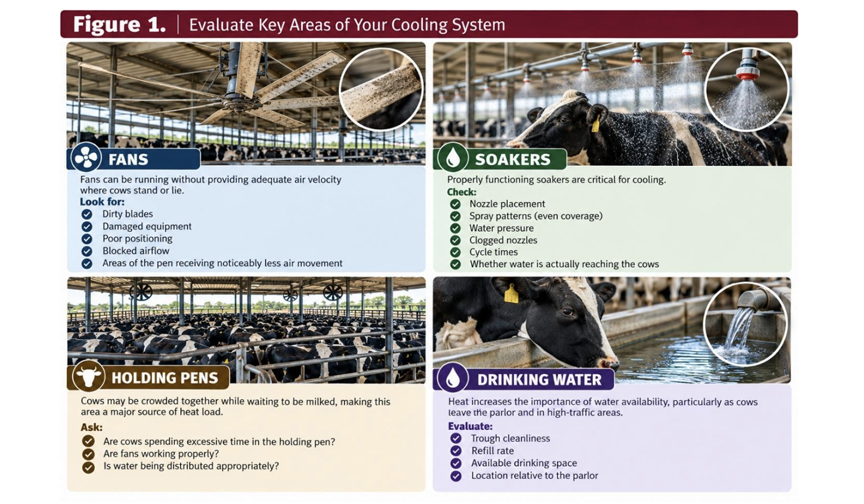
Once the records have been reviewed, turn your attention to the facilities. The question isn’t simply, “Do we have fans and soakers?” The better question is, “Did our cooling system keep cows cool enough to maintain normal behavior and performance?” Walk through the dairy and evaluate several areas such as those described in Figure 1.
Ask the People Who Were There
One of the most valuable sources of information may not be found in your record keeping systems. More importantly, ask your employees. The people working in the pens every day may already know where the problems occurred. Combining employee observations with herd records can help identify management problems that may not be obvious from either source alone.
- Which pens seemed hottest?
- Where did cows bunch?
- Which water troughs emptied fastest?
- Were there fans or soakers that repeatedly caused problems?
- Which groups were hardest to move during the hottest part of the day?
Use This Summer to Prepare for the Next One
By next May, it will be difficult to remember exactly what happened during the hottest months of summer. Fall is an excellent time to begin documenting challenges and identifying opportunities for improvement. However, the timing of performance evaluations should account for when heat stress actually subsides. Milk production may respond relatively quickly to cooler conditions, whereas reproductive measures, particularly pregnancy rate, may take an additional one to two months or longer to reflect improvements because of the interval between insemination and pregnancy diagnosis. Consequently, producers should begin evaluating their cooling systems and management practices in October while continuing to monitor reproductive performance through November and December, or later if heat stress persists.
Make a short list of improvements for next year while the problems are still fresh. Maybe that means replacing or repositioning fans. Maybe additional water access is needed. Perhaps the holding pen needs more attention, or cow-movement schedules need to change during extreme heat. Some solutions may require significant investment. Others may cost very little. The key is to use your own cows and your own herd records to decide where improvements are most likely to have an impact.
Cooler Weather Doesn’t Erase the Lessons of Summer
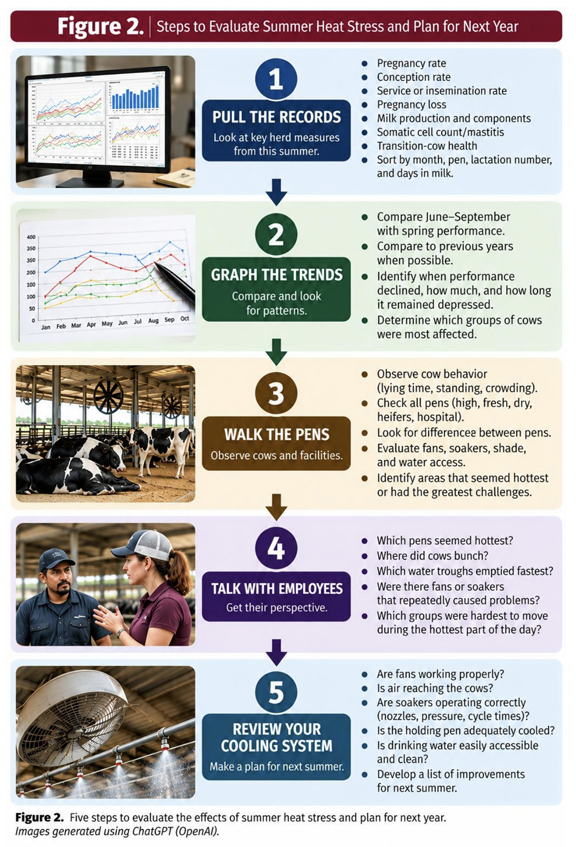
Heat stress is not simply a July problem. Its effects can involve production, reproduction, physiology and behavior, and some biological consequences may continue after the hottest days have passed. So, before putting another Texas summer behind you, give your heat-abatement program a report card. The five-step evaluation process outlined in Figure 2 provides a practical starting point for reviewing herd performance, identifying management challenges and developing improvements before next summer.
Then ask three questions:
What worked?
What didn’t?
What are we going to change before next summer?
Texas summers will continue to challenge dairy cattle. But each summer also provides information that can help us make better management decisions the next time the temperature starts climbing.
Be the first to comment