
The T.C. Jacoby Weekly Market Report Week Ending October 30, 2026
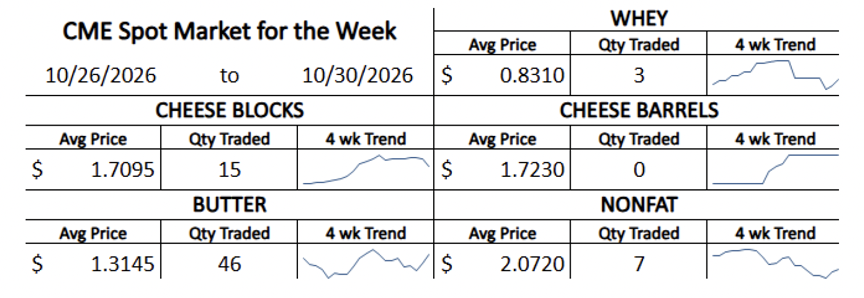
The wild ride continued in the CME spot Cheddar market. Blocks soared in the first three weeks of October as cheese buyers scrambled 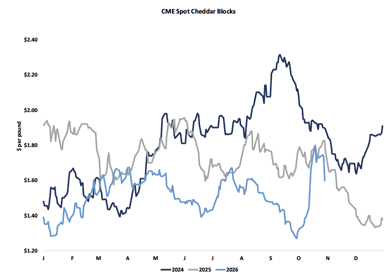 to source fresh Cheddar from plants without production issues. And USDA offered more clarity on those ongoing issues, reporting in Dairy Market News, “The ongoing focus on high protein, premium whey concentrates has led some cheese manufacturers to push the cheesemaking process further than usual. This is increasing liquid whey output, resulting in more off spec cheese production.” Nonetheless, it seems that the fresh cheese squeeze is over. CME spot Cheddar blocks plummeted Friday and closed at $1.5975 per pound, down 13.75ȼ for the week. Cheese production is growing faster than consumption, and prices must stay low enough to attract international buyers away from other markets. That works a lot better around $1.60 than it did at $1.80.
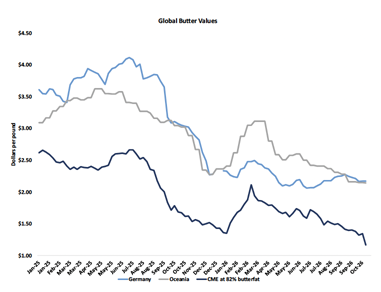
Butter should have no trouble finding global buyers. American butter is the cheapest in the world, by far. And it may have fallen far enough for now. Spot butter rebounded 1.75ȼ this week to $1.3575.
 CME spot nonfat dry milk (NDM) rallied 1.75ȼ to $2.1125. Skim milk powder prices moved upward at the Global Dairy Trade Pulse auction on Tuesday, but American powder still looks pricey. Production remains low as other processors lap up most of the milk supply. Even within a facility, competition is suppressing NDM production. USDA’s Dairy Market News reports that, in the West, “Other high value products continue to utilize dryer space, limiting NDM output.” That’s helpful because there are a lot of headwinds to U.S. NDM exports. American milk powder will look even more expensive as the dollar strengthens. Mexican buyers have lost more than 10% of their purchasing power over the past two months as the peso has fallen relative to the dollar. And
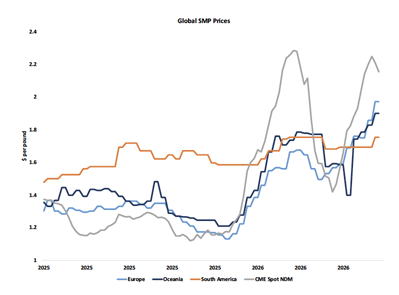 Mexican demand for milk powder is expected to decline. Dairy producers in Mexico’s Chihuahua state reported that the government cut back on purchases of milk for the Leche para el Bienestar program due to dwindling funds. They have been delivering milk to Mexican milk powder dryers instead.
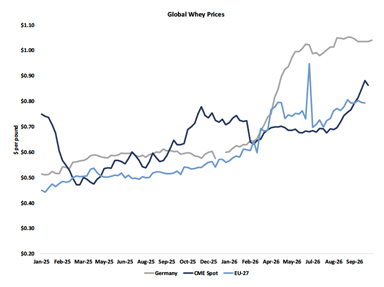
The whey powder market took a small step back this week, but it remains near the high end of the 2026 trading range. CME spot whey powder closed at 84ȼ, down 0.25ȼ from last Friday. U.S. cheesemakers are maximizing whey product output, but in today’s protein-crazed world, whey products aren’t hard to sell. Even after the autumn whey powder rally and the rise in the U.S. dollar index, U.S. whey powder is cheaper than some European offers, and U.S. whey exports are booming.
 After much back and forth, the milk markets finished mixed. Nearby prices lost ground for both III and IV, while deferred futures climbed. Dairy producers in the cheese states will cash a small October milk check, but after that everyone should once again be able to pay their bills with a meaningful assist from their beef revenue. November Class III settled at $17.65 and November Class IV closed at $20.78.
A wet September and an unusually warm, dry October concentrated the harvest into a few weeks of furious fieldwork. It also intensified the pressure that harvest can have on corn and soybean prices. A relatively benign forecast in South America and a strong dollar pushed the bulls further to the sidelines. December corn futures settled at $4.475 per bushel, down 8.5ȼ to its lowest price since early July. December soybean meal plummeted $22 to $324.70 per ton.
Original Report At: https://www.jacoby.com/market-report/the-fresh-cheese-squeeze-is-over/

Be the first to comment