
The T.C. Jacoby Weekly Market Report Week Ending November 20, 2026
Milk output remains strong around the world. In New Zealand, the conventional wisdom calls for a season-to-season decline as the El Niño is 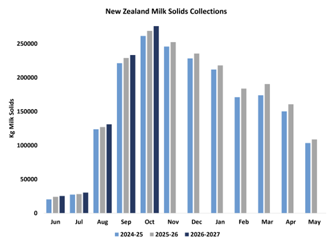 expected to dry out pastures in key milksheds during the Southern Hemisphere summer. But Kiwi cows are thriving through the flush. October milk solids collections were record high, up 2.6% from the year before. Recent rains topped up soil moisture, likely delaying the impact of a sweltering summer. And Kiwi producers are enjoying great margins.
This month, Fonterra raised its farmgate milk price forecast to a midpoint of NZ$10.10 per kg of milk solids, up from NZ$9.75 last month. Throw in the dairy producers’ share of Fonterra’s earnings and the premium for high components, and most producers will reap roughly $20 per cwt., far above their breakevens. Many farmers are stocking up on supplemental feeds in case the summer is as hot and dry as feared. That suggests that New Zealand’s milk production could be more resilient than the markets anticipate.
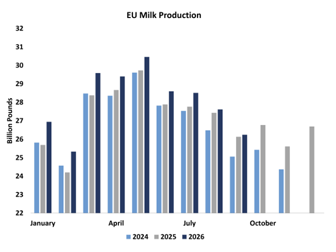
In Europe, output continues to top year-ago volumes despite the severe heatwave. September milk collections reached 26.24 billion pounds in the 26 reporting nations in the bloc, up 0.4% from an already strong showing in September 2025.
 And in the U.S. production just keeps climbing. It grew 2.4% year over year in August, September, and October, well ahead of the typical growth rate for dairy demand, especially after adjusting for skyhigh components. The dairy herd grew 7,000 head from September to October, and it reached 9.745 million head, up 179,000 head from a year ago and up an astounding 378,000 from October 2024. Producers continue to add cows in most major dairy states, and growth is especially impressive in the Central Plains. In just 12 months, dairycow head counts climbed by 28,000 in Texas, 26,000 in Kansas, and 25,000 in South Dakota
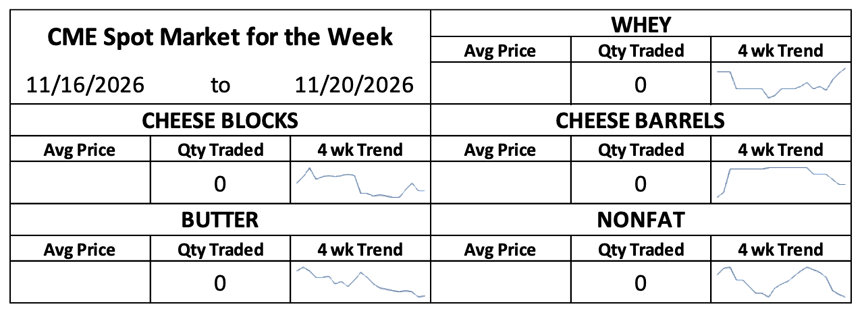
All that high-component milk has created gobs of butterfat. In the Central and East regions, Class II and III processors are absorbing a lot of dairy fats, and cream multiples are running hot. 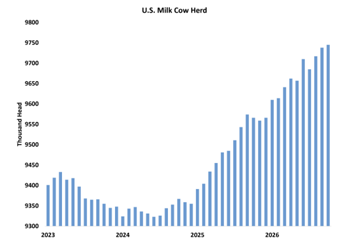 But in the West, churns are going full throttle. Butter is cheap and readily available even as bakers stock their larders for Thanksgiving. Traders exchanged 68 loads of butter at the CME spot market this week. Prices climbed 3ȼ, but, at $1.27 per pound, CME spot butter still resides in the bargain basement.
Heavy cheese production is weighing on prices. This week CME spot Cheddar blocks fell 5.5ȼ to $1.5625. But international cheese prices are fading too, which suggests that the export-dependent market will remain under pressure.
Milk powder prices bounced back from last week’s big selloff, but they remain toward the low end of the recent trading range. CME spot nonfat dry milk (NDM) rallied 3ȼ to $2.065. Skim milk powder prices extended their rally at Tuesday’s 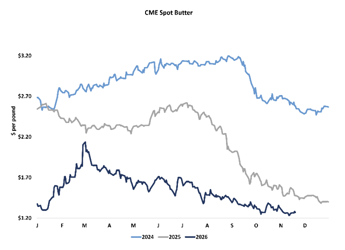 Global Dairy Trade auction. USDA’s Dairy Market News reports that milk powder inventories are tight in the Central and East regions, because “milk continues moving to other processors, constraining drying capacity and limiting production.” But there’s enough milk for dryers in the West. Mexican importers are buying U.S. milk powder at a steady clip.
CME spot whey powder set a fresh alltime high on Monday and held there throughout the week. It closed at 92ȼ, up a penny from last Friday. Americans are eating record-smashing volumes of high-protein whey products, and international buyers are snapping up commodity whey powder, helping to keep inventories in check despite robust output.
Most Class III contracts settled modestly higher this week, thanks to the strength from the whey 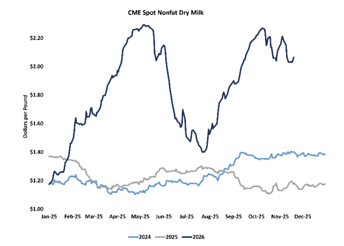 market. But the December contract fell 27ȼ as it followed the cheese market lower. Class III prices generally hover near the $17 mark, which is enough to pay the bills with a little help from beef revenues. Most Class IV contracts took a step back this week. The February contract led the retreat, falling 53ȼ to $18.75. Most other contracts are still north of $19, and producers can expect hefty November revenues based on Class IV at $20.85.
Grain prices dropped again. U.S. corn exports have been slower than expected, and the strong dollar makes them less competitive. Meanwhile, the season is off to a surprisingly good start in South America, alleviating fears of the El Niño impact in Brazil. And the Brazilian real is down 15% since last month’s elections, a siren song for grain importers. March corn futures dropped 8ȼ this week to $4.4875 per bushel, a five-month low. Soybean meal prices continued to climb, propelled upward by strong demand. January soybean meal closed at $340 per ton, up $12 since last Friday.
Original Report At: https://www.jacoby.com/wp-content/uploads/2026/11/The-Global-Milk-Glut-2.pdf



Be the first to comment