
The T.C. Jacoby Weekly Market Report Week Ending January 14, 2022
Markets are swinging wildly from heart-stopping highs to stomach-churning lows and back again. But unlike thrill rides, the dairy markets are breaking new ground.
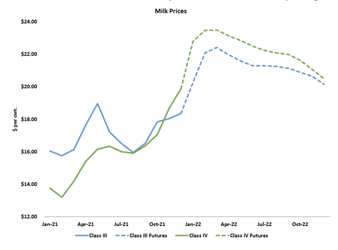 Buckle up and keep your hands inside the tram. The dairy markets are on a roller coaster ride, swinging wildly from heart-stopping highs to stomach-churning lows and back again. But, unlike thrill rides, which end up back where they began, the dairy markets are breaking new ground. Class III and Class IV milk futures forged new life-of-contract highs across the board this week. February Class III advanced 65ȼ and closed at $22.08 per cwt. March was even stronger, up $1.19 to $22.43. Further down the board, most contracts gained around 80ȼ. Class III futures stand at $21 or higher through September. The Class IV markets were stronger yet. The February contract leapt $1.36 to an astounding $23.49, and Class IV milk is $22 or better through August, with September at $21.99.
Slower global milk production and firm demand have invigorated the bulls. Compared to the prior 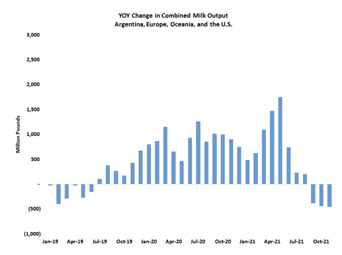 year, November milk output was down 0.4% in the United States, 1.5% in New Zealand, and 0.8% in Australia. Many European nations have not yet reported November data, but production remains depressed in Europe’s largest dairy nations. Output fell 2.9% short of last year in Germany and was down 2.6% in France, 2% in the United Kingdom, and 4% in the Netherlands. Argentina is the only major dairy exporter where milk output has risen. Argentine milk collections grew 4.5% in November compared to a year ago. However, the Daily Dairy Report warns, “South America’s record of bucking the global trend of shrinking production may be under threat,” due to rising costs and adverse weather in Argentina and Uruguay. Aggregate milk collections among the world’s five
Sharply higher prices will surely result in a rebound in milk production as dairy producers around the world respond to higher prices. But the market doesn’t anticipate a flood of milk anytime soon. USDA’s Dairy Market News reports that in Western Europe, “2022 milk production is expected to continue to be lower than desired,” which is likely to keep butter and milk powder output in check. Dairy producers in Europe’s traditional milk sheds are aging out of the business, and, with the government sending clear signals that it is willing to strangle commerce to meet its green commitments, there are fewer young farmers to replace them. European cow numbers are in decline. Meanwhile, a shortage of labor, pricey inputs, and wet weather have dragged on milk yields in Australia and New Zealand, and it will be several months before the new calving season arrives and producers can add to their herds to take advantage of record-high pay prices. Even then, tightening environmental restrictions may limit growth in New Zealand.
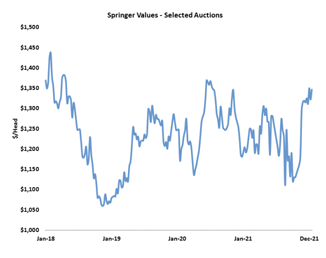 In the United States, $22 milk will surely coax dairy producers to slow cull rates, buy heifers, and keep their barns full. Springer prices are on the rise, a signal that dairy producers are trying to add milk. But in many regions, processors and co-ops will cap this growth through supply management programs. And after two rough years outside the cheese states, those dairy producers who can find a buyer for new milk still have a lot of financial healing to do before they can invest in new facilities. The slow permitting process, tight labor market, high construction costs, and supply chain backlogs will ensure that when these dairy producers are ready to build new barns, it will take a very long time to go from ambition to accomplishment.
Of greater concern, then, is that high prices will remedy themselves by killing demand. The trade will likely falter at the first indication that buyers are backing off due to high prices. There are signs that whole milk powder prices in New Zealand have climbed enough to deter buyers, but, with that exception, global consumers remain hungry for dairy. Many end users stayed on the sidelines in 2021, hoping for a break to buy that never came. Now they are playing catch up, and prices are rising accordingly. The gap between U.S. and global dairy product prices has narrowed, but even at today’s 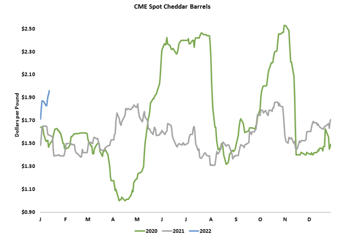 values, U.S. dairy is competitively priced, and exports are booming. Domestic demand remains strong. Nonetheless, dairy prices remain vulnerable to a setback simply because they are already so elevated.
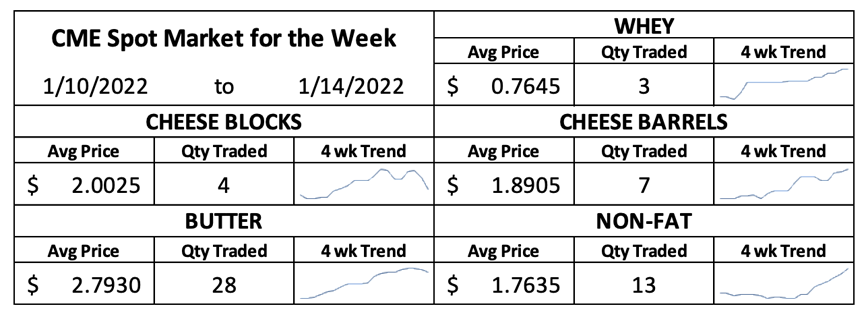
At the CME spot market this week, butter reached a fresh six-year high on Wednesday but then retreated. It closed at $2.725 per pound, down 1.75ȼ for the week. The Cheddar markets diverged. After topping $2 for two days, blocks fell back to $1.92, down 7.5ȼ for the week. Barrels jumped 9.5ȼ and closed at a 14-month high of $1.96. The football playoffs, otherwise known as nacho season, have helped barrels trade higher than blocks for the first time since early November. The powders just keep climbing. Dry whey rallied another 1.25ȼ to 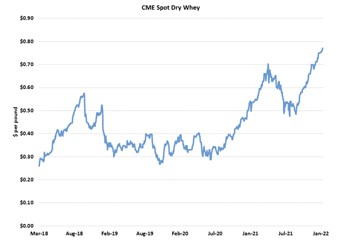 77ȼ, the highest spot value in its nearly four years at the CME. Spot nonfat dry milk jumped 10.5ȼ to $1.815, a price not seen in Chicago since June 2014.
It was a scorching week in Argentina and southern Brazil, but relief is on the way, with lower temperatures and big rains expected next week. Those rains will surely cause crops to perk up, but some damage has been done. USDA acknowledged as much in its monthly update to global crop balance sheets. The agency cut its estimates of soybean production in Argentina, Brazil, and Paraguay by 6.1%, 3.5%, and 15% respectively. USDA slightly trimmed its estimates of South American corn production, but, after surveying farmers, USDA raised its estimate of U.S. corn production. A modest increase in last year’s harvest and some tweaks to demand resulted in larger ending stocks than USDA’s previous forecast, and corn prices dropped. March corn settled today at $5.9625 per bushel, down 12.5ȼ this week. March soybeans closed at $13.6975, down 40.5ȼ. March soybean meal finished at $405.60 per ton, down $19.40.
Original Report at: https://www.jacoby.com/market-report/dairy-markets-are-on-a-roller-coaster-ride/



Be the first to comment