
For December, our example herd was Down.
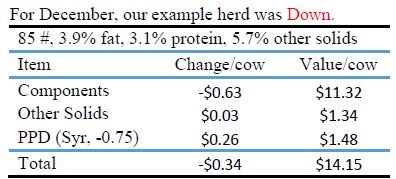
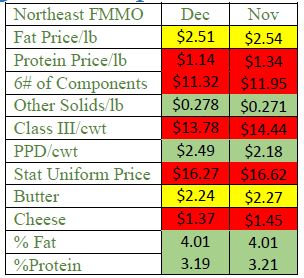
Protein dropped $0.20/lb. and fat decreased $0.03/lb. On a hundred-weight basis, Statistical Uniform Price (3.5% fat) decreased $0.35/cwt and Class III price decreased $0.66/cwt which resulted in PPD increasing $0.31cwt. We had previously predicted PPD to increase $0.32/cwt. Regionally, fat held steady and protein dropped. A new year – new goals: What are our goals and how do we get there? In a recent management meeting, this question was asked. As you can image it resulted in vigorous discussion. However, underlying the discussion were the issues of what assumptions have been made and what information do we really have. New goals need to be challenged rigorously due to the complicated biological and economical relationships governing each operation.
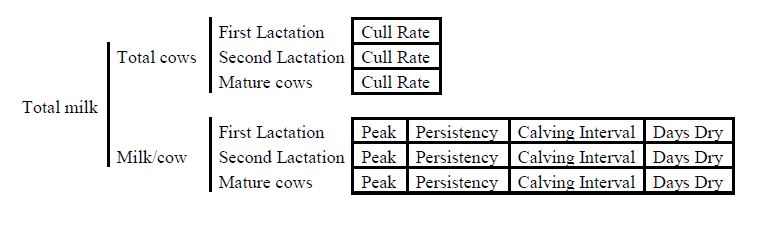
 For example, increasing cow numbers can increase total milk output but only if overcrowding does not lower milk production per cow. Or, supplemental palm fats can increase fat percentage, but cost may not be justified. Goals need to be put into the context of the total system and not isolated. For example, “produce 6 pounds of components” may be a foolhardy goal if not put into the context of “at what cost”. For any business, the end goal is profit. If a specific goal, such as 6 pounds of components, is not profitable, then it is a poor goal unless you are addressing a bigger issue (e.g., environmental, animal welfare, or employee management). The following schematic, showing the interconnection of specific herd parameters with regard to total milk output, can assist in goal setting. For example, if first lactation animals average 63 pounds and mature cows average 83 pounds, it will be much harder to achieve 80 pounds of milk with 45% first lactation animals than with 30% first lactation animals.
Remember that higher profit is always better than bragging rights.

Be the first to comment