

There was a lot of hard work put in this week at the Federal Milk Marketing Order (FMMO) hearing in Carmel, Indiana.
Issue #1, the Milk Component change proposals, were for the most part completed. There are at least two different factors that generated conflicting testimony on Issue #1. These proposals would raise the skim value in Class I, and of course fluid milk buyers vigorously object to that.
Interestingly, the National Milk Producers Federation’s (NMPF) proposal to change milk components seeks a delay in implementation. But in a separate proposal on make allowances, that would also impact Class III and IV prices, they want the changes implemented without a delay. When their witness was asked about this inconsistency, the response was that NMPF had to weigh the various factors, and on balance, this is where the group came out. While some might be critical of this apparent inconsistency, it does point out that the FMMO hearing process is about finding a balance between competing interests, and even within the producer community, there are competing interests that need to be balanced.
The week was not without its legal controversies. As I reported last week, two groups who had submitted proposals that USDA had not accepted for consideration at this hearing filed official objections to the exclusion of their proposals. On Tuesday, USDA gave their response to the objections. This then set off nearly an hour of legal argument about the merits of the exclusion and differing opinions on the administrative law judge’s authority to essentially order the Secretary of Agriculture to reopen the notice of hearing. The USDA attorney’s position is that the judge does not have that authority. The judge took all the argument under advisement, and we will get a ruling from him later.
Issue #2 for the hearing is Surveyed Commodity Products proposals. There is a proposal to add mozzarella cheese to the list of product prices surveyed for the Class III formula. Some of the questions about this proposal are around the fact that there is not an industry standard mozzarella product or package size. There is very limited price information for mozzarella, and there is no accepted yield standard or manufacturing cost data for mozzarella, and therefore to make this proposal a reality, a lot more information would have to be developed.
The big item in Issue #2 is the proposal by NMPF to eliminate barrel cheese from the surveyed prices. NMPF put on two cooperative cheese plant managers as witnesses who had extensive knowledge of the cheese business. Both made the case that in 2017 the cheddar barrel price relationship to the 40# block price began to diverge in a way that was creating great market instability, which continues to this day. This divergence was estimated to have reduced dairy producer Class III income by over $2 billion since 2017 from the depression in the Class III price caused by the inclusion of barrels in the formula. The chart below from the testimony of Darin Hanson, Foremost Farms, Middleton, Wisconsin, depicts the $2 billion impact to dairy producers.
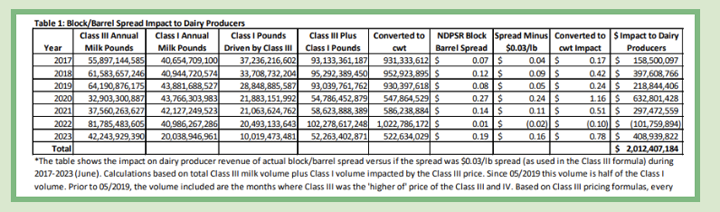
It was asserted that at least 75% and up to 90% of total cheese in the US is indexed off of the 40# block price and that the inclusion of the barrel price depresses not only Class III, but also Class I prices that include the depressed Class III in the base price.
The witnesses were asked why there has been a divergence since 2017. It seems to be related to the Chicago Mercantile Exchange influence on barrel prices and some of the CME rules which deal with quality and transportation requirements. There was also some discussion around the fact that the whey stream from a barrel operation is potentially of higher value than whey from a block operation, which might explain part of the divergence in the cheese price reported by the different operations. These witnesses provided significant insight into how the cheese markets work and made a strong case that barrel cheese can no longer be used to create a “synthetic 40# block cheese value” since blocks and barrels, which for decades had moved generally together in price, are now separate markets and move in divergent directions. The current formula assumes identical yields and costs for cheddar blocks and barrels, and in the formula automatically adjusts moisture levels and adds three cents per pound to the barrel price as a proxy for the assumed lower packaging costs of barrel cheese.
Also on Friday, six dairy farmers were able to testify virtually, including MPC member Gerben Leyendekker, who testified in favor of the NMPF proposals.



Be the first to comment