

After more than a year of in-depth analysis and examination of numerous Federal Milk Marketing Order (FMMO) issues by a dedicated team of technical experts from National Milk Producers Federation (NMPF) member cooperatives, followed by the unanimous approval of NMPF Board of Directors, NMPF submitted to USDA its comprehensive package of FO Modernization proposals on May 1, 2023.
NMPF is now anticipating USDA to announce a national FMMO hearing in which our proposals for modernizing the federal order regulations will be included. We are hopeful USDA will grant the hearing, which would likely occur sometime late summer/early fall of this year. In the meantime, the team of technical experts is preparing for the anticipated national hearing by preparing testimony and justifying each and every submitted recommendation.
Background
But with significant industry changes occurring since 2000 – including in milk composition, product manufacturing costs, costs of transporting milk, consolidation, plant closures, and shifts in milk production areas, the time has come to modernize the program for today’s industry.
Initially, during 2021, NMPF surveyed its members on FMMO issues. The results showed that member co-ops overwhelmingly supported the Federal Order system while agreeing that its provisions need to be modernized to reflect industry changes. NMPF’s Economic Policy Committee, chaired by Land O Lakes’ Pete Kappelman, was tasked with implementing a process to determine potential FMMO provisions in need of updating. After initial committee consultations, a task force of technical experts from NMPF member cooperatives was established to conduct an in-depth review of key FMMO issues, evaluate possible approaches and distinguish national from regional issues.
These experts began meeting in December 2021, with four Working Groups established and charged with developing focused recommendations in specific topic areas. After fifteen months and nearly 150 meetings that included an extensive examination of the key FMMO price formula issues, the task force submitted its comprehensive recommendations to the EPC. That committee deliberated on the task force recommendations and approved the following proposals that were adopted unanimously by the Board of Directors at NMPF’s meeting on March 7, 2023.
Key Points:
1. Revert back to the “higher-of” in the Class I mover
2. Discontinue use of barrel cheese in the protein component price formula
Presently, the FMMO formulas weight cheese blocks and barrels about 50/50 in the reports to USDA’s weekly mandatory price survey. But that does not reflect the relative volumes of cheese actually produced and priced by these two forms of natural cheddar cheese. Price volatility in recent years has made barrel cheese an inaccurate indicator of the value of most cheese, and so eliminating it from the pricing formula will better reflect the value of producer milk for manufacturing cheese.
3. Update the milk component factors for protein, nonfat solids, and other solids in the Class III and Class IV skim price formulas
The component composition factors in the FMMO skim milk formulas have not changed since 2000. Since that time, the composition of these milk components has increased, causing a steadily growing understatement of the value of producer milk in all four classes in the four fat-skim pricing orders and Class I milk in all orders.
4. Update the current FMMO Make Allowances to the following:
- Cheese $.2400
- Dry Whey $.2300
- Butter $.2100
- NFDM $.2100
This recommendation was approved to provide an interim update to the inadequate make allowance values currently in the pricing formulas, pending implementation of the procedure in recommendation #6, below.
5. Update the current nationwide FMMO Class I price surface
The current FMMO Class I differentials have for the most part not changed since they were first implemented in 2000, while the cost of delivering bulk milk to fluid processing plants has increased. As a result, the current Class I differentials have become increasingly inadequate to effectively supply milk for fluid use and are thereby creating disorderly marketing conditions.
The initial basis for the newly developed Class I price surface was a detailed computer model simulating the supply and demand factors in the movement of milk to dairy processing plants and then the movement of dairy products to consumers. To form the basis for the newly recommended Class I differentials, this study used a substantially-expanded version of the same computer model originally used to establish the current Class I differentials. After reviewing the model’s results, several Regional Working Groups were formed to compare and evaluate the model results to “real world” milk movements.
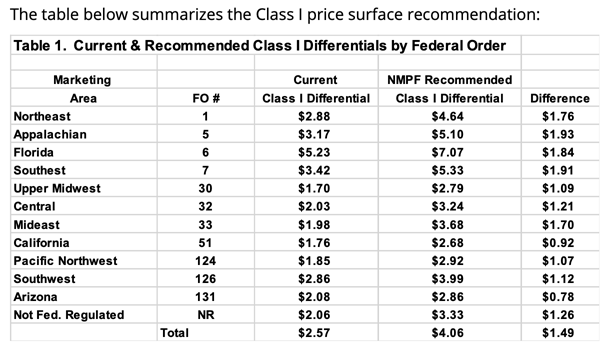
As one would expect, increasing Class I differentials impacts various regions of the country differently. Servicing Class I markets continues to be a challenge especially in certain regions of the country. Despite all of the complexities in developing the Class I price surface recommendations, the Regional Working Groups along with the Task Force considered and evaluated many factors throughout this extensive analysis in order to achieve the right balance between the various orders.
In addition to the previous five recommendations, NMPF will pursue two additional components of its proposal outside of the federal order hearing process, as they don’t involve changing federal order regulations. The recommendations, which are also essential parts of NMPF’s FMMO modernization plan, are:
6. Seek authority in the Farm Bill to ensure manufacturing allowances are reviewed more frequently
This includes enacting legislation to require USDA to conduct regular, mandatory and auditable processing plant cost studies every two years and to report the results. This would provide information necessary for the industry to consider requesting a hearing to update federal order formula make allowances and yield factors based on more accurate and timely data. Current FMMO make allowances have not changed since 2008, while costs of manufacturing dairy products used in the FMMO component price formulas have increased. The problem of maintaining proper make allowances in the FMMO pricing formulas is exacerbated by the persistent lack of accurate information relative to costs of manufacturing dairy products.
7. Extend the current 30-day reporting limit to 45 days on forward priced sales of NFDM and dry whey, through amending the mandatory price reporting program regulations
Increasing the number of reporting days on these two products will increase the representation of exported volumes of both NFDM and dry whey while still keeping the reporting limit narrow enough to ensure the reports represent current prices.
Conclusion:
Now that the dairy producer community has achieved a consensus in developing the package of proposals, and NMPF has officially submitted its request for USDA to conduct a national FMMO hearing, our work is still not complete. We will need to prepare and make the best case possible before USDA. The path to modernize the FMMO system is lengthy, tedious, and technical, but at the end, dairy farmers and the entire dairy industry will benefit from a job well done.


Be the first to comment