
The T.C. Jacoby Weekly Market Report Week Ending December 3, 2021
Churns made just 159.4 million pounds of butter in October, down 1.6% from a year ago. Stiff competition for cream and supply chain tangles likely kept a lid on output in November as well.
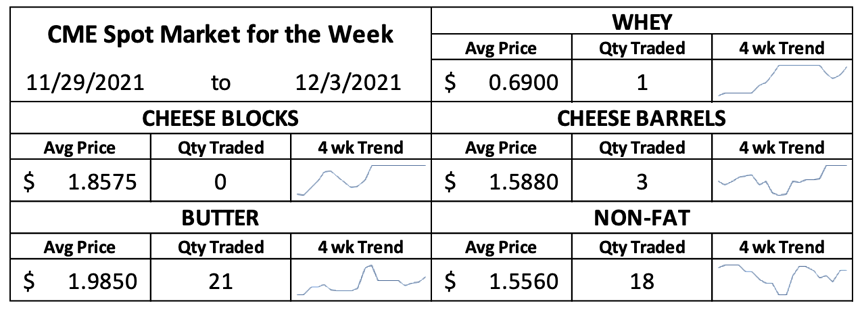
Less milk means less butter. Churns made just 159.4 million pounds of butter in 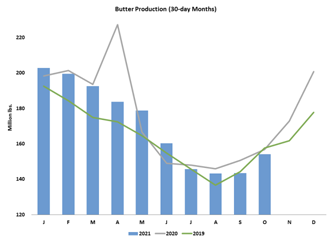 October, down 1.6% from a year ago. Stiff competition for cream and supply chain tangles likely kept a lid on output in November as well. USDA’s Dairy Market News notes that in the East, “widespread logistical issues, including driver shortages and delivery delays, pose a greater hindrance to cream-based operations than tighter cream availability does.” Butter stocks are falling seasonally, and prices are on the rise. CME spot butter climbed back over the $2 mark today and closed at $2.0025 per pound, up 1.25ȼ for the week.
Driers also ran lighter in October. Combined production of nonfat dry milk (NDM) and skim milk powder (SMP) totaled 183 million pounds, down 10.5% from October 2020. Despite all the headaches required to get goods from here to there, manufacturers kept product moving. Stocks waned for the fourth consecutive month, dropping to 221.7 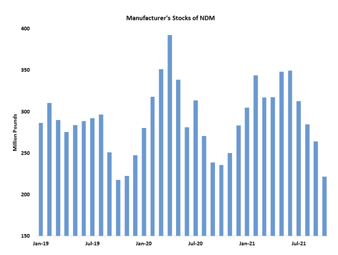 million pounds on October 31, down 5.9% from last year. This summer, manufacturers’ stocks of NDM bordered on burdensome. Now, they stand at two-year lows.
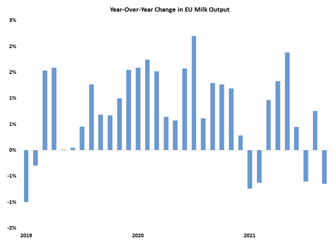
Some processors are concerned that high prices will deter milk powder buyers, but those who need the product don’t have many other places to turn. October milk collections were down 2.1% year over year in Australia and down 3.1% in New Zealand. European milk output fell 0.6% from yearago volumes in September and was flat in the third quarter. Just like their peers in the United States, European manufacturers are keeping cheese vats full, while churns and driers do without. Compared to the first nine months of last year, European cheese production is up 2.3%, while SMP output is down 3.6% and butter lags last year by 1.3%.
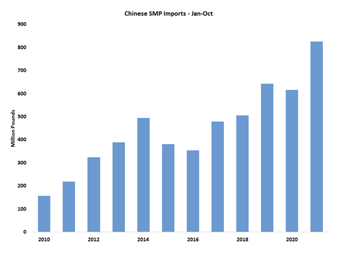
 Meanwhile, global demand for milk powder remains firm. Dairy Market News reports that North African buyers are trying to nail down 2022 contracts with European processors, but merchants in Europe are holding back, uncertain that they’ll have enough milk to meet big commitments. SMP supplies are also “tighter than desired” in Oceania as China just keeps buying. China imported another 72 million pounds of SMP in October, bringing year-to-date imports to a record smashing total, up 34% from a year ago.
Global SMP prices are high and holding. In Chicago, CME spot NDM held steady this week at $1.5625. The futures rallied. With both butter and milk powder futures on the rise, most Class IV contracts for 2022 climbed by double digits. The futures project that Class IV milk will average $19.50 per cwt. next year.
 CME spot Cheddar blocks didn’t move at all this week. They sat at $1.8575. Meanwhile, barrels leapt 7.75ȼ to $1.6025. Cheese production remains heavy, but Cheddar output slipped 1.4% from the very high volumes of a year ago. U.S. cheese production reached 1.15 billion pounds in October, up 0.9% from last year. Italian-style cheese output jumped 3.5% year over year.
Whey product output surged in October. Output of whey protein concentrates (WPCs) was 13.8% greater than a year ago, and production of whey protein isolates (WPIs) grew 5.3%. Over the past six months, high WPC and WPI output has kept commodity whey 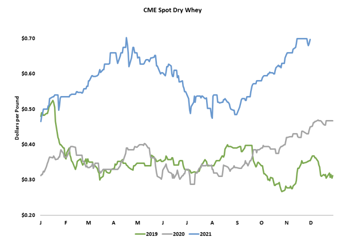 production in check. But dry whey output was also strong in October, up 3.9% from last year. Nonetheless, whey stocks fell from already low levels. Spot whey slipped a fraction of a cent this week to 69.75ȼ. This year, high whey prices have added more than $1.30 per cwt. to the Class III price, compared to 2020 whey values. Class III futures rebounded this week, with most contracts gaining roughly 20ȼ. The December contract stands at $18.60, and the futures call for Class III to average $18.99 in 2022.
Crops in central Brazil continue to thrive, thanks to regular rains. But southern Brazil and Argentina are trending dry, which is causing concerns about crop conditions there. Some of the crop isn’t even in the ground yet, so it’s a bit early to declare disaster. Indeed, Argentina’s statistics agency reports that just 31% of corn acreage is planted so far, and it describes excellent conditions for the corn already in the ground. But it’s a La Niña year, and the market seems inclined to price in a lot of weather risk until it is proven wrong.
Original Report at: https://www.jacoby.com/market-report/less-milk-leads-to-less-butter/

Be the first to comment