
The T.C. Jacoby Weekly Market Report Week Ending May 28, 2021
Spot milk values in the Upper Midwest fell hard this week, making clear that milk is abundant. Steep discounts on spot milk incentivize cheese producers to squeeze in extra loads. Given these discounts and expansions in cheese processing capacity this year, we’ve been making massive volumes of cheese.
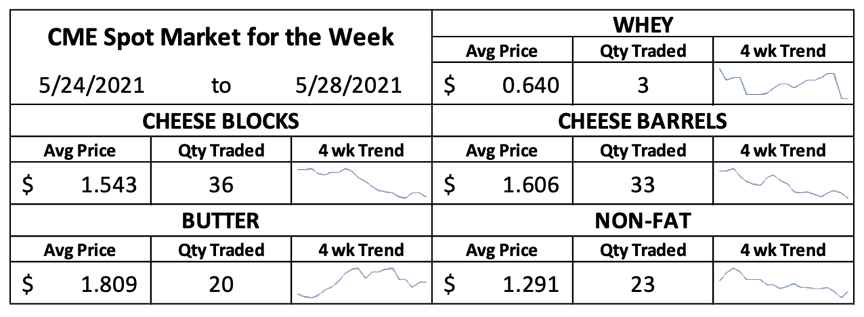
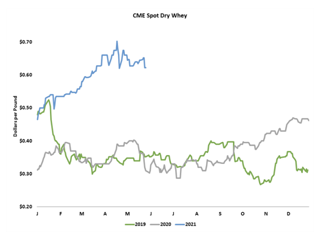 The Class III markets weakened as they headed into the long weekend. Spot whey, the unsung hero in the Class III complex this year, took a sizeable step back. It closed today at a fiveweek low of 62.25ȼ per pound, down 2.25ȼ since last Friday. Whey values had climbed high enough to deter some domestic buyers, so a setback was likely warranted. But exports are still moving, and stocks remain relatively tight, so further downside may be limited.
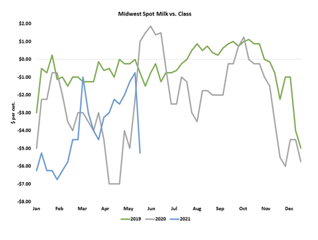 Spot milk values in the Upper Midwest fell hard this week, making clear that milk is abundant. Steep discounts on spot milk incentivize cheese producers to squeeze in extra loads. Given these discounts and expansions in cheese processing capacity this year, we’ve been making massive volumes of cheese. Even so, cheese stocks declined last month, falling nearly 16 million pounds to 1.45 billion pounds. This marks the first time since 1993 that cheese inventories retreated in April, confirming reports of very strong sales to foodservice. It’s likely that restaurants were restocking their larders, and that some of this cheese simply moved from a warehouse to a refrigerator, with no change in net
 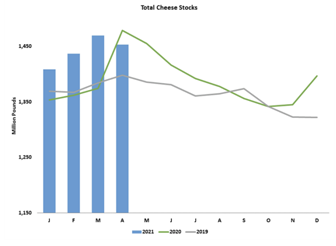 cheese consumption. The spot market suggests that this is the case. Spot cheese values held firm in March and April, as many restaurants opened their doors for the first time. But more recently, cheese values have tumbled. CME spot Cheddar blocks fell 4ȼ this week to $1.53, just a couple cents above the calendar-year lows. Barrels dropped 3.75ȼ to $1.57.
Dragged down by both cheese and whey, Class III futures finished deep in the red. June Class III fell 89ȼ to $17.24 per cwt. Second-half futures fell by an average of 38ȼ. All second-half contracts stand well above $18. Class IV futures rallied today, but they still finished the week lower than where they began. June Class IV settled at $16.70, down 30ȼ from last Friday. Second-half futures fell by an average of 26ȼ. They range from $17.03 to $17.85.
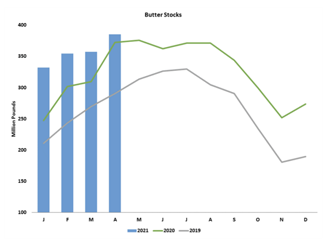 CME spot butter fell 6ȼ to $1.81. Butter inventories grew by a smaller than typical margin in April. Still, at 385 million pounds, stocks are up 3.4% from April 2020, when inventories were already elevated due to the advent of Covid-19 lockdowns. Butter stocks have not been this large in April since 1993.
Between the flush and the holiday, dryers are running hard. Domestic demand for milk powders has softened, but exports are still going strong, particularly to Mexico. CME spot nonfat dry milk (NDM) fell a half-cent this week to $1.2925.
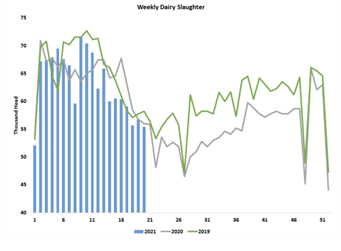 Dairy slaughter remains light, which suggests that the herd continues to expand. For the year to date, dairy producers have culled 1.4% fewer milk cows than they did in 2020. Eventually, high feed costs might slow growth in U.S. milk output. But there is no sign that it’s happening yet.
The corn market collapsed on Tuesday amid rumors that Chinese importers had cancelled orders for U.S. corn. As the market crashed through important points on the chart, the selling accelerated, and investment funds dumped their positions in a hurry. But later in the week, once the trade had a chance to better understand the relatively small scope of the Chinese cancellations, corn futures came roaring back. For the next few months, exporters, feed vendors, and ethanol processors will compete for the same scarce supplies, which is likely to keep a floor under
The fate of December corn futures depends on the size of the corn crop. Farmers likely planted more acres than they planned to in March, so the trade will spend the next few months assessing just how much ground corn has gained. Rains this week favored the young crop, but there is a lot of growing season – and weather risk – ahead. December corn settled at $5.455, a penny lower than last Friday.
The bean market also swung wildly back and forth this week. It ultimately closed about four cents higher than last Friday, at $15.305.
Original Report at: https://www.jacoby.com/market-report/milk-is-abundant-prompting-massive-volumes-of-cheese/

Be the first to comment