

Though its official name – the Temporary Non-Agricultural Workers Program – says otherwise, the H-2B visa program provides workers who are vital to numerous sectors of agriculture, including those who are involved in the direct production of nursery, forestry and seafood products. These industries must, however, compete with a whole slew of other fields for a limited number of visas. The H-2B visa cap creates another barrier to ensuring seasonal labor across industries that already suffer from proven labor shortages.
Overview of the H-2B Program
Furthermore, H-2B workers must not adversely affect the wages of similarly employed domestic workers. However, rather than setting a predefined adverse effect wage rate, which is the standard for the H-2A program, employers utilizing H-2B labor petition the U.S. Department of Labor (DOL) to be assigned a prevailing wage rate, or pay the state or federal minimum wage if it is higher. The prevailing wage is the mean wage in the Bureau of Labor Statistics (BLS) Occupational Employment and Wage Statistics (OEWS) for the position and geographic location of the petition.
H-2B in Agriculture
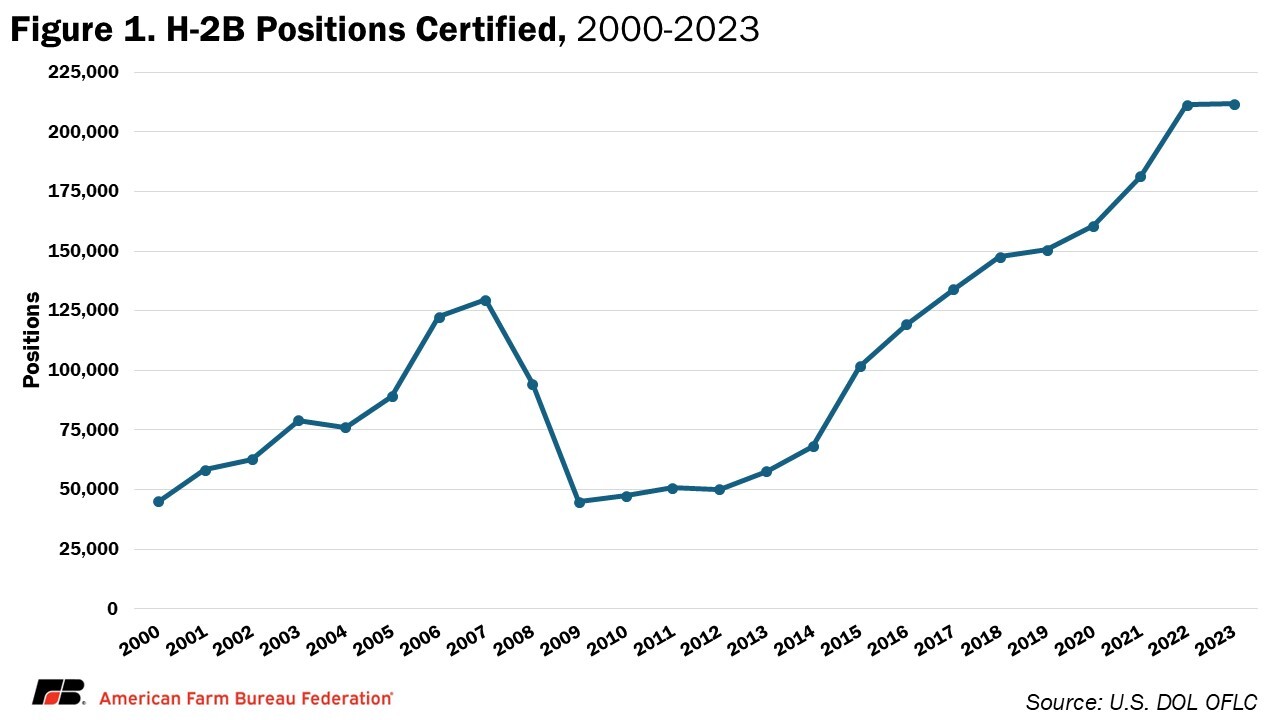
Access to the H-2B program is one way the agricultural supply chain can find an efficient, trained workforce. Nearly 60% of the H-2B positions certified in fiscal year 2023 were employed by segments of the agricultural supply chain, from processing to final retail. When including food service, agricultural supply chain positions take six of the top 10 H-2B occupations.
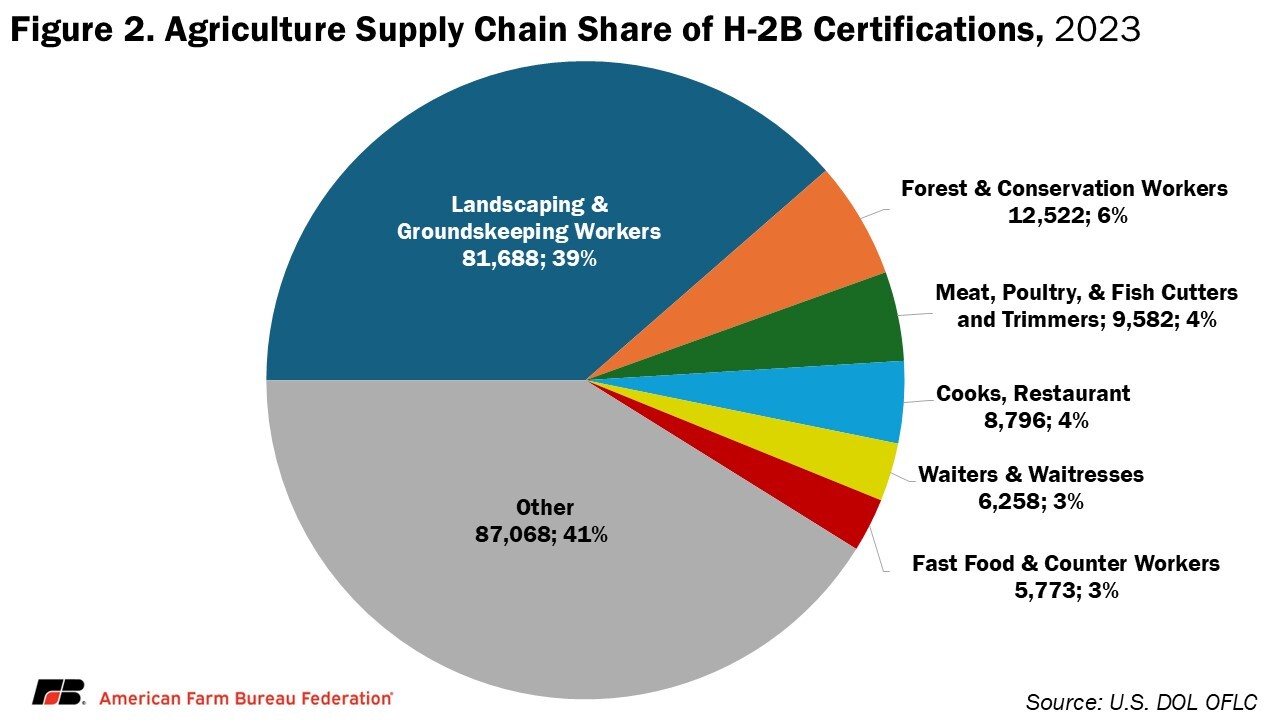
Landscapers and groundskeepers are the top occupations in the H-2B program, making up nearly 40% of all positions. These are closely integrated with the nursery and greenhouse industries. Some nurseries provide landscaping services directly, but even if they do not, landscapers and groundskeepers are significant consumers of horticulture products. In instances where a nursery provides landscaping services, individuals responsible for the cultivation of nursery goods to be sold may be H-2A agricultural workers, while the ones incorporating them into landscaping on private properties may be H-2B “non-agricultural” workers.
Nearly 10,000 H-2B workers are employed in the animal processing sector – the fifth-largest program occupation – helping to maintain U.S. meat, poultry and fish processing capacity, to the benefit of farmers, ranchers and fishermen. Labor shortages in meat processing during the COVID-19 pandemic displayed the harmful effects insufficient labor can have on the entire supply chain, constraining processing capacity, driving up consumer prices and driving down prices for livestock whose excess supply cannot be harvested. H-2B was a valuable resource during this uncertainty; 8,486 meat, poultry and fish cutters and trimmers positions were certified in fiscal year 2019, but that number jumped to 11,059 in fiscal year 2020 and 17,754 in fiscal year 2021 as the processing sector recovered from the interruptions. This variation displays the importance of temporary, nonimmigrant work programs not only in expected shortages, but also when responding to irregular labor scarcities.
Program Limitations
The most critical difference between the H-2A and H-2B visa programs is that H-2B visas are capped annually. Only 66,000 H-2B petitions may be accepted in a fiscal year, to be split evenly between the first and second halves of the year, starting Oct. 1 and April 1, respectively. Fish roe processors, technicians and supervisors employed throughout the U.S. and anyone employed in the Northern Mariana Islands or Guam until Dec. 31, 2029, are exempt from the cap to promote economic growth in these markets. This cap also does not apply to H-2B workers currently in the U.S. petitioning for changes in their visa terms such as extension of stay, change of employer or change in employment terms. A single petition toward the 66,000-petition cap may include up to 25 individual workers employed for the same services, location and time frame. Employers in the seafood industry, however, have an exemption that allows them to stagger their workers’ entry up to 120 days from the designated start date if they agree to conduct additional domestic worker recruitment.
These caps are typically reached very early into the application cycle. As of Sept. 18, 2024, all visas have been allocated for the first half of fiscal year 2025. Due to the high demand for H-2B workers, applications are randomly processed by the U.S. Department of Labor (DOL) in order of work start date. So, applications with a start date of Oct. 1 or April 1 for their respective application cycle have priority for processing. This can leave a shortage for industries that need later-season labor – including farms that may hire H-2B construction workers in the off-season to repair infrastructure or perform farm maintenance. If an application makes it through the DOL lottery, they enter a visa lottery conducted by the U.S. Citizenship and Immigration Services (USCIS).
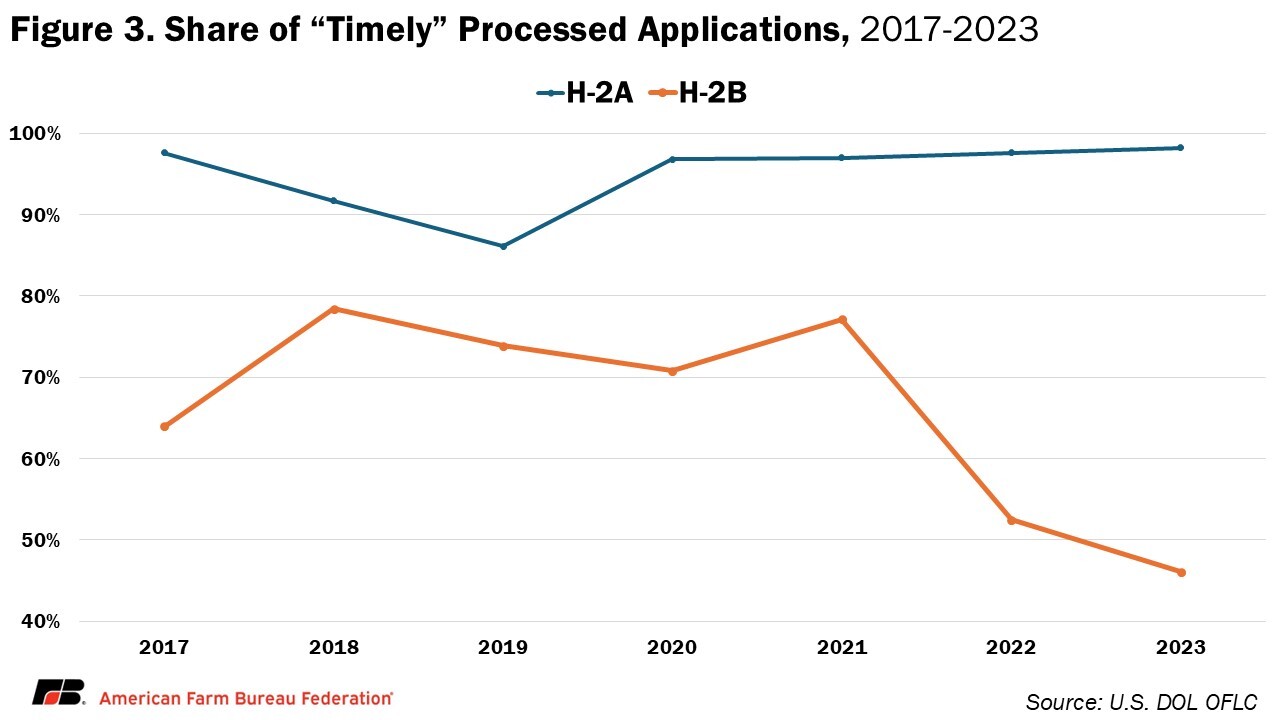
Another challenge to using the H-2B program is the slow speed at which the visa petitions are generally processed by DOL. An application process is considered “timely” if the position is certified by DOL within 30 days – not including the additional time needed to move through the visa process with USCIS and the U.S. State Department. While more than 90% of H-2A applications are processed within 30 days, H-2B applications were only processed timely on average 66% of the time over the past seven years. This share has dropped over the past three years, from 77% in fiscal year 2021 to only 46% of applications in fiscal 2023. Application approval time also varies drastically depending on the quarter of the year. The third quarter (April through June) has the lowest timely approval rate – only 1% in fiscal year 2023 – likely due to exceeded caps.
Opportunities for Relief
There is a long history of providing temporary relief from the H-2B statutory cap. In fiscal years 2005, 2006 and 2016, returning worker exemptions were enacted in Congress for anyone who had received a visa in the past three fiscal years from counting toward the visa cap. In fiscal year 2017, the congressional approach for H-2B cap relief changed. In each appropriations package since, Congress has authorized the Secretary of the U.S. Department of Homeland Security (DHS), who oversees USCIS and visa processing, in conjunction with the Secretary of DOL to make additional H-2B visas available. This tradition has continued under the FY2025 Continuing Appropriations and Extensions Act. The Secretary may raise the visa cap up to “the highest number of returning workers in any such fiscal year in which returning workers were exempt from such numerical exemptions.” For example, 69,320 H-2B visas were issued to returning workers in 2007, so that is now the maximum additional visas the secretary may offer in fiscal year 2025. However, this relief also typically comes with some restraints: 19,000 of the additional 64,716 visas made available in fiscal year 2024 were reserved for returning workers, and 20,000 visas were to be granted exclusively to citizens of El Salvador, Guatemala, Honduras, Haiti, Columbia, Ecuador and Costa Rica despite the majority of H-2B workers being from Mexico.
Conclusion
Although officially named the “Temporary Non-Agricultural Workers Program”, the H-2B visa program might be more aptly named the “Temporary Non-Farmworkers Workers Program”. H-2B workers are valuable to many industries, including the agricultural supply chain. The demand for this program well outpaces the supply set by the statutory petition cap, as shown by the closing of application cycles well before the start of the work period. A bipartisan effort has risen from the U.S. Senate to urge the Secretary of Homeland Security to raise the H-2B cap for fiscal year 2025. These temporary workers are vital to ensuring sufficient labor across the entire economy, including the agricultural supply chain.


Be the first to comment