
Read the latest issue of Dairy Market Drivers, a bi-weekly report from IDFA partner Ever.Ag. Dairy Market Drivers features spotlight data, key policy updates, and a one-minute video that covers timely topics for the dairy industry.
Dairy Market Drivers: SNAP Program Driving Dairy Demand; an Update on U.S. Cheese Exports; and Inflation in a Minute!
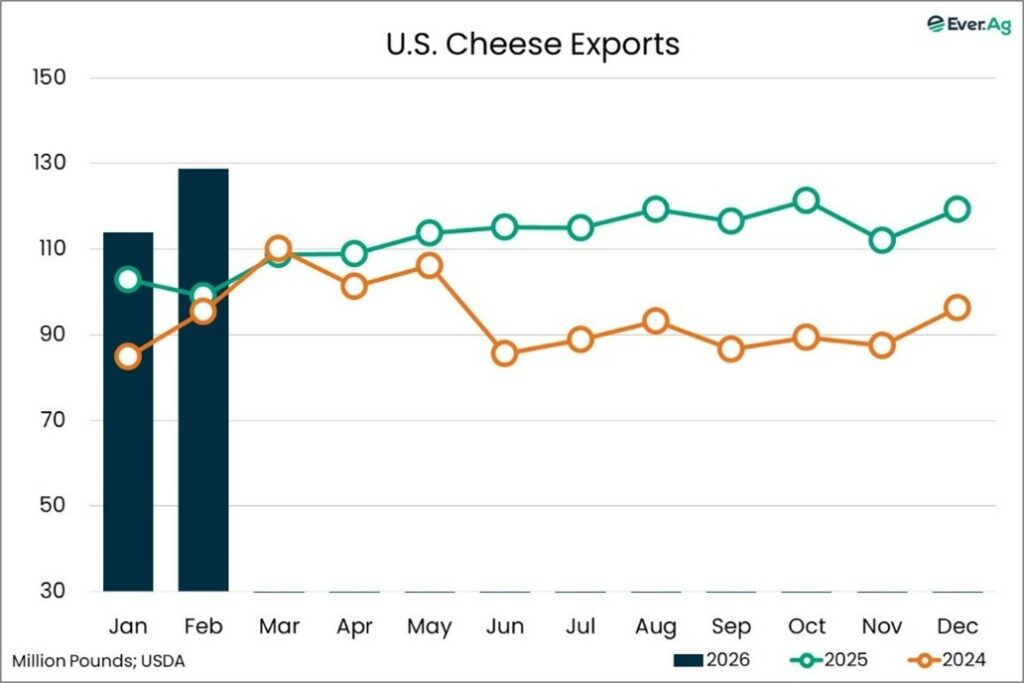
Quick Bites: Cheese Exports Hit New High
- The U.S. exported 129 million pounds of cheese in February – a new single-month record for U.S. cheese exports. And that was during the shortest month of the year! Shipments were up 30% from the prior February, with 30 million additional pounds of U.S. cheese exported.
- Mexico is the biggest buyer of U.S. cheese, and February sales reached a record high there, too. Nearly 46 million pounds were purchased by our neighbor to the south.
- Volume to Latin America (not including Mexico) topped 28 million pounds, 41% higher year-over-year. Most of that volume moved into Central America, with Guatemala receiving 6 million pounds. Another noteworthy customer, Japan, increased shipments in February by 67% to reach nearly 11 million pounds.
- Competitive prices keep U.S. cheese moving overseas. In early April, U.S. cheese averaged $1.63 per pound. That compared to $1.86 per pound in Europe and $2.16 in New Zealand. With continued growth in U.S. milk production and cheese processing capacity, export demand is the main puzzle piece that keeps inventory from building and prices from slipping further.
Today’s Special
-
The Supplemental Nutrition Assistance Program (SNAP) remains the nation’s largest federal nutrition program and a major driver of retail dairy demand. But fewer Americans are receiving food benefits from SNAP these days.After averaging 42.1 million monthly participants in FY2025 (October 2024 – September 2025), by December enrollment had declined by 2.5 million people (6%) since July and 3.4 million (8%) year over year.
- Overall program spending and household buying power is also decreasing. In FY2025, SNAP spending totaled approximately $101.7 billion, down from pandemic-era levels that exceeded $135 billion. And with pandemic-era benefit enhancements now fully phased out, average SNAP benefits were approximately $188.45 per participant per month.
- Recent federal changes are expected to reinforce this downward trend. New eligibility, work requirement and state administrative cost-share provisions are expected to continue reducing participation and aggregate grocery purchasing power over the next several years.
- Healthy Fluid Milk Incentives (HFMI) Projects are stretching SNAP dollars further when participants purchase qualifying milk at participating stores. USDA awarded Auburn University a nearly $3 million grant to expand the HFMI program in 2026.In just six years of the program, HFMI projects have reached 1,270 retail stores in 33 states.
- The program is working. Purchases of skim and 1% milk by SNAP households at participating locations rose 72% from fiscal year 2024 to fiscal year 2025. Between May 2023 and September 2025, SNAP households utilized $2.39 million in program incentives.
- At the same time, state SNAP restrictions are accelerating. Nearly two dozen states are expected to have approval to test restrictions on purchases by the end of 2026. As states increasingly pair restrictions on low-nutrient products with incentives that encourage healthier choices, dairy remains well positioned as a nutrient-dense, affordable option that aligns with the program’s evolving direction.
Be the first to comment