
The T.C. Jacoby Weekly Market Report Week Ending July 16, 2021
Manufacturers report that cheese demand is robust and that spot milk for manufacturing is available and affordable. While cheese manufacturers would be keen to capitalize on the available milk, a plethora of issues are complicating operations and preventing additional output.
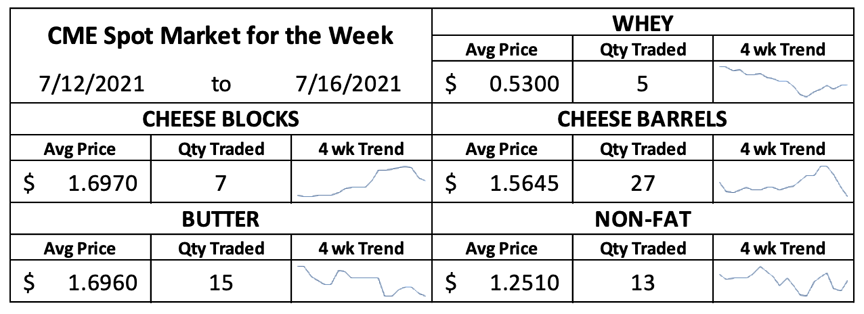
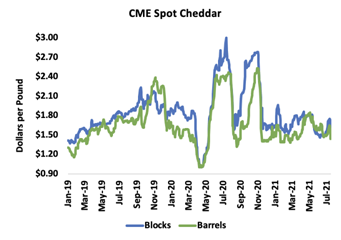 Following last week’s rally, spot cheese markets buckled under the pressure of higher prices. After making one final upward effort on Tuesday, cheese prices deteriorated over the balance of the week, including a particularly precipitous loss on Thursday. Cheddar blocks ultimately gave up 11¢ versus last Friday to close the week at $1.615 per pound, with a modest seven loads trading hands. Meanwhile, barrels sacrificed 14¢, ending the week at $1.44 per pound, a 17.5¢ discount to blocks and the lowest price since late March. The spot losses weighed heavily on Class III milk futures with some contracts moving limit down on Thursday.
Firstly, continued scarcity of inputs, namely a lack of boxes for 640-lb. Cheddar blocks are narrowing the production options for cheese manufacturers. Secondly, widespread labor shortages, affecting all corners of the dairy industry, are preventing cheese and other dairy product manufacturers from operating at full capacity. If processors are able to get product made, they are running into logistical issues including a dearth of truck drivers and port congestion. This has caused product to back up in warehouses, limiting storage space, and ultimately impinging on production schedules. These wrinkles will have to be ironed out before manufacturers can capitalize on the available milk supplies.
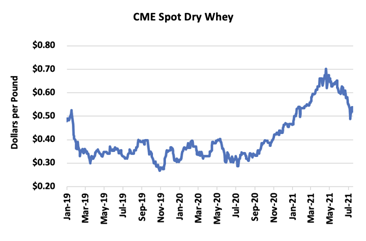 The tone in the whey markets was mixed this week. At the CME, spot dry whey resisted the weakness seen in the cheese market and despite a brief dip on Wednesday, stayed relatively strong, ending the week at 53.75¢ per pound, an increase of 3¢ versus last Friday. However, market participants report that prices are softening across the country as ample cheese manufacturing and diminishing export demand has created plenty of supply. Though higher protein products like whey protein concentrates and whey protein isolates continue to disproportionately attract the whey stream, dry whey production is reportedly sufficient to meet buyers’ needs.
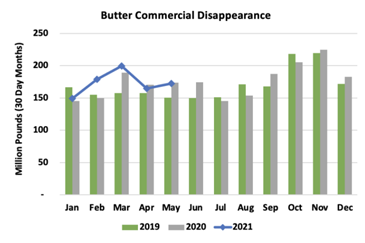 In the Class IV complex, spot butter prices found some strength early in the week before slipping once again on Thursday and Friday. CME spot butter closed the week at $1.6775 per pound, just a quarter cent higher than last Friday. Cream supplies are lighter, particularly in Western states, but flat to slightly reduced demand has prevented tension from building in the market. Commercial disappearance of butter was higher in May than in April on an average daily basis, and remains elevated by historical standards, but sat 1% below the same month last year.
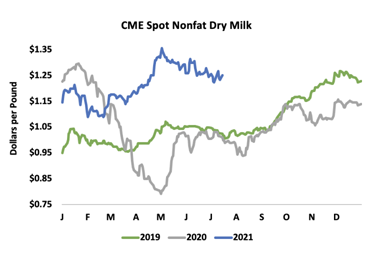 Even in the face of mounting inventories and slowing international interest, nonfat dry milk (NDM) markets continue to demonstrate surprising resilience. Condensed skim production is slowing seasonally with labor and transportation issues creating hiccups across the value chain. At the CME, spot NDM saw prices lose momentum over the majority of the week before finding renewed strength to rise 2.5¢ on Friday, closing the week at $1.2525 per pound, a quarter penny higher than last Friday.
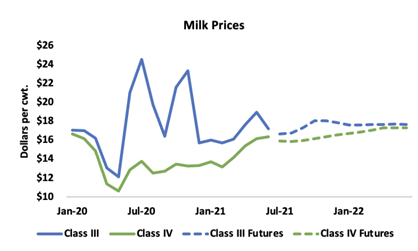 Milk production is declining as seasonal fluctuations and heat related impacts weigh on output. Nevertheless, milk remains more than available to cover needs in most areas of the country. Class I sales are seasonally light though market participants are looking for the pull from educational institutions to perk up in the near future as the start of the new school year is around the corner. Heat related impacts on milk production have been felt heavily in many areas of the country, especially the Pacific Northwest, and though recent weeks have brought some respite, producers in the affected areas are once again bracing themselves for hot summer temperatures.
The balance sheet for soybeans included in the WASDE report remained unchanged, though USDA did also decrease the average farm price by 15¢ to $13.70 per bushel for the 2021/2022 crop year. Global soybean projections were also left largely untouched.
Corn and soybean futures markets rallied early in the week, emboldened by the WASDE report and concerning weather forecasts. Despite relaxing on Thursday most nearby corn futures contracts settled the week at least 10¢ higher on Friday than on Monday, while each of the remaining 2021 soybean contracts saw gains above 40¢.
Original Report at: https://www.jacoby.com/market-report/spot-cheese-markets-buckle-under-pressure-of-higher-prices/

Be the first to comment