
T.C. Jacoby Weekly Market Report
Week Ending March 13, 2020
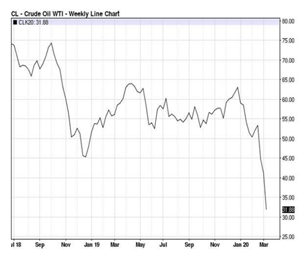 This was the worst week on Wall Street since 2008, and the major indices suffered their largest daily losses since Black Monday in 1987. At the closing bell, the S&P 500 Index settled 8.7% lower than last Friday. Oil futures plummeted more than 23%. Saudi Arabia and Russia are in a lose-lose face-off; both have abandoned oil production cuts and are now boosting output with abandon. They are in a bidding war for a larger share of a shrinking market.
Plunging stocks, cheap oil, and a strong dollar would normally spell disaster in the dairy markets. Indeed, there was a lot of red ink on LaSalle Street, but the damage was not nearly as extreme as feared. Losses in April through December Class III futures ranged from 13 to 50ȼ, posting declines of between 0.8% and 3.1%, respectively.
Class IV fared far worse, with most contracts 60 or 70ȼ in the red. April through December Class IV contracts suffered an average decline of 4% this week. The April and May contracts settled at 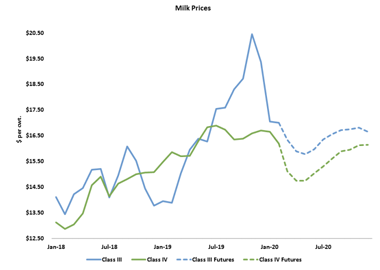 a disappointing $14.75 per cwt. Nearby contracts, which will most quickly translate into dairy producer milk checks, were the most resilient. March Class III futures slipped just 3ȼ to $16.34, and April closed at $15.90, down 13ȼ this week. At $15.11, March Class IV futures settled 44ȼ lower than last Friday.
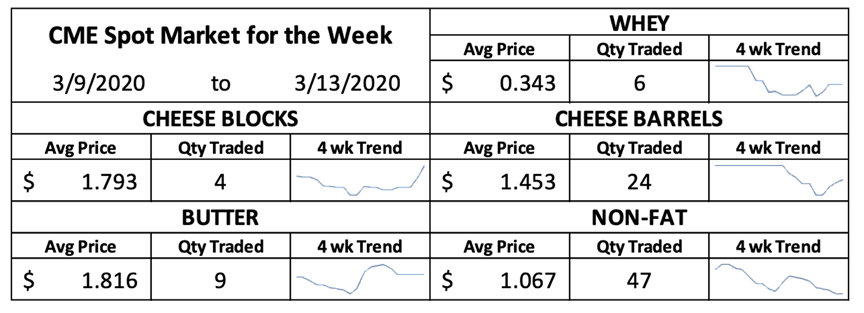
CME spot butter gave back some of its recent gains, slipping to $1.8125 per pound. That is 4.25ȼ lower than last Friday, but well above the trading range for much of the last month. Butter demand is ramping up, as befits the season. Retailers have stocked up on butter and they are advertising frequently to keep product moving. Due to the 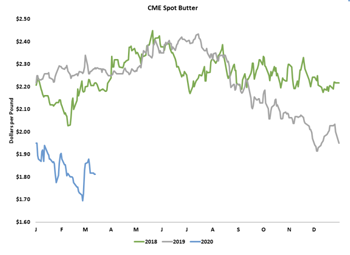 coronavirus (Covid-19), butter makers expect to lose sales from food service and restauranteurs while retail demand climbs.
Unlike butter, spot nonfat dry milk (NDM) is weighed down by both the virus and the calendar. Driers are running hard and the spring flush is accelerating. As consumers stock up on pantry items, higher packaged food sales could boost demand for domestic milk powder eventually. But export sales have dried up, and logistics are a major hurdle even for those export sales that are on the books. Buyers are ordering only enough to meet immediate needs and are mostly watching from the sidelines to 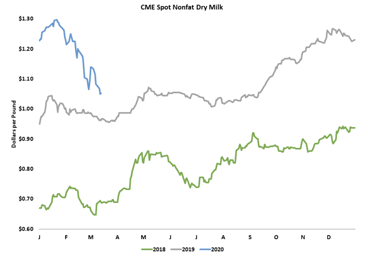 see how low prices will go. This week CME spot NDM slipped 6.25ȼ to $1.0525, a sixmonth low. Still, the world’s milk powder stocks are far from burdensome, and milk powder prices stand about a dime higher than they were a year ago.
The Class III markets had a relatively good week, all things considered. CME spot whey powder went nowhere at all and closed once again at 34.75ȼ per pound. That’s a victory when most other markets suffered a complete rout. Amazingly, CME spot Cheddar managed to gain ground this week. Blocks jumped an impressive 12.25ȼ to $1.8725. Barrels climbed 2.25ȼ to $1.50. Cheese demand has so far thrived amidst Covid-19. Pizza sales are going strong, with consumers preferring foods 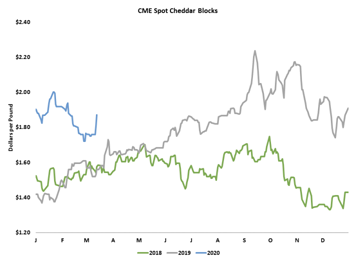 they can pick up or have delivered. And the grocery rush favors cheese as well. Retailers are hurrying to restock as the shelves are quickly emptied. Cheese is packed with protein and calcium, and offers a long shelf life in a convenient package. Consumers love it. A surge in retail sales is starting to tighten fresh supplies, as evidenced by the spot market. The uptick may be temporary, but it is having an impact.
Around the nation, conferences, concerts, and sporting events have been cancelled to slow the spread of Covid-19. Many schools and churches will be closed for a time. As consumers distance themselves from one another, they are likely to spend less time in restaurants and more time at home. There are a lot of dairy-laden foods – nachos,
If dairy product prices continue to languish, dairy producers are in for a rough few months, a situation that is unfortunately familiar. But it can’t go on forever. Sustained prices like these
Like nearly all other markets, the grains retreated this week. May corn settled at $3.6575 per bushel, about a dime lower than last Friday. At $8.4875, May soybeans finished 42.5ȼ in the red. May soybean meal closed at $299.50, down $5.60 per ton. New crop futures are similarly inexpensive, with December corn at $3.73 and November beans at $8.645. At those values, farmers are likely to plant a lot of corn this year, which suggests that, barring a crop problem, grain could get even cheaper.
Original Report at: https://www.jacoby.com/market-report/the-worst-week-on-wall-street-since-2008/



Be the first to comment