
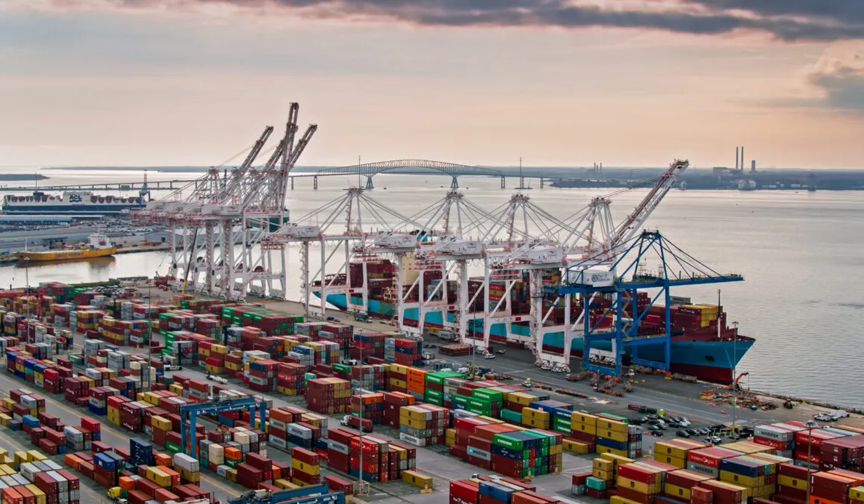
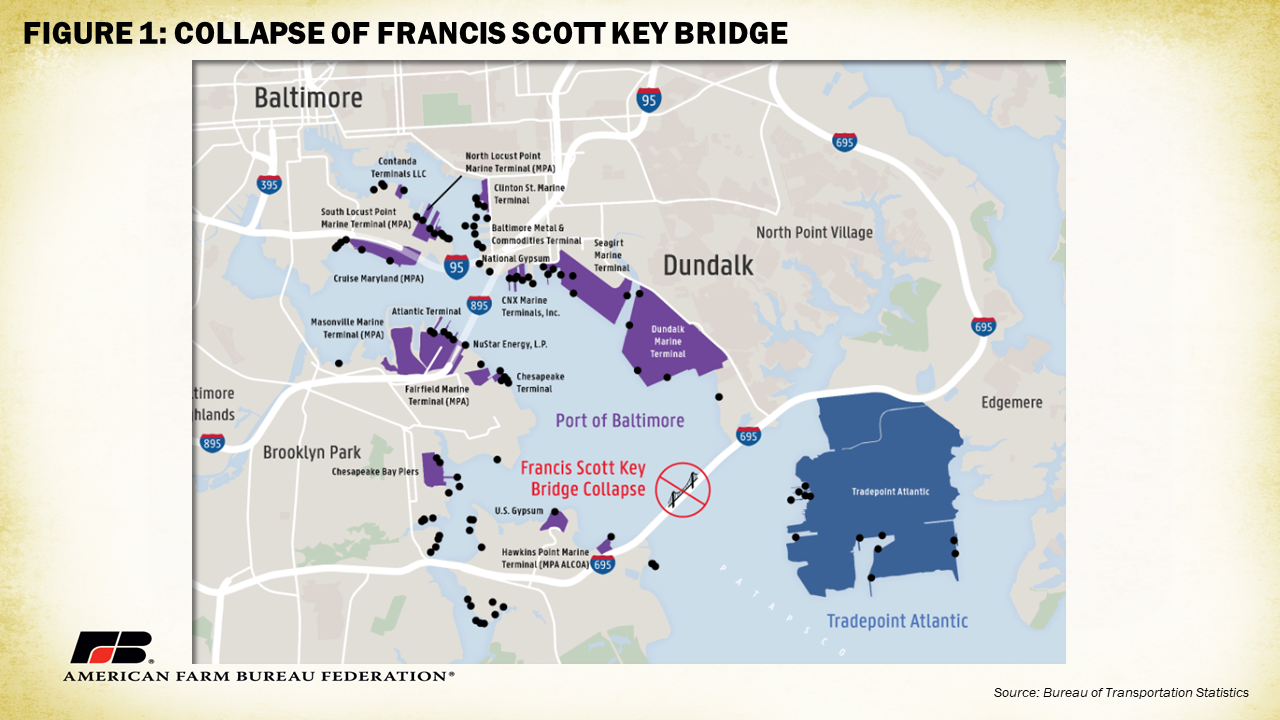
USDA’s Global Agricultural Trade System provides data on the quantity and value of agricultural trade to and from certain U.S. customs districts or locations where ag trade enters and leaves the country. Selecting Baltimore allows for the isolation of agricultural trade through Baltimore’s ports. While some product volume likely arrives in Baltimore via air, the vast majority arrives on cargo ships, providing a window into the importance of the Port of Baltimore to agricultural markets.
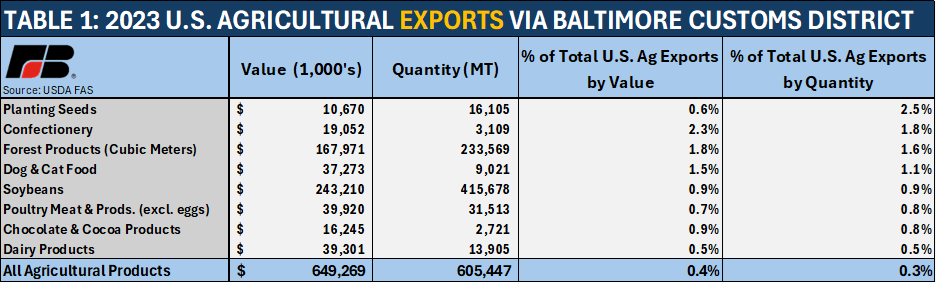
On the import side, in 2023, over 1.59 MT of agricultural products entered though Baltimore, corresponding to nearly $3.34 billion in value. By quantity, over 25% of all U.S. imported raw beet and cane sugar entered through Baltimore (562,000 MT valued at $391 million). Over $1 billion in forest products were imported through Baltimore in 2023 (1.98 million cubic meters), 3.7% of all imported U.S. forest products. Baltimore also serves as a significant receiver of industrial alcohols and fatty acids (11% of U.S. imports), spices (9.1% of U.S. imports) and coffee (6.2% of U.S. imports). In terms of quantity imported, the customs district of Baltimore ranks 18th (out of 41), right behind Duluth, Minnesota, and ahead of Ogdensburg, New York. The largest import origins for agricultural products entering Baltimore, by value, were Brazil, Indonesia and Spain.
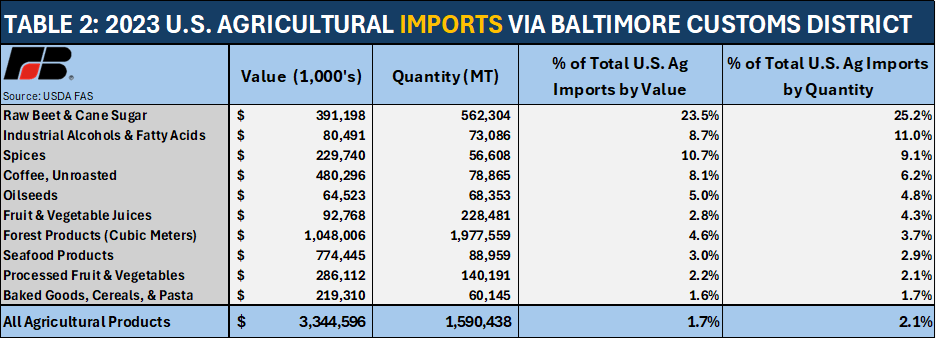
Baltimore has a fairly minor role, comparatively, in U.S. ag trade although its value in
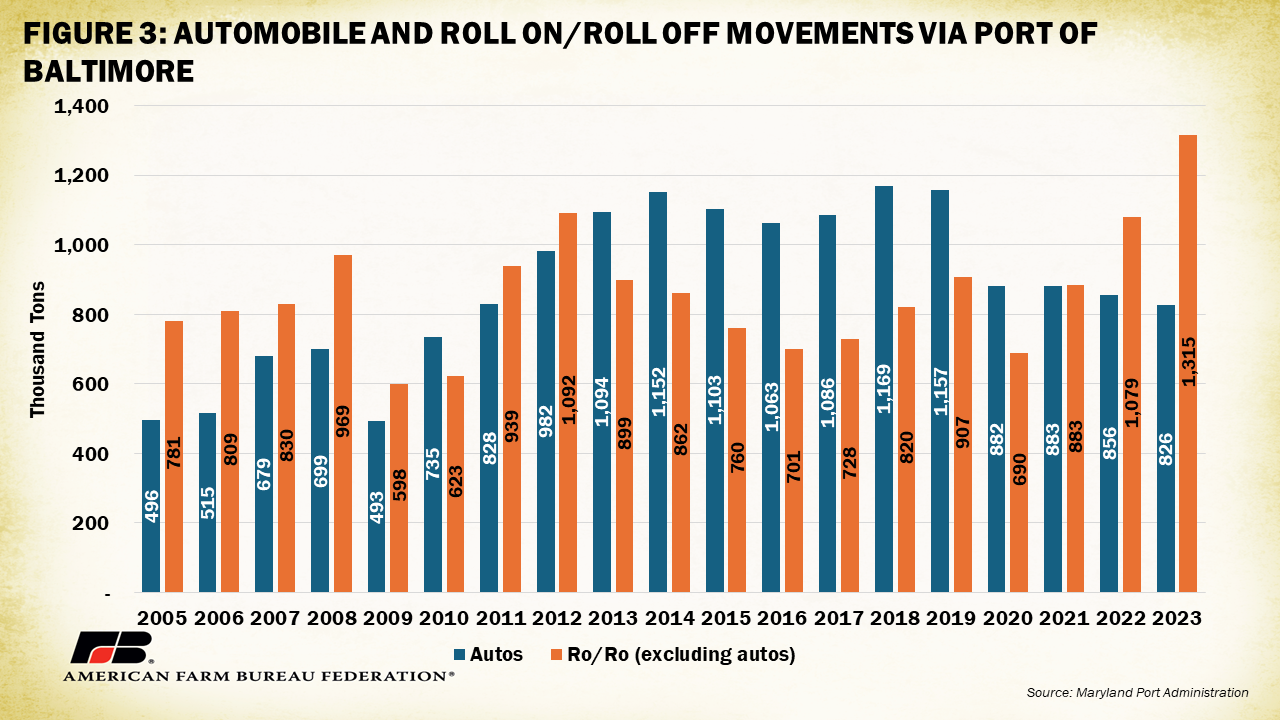
Of all ag-related businesses, sugar refineries appear to be the most exposed to possible negative impacts from the Port’s closure. Nearby refineries, however, have assured customers they had six to eight weeks of raw sugar on hand before operations could potentially be impacted. Ag equipment manufacturers may also face challenges. Roll on/roll off (Ro/Ro) vehicles which includes farm and construction machinery, are common passengers through the Port of Baltimore. Since 2010, over 600,000 tons of non-automobile Ro/Ro cargo have transited the port each year. Since 2022, the volume of Ro/Ro vehicles has even surpassed automobiles – one of the Ports most served industries (Figure 3). In 2023, over 1.3 million tons of Ro/Ro cargo crossed Baltimore terminals. The inability of farmers, domestically or internationally, to receive equipment they ordered could have a significant impact as spring planting season arrives. The Association of Equipment Manufacturers noted the port is a “very important part of our industry’s ability to ship equipment and equipment components all over the world” but also shared, “it is too early to predict the impact currently.”
Data on the impact to other important inputs, such as fertilizer, is limited. There was one report of a Urea Ammonium Nitrate vessel that was scheduled to unload in Baltimore. It is likely the vessel will be diverted to other nearby ports, perhaps to Chesapeake, Virginia, or Philadelphia. Supply chain issues usually lead to higher prices for goods, and it would not be surprising to see the local price of inputs tick up in response. Most farmers have likely already paid for their fertilizer supply for the year, but for those in the region waiting on shipments, diversions may cause headaches.
Summary
The collapse of Baltimore’s Francis Scott Key Bridge following a container ship collision shocked the nation and tragically claimed the lives of six people. Farmers and ranchers across the country joined many others in praying for the families affected. In the aftermath, questions have emerged about the potential impact on agricultural markets. The Port of Baltimore is responsible for moving 0.3% of U.S. ag exports and 2.1% of imports, meaning its impact on overall U.S. ag trade is quite minor. Despite its limited role, its significance in providing access to international markets for businesses, including farmers, should not be minimized. Industries reliant on the port, such as sugar refineries and ag equipment manufacturers, appear to face more imminent challenges, while longer term supply chain disruptions may lead to increased prices and logistical hurdles for farmers awaiting inputs. Thankfully, the global freight network has become accustomed to uncertain shipping conditions, allowing it to adapt effectively to such situations.
Be the first to comment