
In response to the COVID-19 pandemic that has roiled the U.S. economy, the Senate passed the Coronavirus Aid, Relief, and Economic Security Act. In addition to direct
For the agriculture-related provisions, the Office of the Secretary of the Department of Agriculture received $9.5 billion, approximately 19% of the total food and agriculture provisions, to provide financial support to farmers and ranchers impacted by coronavirus. The funding is allocated specifically for specialty crops, producers who supply local food systems and farmers’ markets, restaurants and schools, livestock producers, i.e., cattlemen and women, and dairy farmers.
In addition to the $9.5 billion, the Commodity Credit Corporation was replenished with $14 billion – 29% of the total funding amount for agriculture. The CCC is the funding mechanism for agricultural programs such as Price Loss Coverage and Dairy Margin Coverage. The CCC bolsters commodity and income support programs, natural resources conservation programs, disaster assistance programs and most recently the Market Facilitation Program. The $14-billion replenishment is for fiscal year 2020, so that’s in addition to the second and third tranche of MFP payments, as well as farm bill payments made last fall. This replenishment will allow USDA to develop new support programs to assist agricultural producers and potentially help agribusinesses such as ethanol plants (Ethanol Plants Pushed Toward Unprofitability).
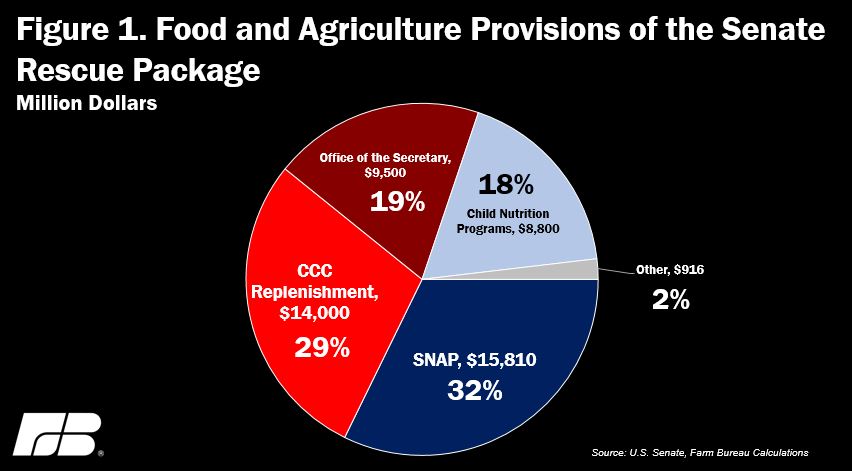

Direct food- and agriculture-related provisions in the CARES Act total approximately $49 billion, or 0.0245% of the $2-trillion measure. The act provides a total of $24.6 billion for
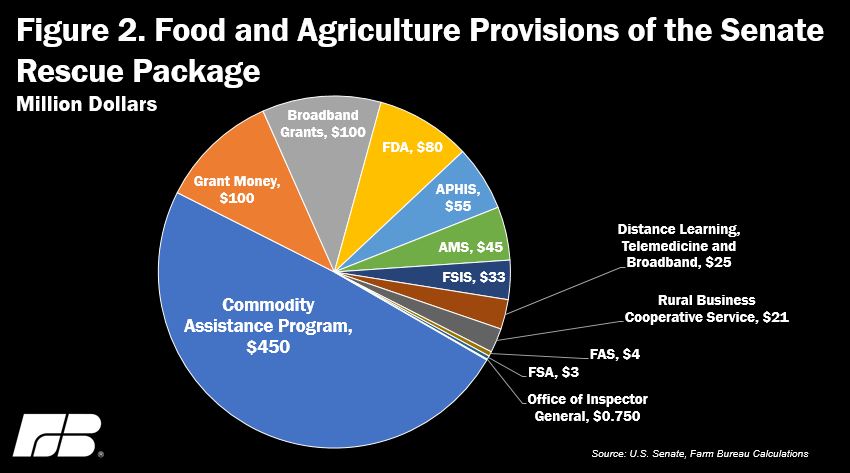
Combined, these four buckets represent 98% of the food- and agriculture-related provisions in the CARES Act. The remaining 2% of funding – approximately $916 million – is allocated for enhancing staffing and services in a number of key mission areas. The package includes funding for a variety of programs critical for rural America, including $100 million for USDA’s ReConnect pilot, $25 million for distance learning and telemedicine programs, $185 million to support rural critical access hospitals, rural tribal health and telehealth programs, and poison control centers, and $20.5 million to support an additional $1 billion of lending through USDA’s Rural Development, Figure 2.

Summary
The Coronavirus Aid, Relief, and Economic Security Act provides the financial resources
The COVID-19 pandemic is likely to have a long tail economically, and recovery will take time. The full extent of the economic damage to U.S. farmers, ranchers, agribusinesses and the many others involved in food production is unknown. Moreover, the ability for U.S. agricultural exports to recover and potentially meet the Phase 1 commitments is also unknown. If more resources ultimately prove necessary, our lawmakers and the administration have demonstrated their ability to make those resources available.
Be the first to comment