

Very dry conditions in the Western U.S. and most of Mexico are getting more attention. The concern is that drought could reduce milk production in both countries, which would mean Mexico would be looking to import more dairy products from the U.S. at a time when U.S. supplies may be tightening. Let’s start with Mexico.
Milk production growth used to be pretty volatile in Mexico, but since 2016 growth has been relatively steady in the 1.5-2.5% range. Roughly 50% of milk production happens in just four Mexican states; Jalisco, Coahuila, Durango and Chihuahua, which are all in the Northern half of the country. The graph below shows total Mexican cow milk production growth on a 6-month rolling basis along with the Palmer Drought Index (PDI) averaged across the four major milk producing states. The more negative the PDI is, the worse the drought is. Looking at the graph there seems to be some correlation between the drought index and production growth, but you can also pick out periods where the correlation broke down like 2012/2013 when the index was near –2 and milk production growth was running around +2%.
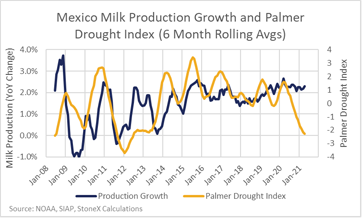
The other big divergence between the PDI and milk production has been during the past 10 months. The PDI has collapsed to –2 while milk production has stayed strong, over 2% growth. I tried building a few different models and statistically, the link between PDI and
When you think through how a drought will impact milk production, the lack of moisture is more of a problem for crops than cows, although hot weather could damage both. Presumably, drought conditions will reduce local feed supplies. Farmers will either have to buy more feed, or take a hit on milk production. In the models, Mexican production is sensitive to feed costs. A 10% increase in feed costs reduces production by about 0.25% with a six month lag. As we move through 2021 we should expect Mexican production growth to slow down, due both to the high feed costs and drought conditions in the country.
So, does that mean an increase in imports? Mexican imports fell hard in 2020, down almost 20%, mostly due to the pandemic. Imports in the first quarter of 2021 have improved, but with milk production growth running strong the past 2 years, Mexico is a little more self sufficient than they used to be. If total Mexican consumption gets back to 2019 levels, and milk production is up 1.8% this year, imports would only grow 11% and would still be below 2016 levels. It would take 2019 consumption levels and a 4.3% drop in milk production for the remainder of this year to get imports back up to 2019 levels. Between the weather and high feed costs we should see some slowdown in Mexican milk production, and hopefully consumption is rebounding, but imports are unlikely to get back to the peak 2019 levels.
Three-fourths of California is in severe drought. The Palmer Modified Drought Index hit –4.6 in April, the lowest it has been since the horrible 2012-2016 drought. It was a dry winter and reservoirs and snow pack are already at low levels despite the hottest and driest months still ahead of us. Statistically I was able to find a tighter relationship between the drought index and milk production in California than I was able to find for Mexico. I was able to build models that connected the PDI, milk price and feed costs to changes in milk production per cow as well as changes in the number of dairy cows in the state.
Statistically there is a long lag between drought conditions and impact on milk production with lags between 9 and 12 being the strongest. I think that makes sense. The drought conditions are likely going to impact feed availability and quality, and it will take some time for the crops to be harvested and eventually fed to the cows. For the past 12 months, milk production in California has mostly been running 1-2% above the previous year. The model is suggesting production growth should drop toward 0.5% during Q2, before running about 0.5% below last year during the second half of this year. I’m probably overly-optimistic on my drought assumption. I plugged in April as the low point for the PDI and a slow trend higher from there. If that happens, and if feed costs come down like the futures curve suggests, then we could get California production back above year ago by Q2 of next year.
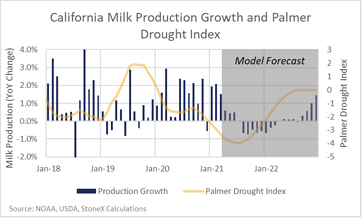
Compared to a scenario where there is no drought (PDI=0), the dry conditions knock about 0.8% off California milk production this year and 2% off next year. Since California accounts for about 18.5% of U.S. production, the drought in the state could hold back national production by a mild 0.15% this year, but 0.37% next year.
Editor’s Note: Nate Donnay is the Director of Dairy Market Insight at StoneX Financial Inc. and has been applying his interest in large complicated systems and statistical analysis to the international and U.S. dairy markets since 2005. He can be contacted at Nate.Donnay@StoneX.com
Be the first to comment