

About 90% of California’s dairy industry operates in the San Joaquin Valley. When California passed the Sustainable Groundwater Management Act (SGMA) in 2014, most of the Valley groundwater basins were designated as critically overdrafted. The Turlock and Modesto subbasins are the exception to that; they are designated as medium priority basins whereas the rest of the subbasins in the Valley are designated as high priority.
An incredibly significant, but often unappreciated result of SGMA is the collection and public reporting of annual data about water usage, groundwater pumping and changes in groundwater storage. Each GSA has to report annually to the Department of Water Resources. Those reports can be found here. I have been following these reports of the subbasins in the San Joaquin Valley that have a dairy presence for a number of years. This reporting began in the 2020 water year that runs from October 1, 2019- September 30, 2020, for the high priority basins and began a year later for the medium priority basins. I have created the table below that summarizes the “Change in Groundwater Storage” numbers that each subbasin has reported. Change in Groundwater Storage is really the best general indicator of overdraft in a particular subbasin. If the number is negative, more water came out of the ground than was recharged and if the number is positive, then more water was put into the ground than was extracted. As you can see from the table, all subbasins in the Valley had a negative change in groundwater storage in water years 2020, 2021 and 2022. This is not really surprising since those were drought years. The 2023 numbers were just posted and all subbasins are positive and the collective positive change in storage is enormous.
While the wet year obviously provided the water, it was the actions of farmers who in unprecedented numbers took on the flood waters and actively turned their fields into recharge locations. Governor Newsom issued an emergency order that allowed diversions of these flood waters for recharge and the Department of Water Resources took actions to provide pumps and funding that facilitated a part of this increase in recharge. A lot was learned during 2023 about what can be done and what investments need to be made to further enhance wet-year recharge beyond what was done during the 2023 water year.
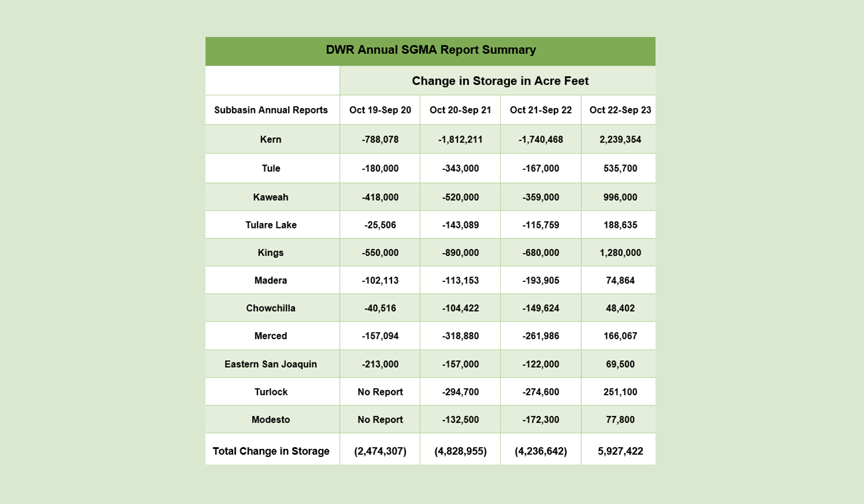
As you can see, the negative changes in groundwater storage from the previous three years was not made up in one wet year, but absent the wet year and the actions folks took to capture that water, the reality we would be facing today would be profoundly serious. In effect, the Good Lord has provided us with some breathing room and a path forward to sustainably manage this precious resource.
Be the first to comment