
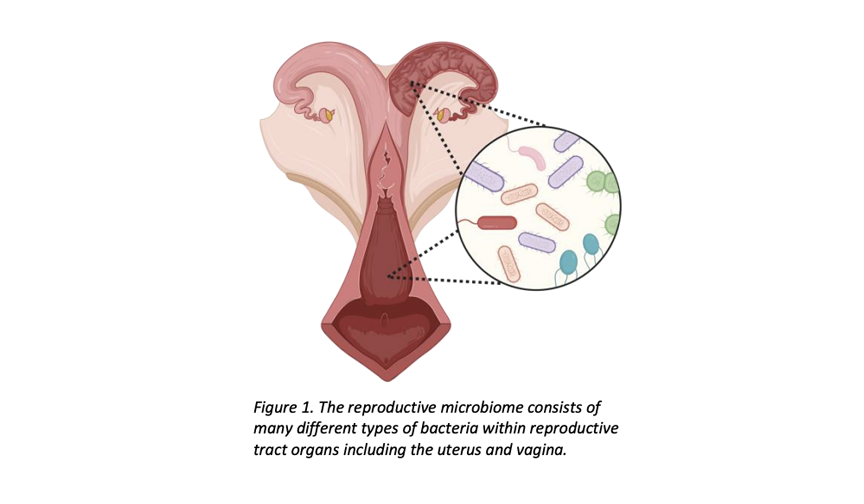
Reproductive Microbiome
The reproductive microbiome consists of the microbial communities located within the organs of the reproductive tract, i.e. vagina, uterus, etc.2 . These microbial communities can be made up of bacteria, fungi and archaea; however, most studies focus on the influence of bacteria, as these are the most prevalent throughout the reproductive tract2 .
The abundance, composition and diversity of bacterial populations are the main focus points for determining beneficial versus pathogenic bacteria. Grasping how these communities change based on different factors can help producers understand the benefits and hindrances on fertility in their dairy operation.
Internal and External Factors
Many of the same bacteria have been found in the vagina and uterus of both heifers and cows2,3-6 . However, these bacterial populations appear to shift in abundance and diversity with the influence of different internal and external factors on the animal.
For instance, bacteria within the reproductive tract are associated with disease status and can inherently impact a female’s ability to become pregnant. Postpartum dairy cows known to be more susceptible to uterine diseases have altered bacteria profiles compared to healthy cows2,7 . Specifically, an increased abundance and lower diversity of pathogenic bacteria is associated with endometritis and metritis infections2,8-10. This may be caused by injury to the reproductive tract due to issues in labor, including retained placenta or tissue tearing from passage of the calf. In fact, passage of the calf through the vagina alone can introduce new and potentially pathogenic bacteria, so that multiparous cows with a larger number of calvings have increased bacteria diversity3,11 . Increases in bad bacteria during the postpartum period can then prevent cows from becoming pregnant and thus increase the number of days open. Therefore, maintaining a herd with healthy reproductive tracts during the postpartum period is important. Producers that are vigilant in assisting cows having calving issues and quickly removing retained placentas and providing antibiotics can help prevent colonization of pathogenic bacteria that lead to disease and eventual reproductive failure.
Contamination of the reproductive tract with bad bacteria can also be caused by external factors including artificial insemination or controlled internal drug release devices3,12 . Specifically, the vaginal microbiome has been shown to change across multiple artificial insemination services12 . This may be due to a lack of cleanliness which can come from introduction of dirt or feces from the artificial insemination rod itself as it is inserted through the reproductive tract. Thus, it is important for artificial insemination technicians to clean the rods between cows and remove any feces from the vulva area prior to insemination. The use of controlled internal drug release devices can also be a cause of external contamination where proper cleaning and sanitation techniques will be useful in minimizing the risk of introducing pathogenic bacteria to the cow’s reproductive tract. Producers may also implement estrus synchronization protocols that do not require the use of a controlled internal drug release device to avoid this risk.
In terms of pregnancy status, little data has been established in dairy cattle compared to beef cattle. One study has shown no differences in bacteria abundance between pregnant and open dairy cows. However, there were differences between days, where the diversity of bacteria was lower 18 days post-artificial insemination (Figure 2)13 . This indicates that factors at the time of artificial insemination may play a role in bacteria populations later, further emphasizing that minimizing sources of external contamination and ensuring the cow has a healthy reproductive tract at the time of artificial insemination can be important for more beneficial bacteria to populate the reproductive tract and potentially promote pregnancy.
Conclusion
The abundance and diversity of bacteria within the reproductive tract of dairy cattle will shift and differ based on internal and external factors and can impact fertility status. By understanding the implications of the bacterial communities on reproduction in dairy cattle, physiological strategies, such as minimizing external contamination and assisting in difficult calvings, can allow beneficial bacteria to flourish for promotion of pregnancy. Producers could also select estrus synchronization protocols that limit external contamination and increase estradiol concentrations to optimize reproductive success following artificial insemination. It is important for dairy producers to be aware of the implications of the reproductive microbiome and what factors impact its role on fertility to make suitable management decisions for profitability and sustainability moving forward. Further research is needed on determining how to successfully and easily implement a microbiome detection method producers may be able to use in the future for reproductive management as well.
References
1 Lee, J.-I. and I.-H. Kim. 2007. Pregnancy loss in dairy cows: the contributing factors, the
effects on reproductive performance and the economic impact. Journal of veterinary
science 8(3):283.
2 Poole, R. K., D. R. Soffa, B. E. McAnally, M. S. Smith, K. J. Hickman-Brown, and E. L.
Stockland. 2023. Reproductive microbiomes in domestic livestock: Insights utilizing 16S
rRNA gene amplicon community sequencing. Animals 13(3):485.
3 Quadros, D. L., R. Zanella, C. Bondan, G. C. Zanella, F. L. Facioli, A. N. da Silva, and E. L.
Zanella. 2020. Study of vaginal microbiota of Holstein cows submitted to an estrus
synchronization protocol with the use of intravaginal progesterone device. Research in
veterinary science 131:1-6.
4 Quereda, J. J., M. Barba, M. L. Mocé, J. Gomis, E. Jiménez-Trigos, Á. García-Muñoz, Á.
Gómez-Martín, P. González-Torres, B. Carbonetto, and E. García-Roselló. 2020. Vaginal
microbiota changes during estrous cycle in dairy heifers. Frontiers in veterinary science
7:371.
5 Moore, S., A. Ericsson, S. Poock, P. Melendez, and M. Lucy. 2017. Hot topic: 16S rRNA gene
sequencing reveals the microbiome of the virgin and pregnant bovine uterus. Journal of
dairy science 100(6):4953-4960.
6 Sannat, C., A. Nair, S. Sahu, S. Sahasrabudhe, A. Kumar, A. K. Gupta, and R. Shende. 2015.
Effect of species, breed, and age on bacterial load in bovine and bubaline semen.
Veterinary world 8(4):461.
7 Miranda-CasoLuengo, R., J. Lu, E. J. Williams, A. A. Miranda-CasoLuengo, S. D. Carrington,
A. C. Evans, and W. G. Meijer. 2019. Delayed differentiation of vaginal and uterine
microbiomes in dairy cows developing postpartum endometritis. PloS one
14(1):e0200974.
8 Kudo, H., T. Sugiura, S. Higashi, K. Oka, M. Takahashi, S. Kamiya, Y. Tamura, and M. Usui.
2021. Characterization of reproductive microbiota of primiparous cows during early
postpartum periods in the presence and absence of endometritis. Frontiers in Veterinary
Science 8:736996.
9 Bicalho, M., T. Santin, M. Rodrigues, C. Marques, S. Lima, and R. Bicalho. 2017. Dynamics of
the microbiota found in the vaginas of dairy cows during the transition period:
Associations with uterine diseases and reproductive outcome. Journal of dairy science
100(4):3043-3058.
10 Moreno, C. G., A. T. Luque, K. N. Galvão, and M. C. Otero. 2022. Bacterial communities
from vagina of dairy healthy heifers and cows with impaired reproductive performance.
Research in Veterinary Science 142:15-23.
11 Bogado Pascottini, O., J. Spricigo, S. Van Schyndel, B. Mion, J. Rousseau, J. Weese, and S.
LeBlanc. 2021. Effects of parity, blood progesterone, and non-steroidal anti- inflammatory treatment on the dynamics of the uterine microbiota of healthy postpartum dairy cows. PLoS One 16(2):e0233943.
12Chen, S.-Y., F. Deng, M. Zhang, X. Jia, and S.-J. Lai. 2020. Characterization of vaginal microbiota associated with pregnancy outcomes of artificial insemination in dairy cows. Journal of Microbiology and Biotechnology 30(6):804.
13 Soffa, D.R., K.J. Hickman, J.W. Cain, J.A. Spencer, and R.K. Poole. Vaginal microbiota and circulating interferon-stimulated genes in lactating dairy cows during maternal recognition of pregnancy. In Review at Journal of Dairy Science.



Be the first to comment