
Consider the PTA milk for Holstein bull Seagull-Bay Supersire-ET (007HO11351; HOUSA000069981349). The base change for milk in April is 752 pounds for Holsteins (https://uscdcb.com/basechange), so we anticipate Supersire’s PTA will decrease by 752 pounds. As an older bull, he has a high 99% reliability, and his evaluation should be very stable at this point. What do we see when we compare his December 2024 and April 2025 records? His PTA milk decreased from 978 to 361, a drop of only 617 pounds, but we thought it would drop by 752 pounds. What happened?
An animal’s evaluation is adjusted to reflect the current genetic base (cows born in 2020), which reflects the genetic progress made in the population over the past five years. However, proofs are also adjusted to account for individual animal heterosis and the inbreeding depression animals are expected to contribute in the future because of their relationship to the breed.

In Supersire’s case, his unadjusted PTAs were 1,419 and 671, a difference of 747 pounds, which is very close to what we expected from the base change. (Note, some of these values are slightly different than those shown in the “Impact to PTAs” section on the 2025 Genetic Base Change page because of rounding.) However, his inbreeding adjustment changed between December and April. As a purebred Holstein, no heterosis effects are applied for Supersire.

The important thing to note here is that Supersire’s adjustment for expected future inbreeding decreased from 441 pounds to 310 pounds. Why is that?
How does CDCB measure inbreeding?
When we talk about inbreeding, we usually refer to an individual’s coefficient of inbreeding, which is how much diversity there is in an individual animal’s genome. That doesn’t tell us much about the effect an animal might have on the population because a bull can be highly inbred while also having a low average relationship to the breed. Instead, we use a measurement called “expected future inbreeding”, or EFI, to tell us how an animal will change inbreeding in the population. An individual’s current EFI is based on their relationship to a group of heifers born in 2020, and their PTA is adjusted for the difference between their EFI and that of the base population.

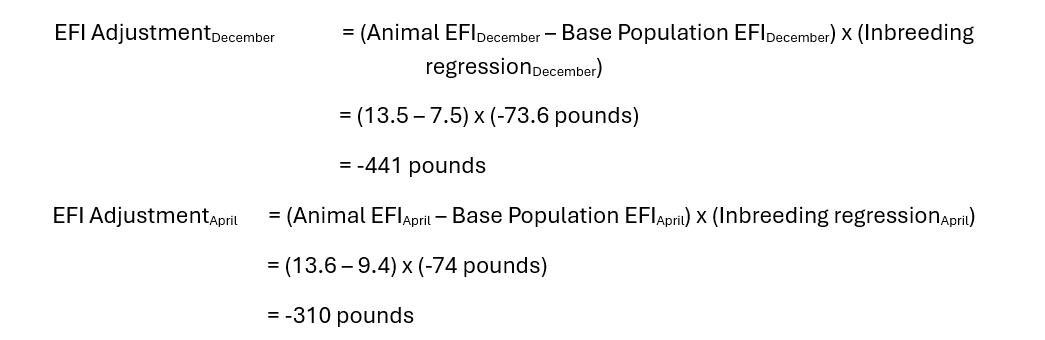
These differences aren’t due to any change in Supersire’s individual coefficient of inbreeding; they’re due to changes in relationships in the population.
What does this all mean?
Observed changes in PTA for individual animals may not match the base change values as closely as they have in the past. This is not due to any errors in the evaluation, they’re due instead to EFI changes in the population that are larger than they’ve been in the past.



Be the first to comment