
Editor’s Note: Joel Hastings is based in Madera, Calif., the author is editor emeritus of DairyBusiness News and a reporter for WaterWrights.net.
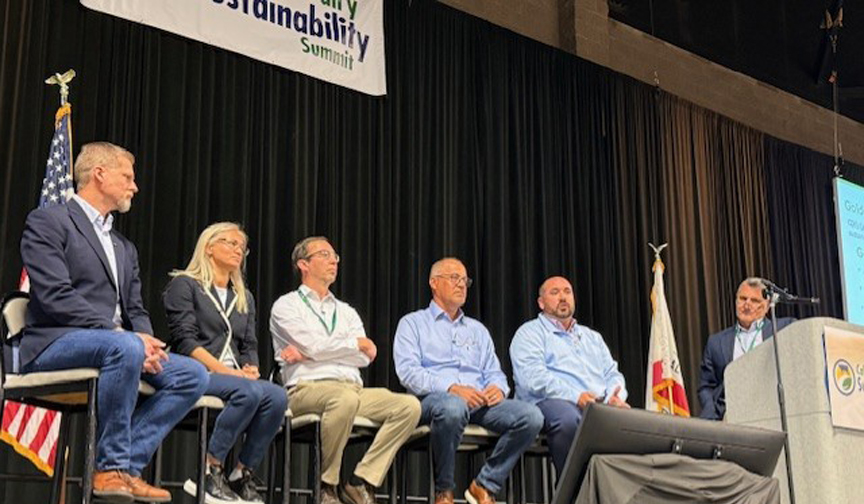
The California Dairy Sustainability Summit, held March 25 in Visalia, attracted over 500, including dairy producers and processors along with a wide range of dairy agri-service personnel, university Extension staff and students. This fifth annual conference was hosted by Dairy Cares, California Dairy Quality Assurance Program, California Dairy Research Foundation, Dairy Council of California and the California Milk Advisory Board. Over 30 commercial firms and dairy organizations exhibited at the trade show providing additional financial support allowing milk producers to attend at no charge.
Dr. Frank Mitloehner, widely known air quality specialist at UC Davis, presented a most encouraging talk on how California is meeting and will meet the required goal of reducing dairy methane by 40 percent by 2030. He said that by producing more milk from slightly reduced cow numbers, installing dairy digesters, and increasing the use of feed additives, the California dairy industry is well along towards achieving this goal. He encouraged producers to think about sustainability as stewardship – striving to be the best stewards of land, animals, people working with them, products and financial resources – five pillars.
Next, a panel with executives from two major food companies, two dairy cooperatives and a dairy farmer responded to questions from Michael Boccadoro, executive director of Dairy Cares. A presentation on the importance of dairy protein concluded the opening session delivered by Dr. Mitch Kanter of Kanter Health and Nutrition Insights, LLC.
Throughout the remainder of the day, the program consisted of nine panel discussions that included both dairy producers and various industry personnel. Topics included genomic testing as a tool for sustainability, animal care in the era of bird flu, manure management and digesters and new models for growing high quality feed, as well as a session on water for dairy farms.
Dairy Water Panel
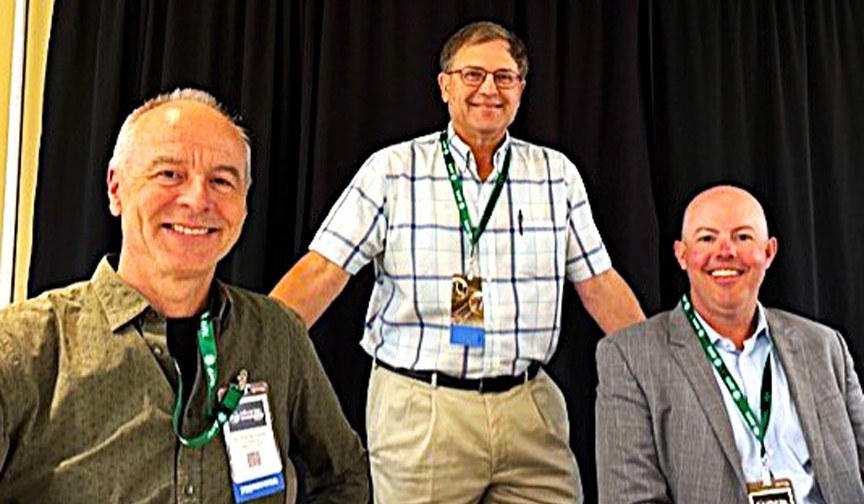
One of three breakout sessions in the final hour of the morning was entitled Tackling Water Scarcity: Evolving policies & strategies for improving water availability. A standing room audience of over 80 heard panel moderator Geoff Vanden Heuvel, MPC’s director of regulatory and economic affairs, lead a discussion with David DeGroot, water engineer and dairy producer, and Thomas Harter, PhD, professor at UC Davis.
Providing more background, he said that SGMA was the first ever statewide attempt In California at regulating groundwater. Pointing out that surface water has been extensively regulated for over a century, he said SGMA requires that groundwater must be brought into balance by 2040 by local entities. He said over 250 local groundwater sustainability agencies or GSAs have been formed to carry this out. He said the most critically overdrafted areas needed to have groundwater sustainability plans (GSPs) to stop taking more water out than can be replenished. Almost the entire San Joaquin Valley is termed critically overdrafted, from Stockton to Bakersfield, with the exception of the areas around Modesto and Turlock, which are one level better.
He went on to explain that dairy has been involved for decades in water quality and air quality issues, but not much in water supply. With so much dairy located south of Merced in these overdrafted areas, it became clear that SGMA would have an impact as aggressive GSPs were completed by 2020. Five years in, these plans are “starting to bite”, with reduced water allocations and new fees imposed. He said areas without surface water are treated much differently than areas with surface water, which is land within irrigation districts. Areas with no surface water are now dependent on weather, and a few atmospheric rivers can make a big difference.
“Long term, we are fundamentally out of balance between water we have access to and water we consume in agriculture,” he concluded.
Vanden Heuvel then introduced his two panel members who were on stage with him. He said David DeGroot is a ‘dairy kid’, a civil engineer and partner in the family dairy. DeGroot is CFO/COO of the engineering firm 4Creeks, Inc., and California Bioenergy, LLC. His firm provides consulting services for at least four GSAs giving him firsthand experience with SGMA.
DeGroot began by saying it is crucial to define a problem in order to find solutions. He said the ag community and dairy in particular continue to be increasingly regulated, especially around water quality and now water quantity. He said SGMA has made ground water extremely complicated. He said as GSAs began work, they could not allow ground water levels to continue to drop, they must preserve domestic and community wells, they must prevent land subsidence, and they must maintain water quality.
He said for individual dairy farms. it is critical to understand the farm’s water budget. That is, how much water do you use, how much do you need and how much do you have. He said water use on cropland is being measured by -evapotranspiration (ET) by satellite. But he said on a dairy facility, you don’t have water that can be measured that way. Net consumption involves water used for milk cooling, washing, flushing, cow cooling and manure with much of this water recycled for reuse, but with the exception of milk that leaves the dairy. He said on the dairy facility itself – barns, milking facilities and other structures – it appears that water use amounts to about ½ acre foot per acre. He said he’s been doing a three-year study which is nearly finished that confirms this average figure.
He said dairy producers should try to avoid having their water touch manure, because that’s when it becomes regulated. He said there are ways to manage nutrients to do that, especially if you don’t need it all for crops. He says it will be important to create value for these unused nutrients. He said producers have to be able to store water and that recharge is one way to build a “bank.” Storing feed for more than one year is another way to accomplish this.
Dr. Harter said two big issues for dairy producers are determining the budget for water and managing nutrients. He said we need to maximize additional water recharge to minimize groundwater pumping, which is being reduced. He said the first thing needed for recharge is the water itself, “and that water doesn’t sit around in California.” He said most surface water in canals and reservoirs is spoken for by irrigation districts. The water not spoken for is flood water that only comes once in every ten years in the South Valley and farther north, every five or six years and still further, every three years.
He said that in Southern California and the Bay Area, recharge basins have been built to prevent salt water from intruding into ground water. He said recharge basins have been important for the Central Valley too, with Fresno and smaller cities using them to capture storm flow run-off.
He said flood water comes over short periods of time based on snow melt and the one place that can take that water is the agricultural landscape, much of which has already been prepared for irrigation. He said the challenges are how to get the water to those areas, and since that space is already used to grow crops which must be protected. He continued saying the use of pesticides, fertilizer and manure create the concern that recharge will put those substances into the groundwater and flow downstream to populated areas impacting groundwater used for drinking.
He said in dairy areas, or dairyMAR – managed aquifer recharge – there is the additional legacy of manure which has caused fairly high nitrate concentrations in shallow groundwater. The concern here by regulators and environmental groups is that flooding this cropland will cause more pollution than can be allowed.
He said that he and colleagues are studying that to do both recharge and preserve water quality, can enough water be placed to accomplish recharge and dilute nitrogen concentrations. He described a controlled one-acre study in Stanislaus County growing a winter mix forage crop with groundwater depth of only 20 feet. He said that first seven feet of water and then four feet of water were applied with soils and water samples measured. The early results show that in both agMAR and dairyMAR there is a decrease in salinity. He said if recharge can be done on dairyMAR that protects or even improves water quality, GSAs are looking for more places to put water. It’s possible dairy owners might receive recharge credits, even in areas around municipal and domestic water supplies.
Vanden Heuvel pointed out that in 2023 during the really wet spring, the Governor issued an emergency order allowing recharge with flood water with fewer restrictions but language in the order directed where water could be placed. Then it looked like dairy ground would be a problem. Out of five million irrigated acres in California, there are only 500,000 are associated with dairy.
Speaking of the nitrogen budget for dairy, Harter pointed out manure from 1.5 million cows being applied to dairy cropland totaling 300,000 to 400,000 acres is way more manure than needed.
Vanden Heuvel said we have built these tremendous surface water projects at both the state and federal level, but the Endangered Species Act protecting several species of fish has required the diversion of up to two million acre feet of water per year from these projects. That’s what’s happened, no matter how you might argue. He continued saying that in the state, some 1.6 million acres of cotton have been converted to almonds and pistachios, and while they have more value, they also take more water. He said with less surface water and more ground water demanded, it’s no surprise we’re out of balance.
He said that when he started attending GSA meetings saying he was the ‘dairy guy,’ it was thought that dairy was in worse shape from SGMA. But, he said, trees need water every year while dairy has more flexibility. He said he hauled in feed and hauled out manure every year he was in Chino. He said we may have to dairy differently.
One more question concerned manure and Vanden Heuvel replied, “It’s pretty clear we have a significant nitrogen surplus we need to deal with. Half the fertilizer in the Valley could be provided by our manure.”
This glass half full, half empty thought brought the session to a close.

Be the first to comment