

Hired labor plays a significant role on dairy farms, with more than 9,000 jobs provided by New York dairy farms in 2019.1 As farm size grows, hired employees provide a larger percentage of the labor required to operate the farm. In 2021, authors J. Karszes and C. Wolf presented an in-depth look at hired labor on larger dairy farms over a 10-year period in E.B. 2021-05 “Hired labor on New York state dairy farms: Costs, efficiency and change from 2011 to 2020”. Since then, hired labor costs have continued to increase. This paper presents updated trends, costs and changes over the last seven years through 2024.
From 2018 through 2024, 110 farms utilizing hired labor participated in the DFBS for all seven years. With this balanced data set, change can be looked at over this time frame. On these 110 farms, hired labor grew from 87.7 percent of all labor on the farm in 2018 to 89.3 percent in 2024.
Trends from the same participating farms over the last seven years
Selected factors over the seven years are highlighted in Table 1. Starting with an average herd size of 1,155 cows in 2018, these farms grew an average of 3.7 percent a year, with 2019 showing the highest growth of 5.9 percent and 2021 having the smallest change in growth of 2.4 percent. Herd size averaged 1,438 cows in 2024. Milk production also showed continued growth over this period, from 25,893 pounds per cow to 27,317 pounds per cow, a difference of 3.7 percent.
With the increase in cow numbers, the amount of hired labor also increased to reflect larger labor needs. Average hired labor equivalents rose from 20.5 to 23.3. One worker equivalent equals 2,760 hours of labor for the year. While average herd size grew 24.5 percent from 2018, the hired labor being utilized rose only 13.5 percent. With herd size increasing at a faster pace than hired labor, labor efficiency metrics improved. Average cows per worker rose from 49.3 to 55.1 for the period, an increase of 11.6 percent. Milk sold per worker rose 17.8 percent, reflecting the increase in milk per cow along with the increase in cows per worker equivalent.
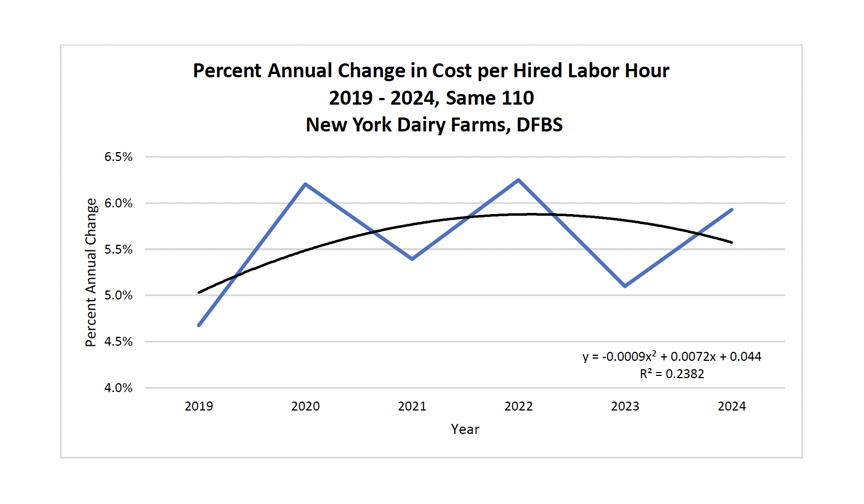
With businesses growing in herd size from 2018 to 2024, the total business payroll cost rose by 57.4 percent. This increase was due to the
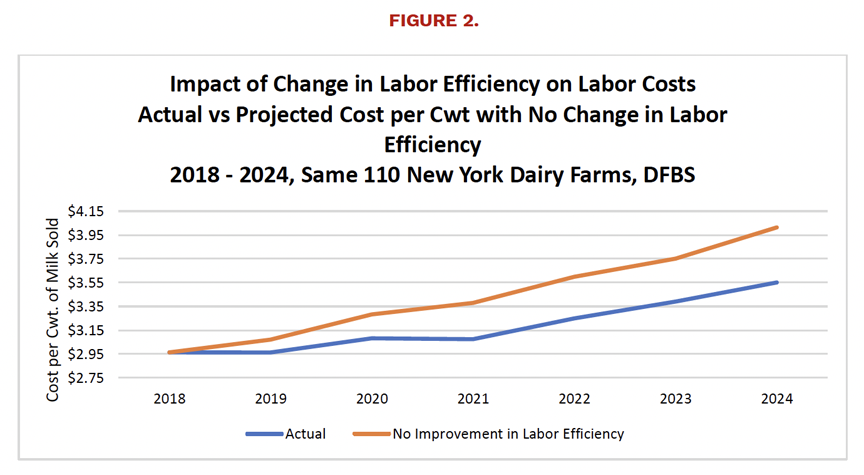
The average hired labor cost per hundredweight of milk produced increased from $2.96 per hundredweight in 2018 to $3.55 per hundredweight in 2024, an increase of 19.8 percent. While the cost increased over the period, the changes year over year were quite variable, with one year showing a decrease in cost, another unchanged and the rest of the years showing over four percent change. This reflects how changes in labor efficiency can offset increases in hired labor costs per hour. These increases in hired labor cost per hundredweight would have been greater if not for the labor efficiency improvements implemented by farms during this period, which partially offset the rising hourly cost of hired labor. If labor efficiency had no changes, hired labor would have increased by an additional three hired worker equivalents and total payroll would have grown by an additional $181,809 per farm, on average. Without any improvement in labor efficiency, the hired labor cost per hundredweight would have been $4.01 in 2024, an increase of 35.4 percent from 2018. Figure 2 highlights the difference in projected versus actual hired labor costs if no improvements in labor efficiency had occurred. Across the 110 farms, the increase in labor efficiency resulted in a total of 340 less hired worker equivalents needed by 2024 than if labor efficiency stayed the same as 2018.
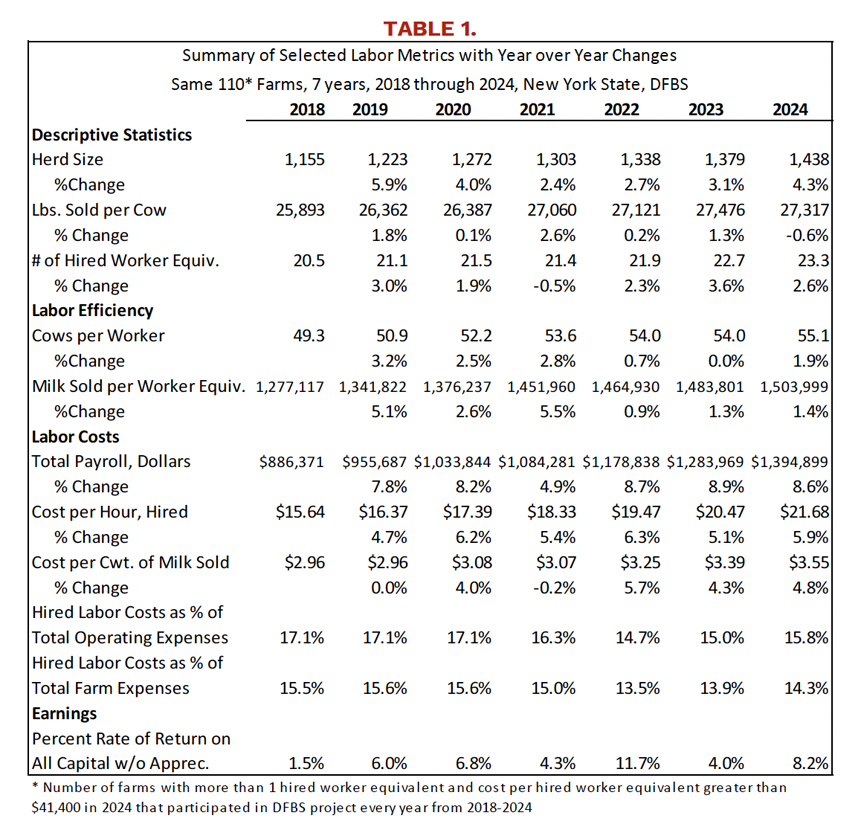
For these same farms from 2018 to 2024, hired labor cost is also reported as a percentage of total operating costs. Operating expenses on dairy farms are continually changing as prices change, different mixes of inputs are utilized and production output changes. Hired labor as a percentage of total operating costs was over 17 percent for 2018 to 2020, fell to 14.7 percent by 2022 and then has increased back up to 15.8 percent in 2024.
This report focused on how costs and labor efficiency have changed over the six years up to 2024. Starting in 2024, a New York State tax credit3 is associated with the decrease in the threshold to determine overtime hours for hourly employees. If this credit is applied for by the owners, this credit would be treated as an additional source of government program income for the farm and provide additional income to offset increases in the costs. No analysis of what that impact would be is currently available.
Summary
While labor costs have been increasing as measured by total payroll and cost per hired labor hour, cost per hundredweight of milk has also risen but at a slower rate. Dairy farms have offset some of the increase in cost per hired labor hour by improvements in labor efficiency as measured by milk sold per worker equivalent. Without these increases in labor efficiency, increasing costs associated with hired labor would have had a much larger negative impact on earnings.
Improvements in labor efficiency have partially offset the increase in hourly hired labor cost, slowing the rise in hired labor cost per hundredweight of milk sold. However, any costs associated with achieving the improvements in labor efficiency are not captured or analyzed within this report. Many different farm characteristics and management decisions may impact labor efficiency on a dairy farm, including farm size, growth, technology, automation, employee training and retention, utilization of custom services and more. For a farm to raise earnings through management changes or investments to improve labor efficiency, any cost saving due to improvements in labor efficiency must exceed the cost increases incurred by the farm to achieve those efficiencies.



Be the first to comment