
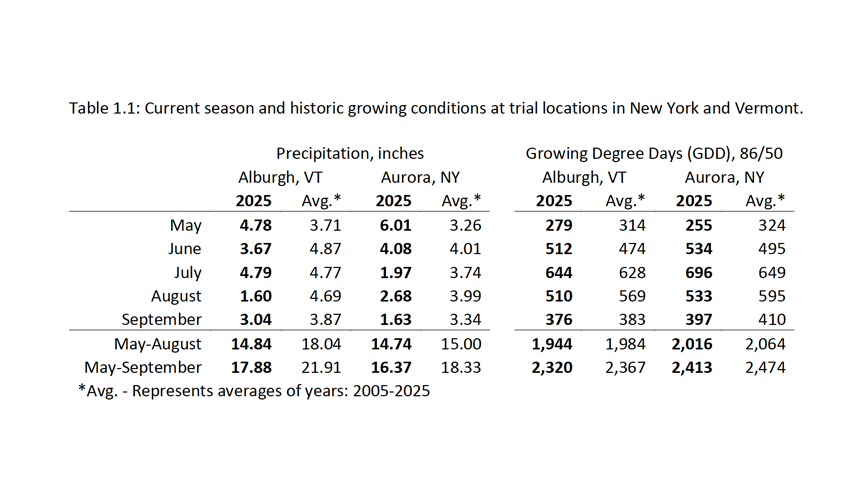
Hybrid evaluation at multiple environments helps in decision making and expands the reach of this type of data to more farmers. Cornell, UVM, and seed companies collaborate to provide this evaluation. Hybrids were either entered into the 85-98 day RM group (Early-Mid; n = 31) or were entered into the 99-110 day RM group (Mid-Late; n = 33). All hybrids were planted at two locations; the Musgrave Research Farm in Aurora, NY (Cayuga County) and Borderview Farm in Alburgh, VT (Grand Isle County). Harvest dates were staggered by maturity group at each location. Weather data, growing degree days (GDD; 86-50°F system), and precipitation, for both the current year and long-term averages, can be found in Table 1.1 for all locations.
The NY and VT corn silage evaluation program is made possible with support from dairy producers, participating seed companies, Cornell University, the University of Vermont, and the Cornell University Agricultural Experiment Station. Seed companies were invited to submit hybrids into either maturity group (two locations per maturity group) for a fee.
Planting occurred on June 4th in Aurora and May 13th in Alburgh (Table 2). The early-mid hybrids were harvested on September 9th, and the mid-late hybrids were harvested on September 17th in Alburgh (Table 1.2). Harvest did not occur at the Aurora location due to extreme weather patterns resulting in failure and substantial variability between plots. Based on RM there is a range in tasseling dates, average tasseling dates across the RM groups are included in Table 1.2. Information on soil type and fertility management can be found in Table 1.2 for each field location. From planting to harvest, the early-mid hybrids accumulated 1,977 GDD with the mid-late hybrids accumulated 2,072 in Alburgh (86-50°F system, Figure 1.1 and Table 1.3).
The goal was to harvest all hybrids at 65% (±3%) moisture. The maturity groups were monitored, and harvest decisions were made by measuring whole plant dry matter (DM) on buffer plots prior to harvest. In Vermont, plots were harvested with a John Deere 2-row chopper into a wagon equipped with an Avery Weigh-Tronix weighing system at a target cutting height of 8 inches (± 1 inch).
An approximate 500 g sample was taken per plot replicate, resulting in 3 samples per hybrid. Samples were sealed in gallon-sized freezer bags, packaged, and shipped for immediate analysis. Samples were submitted to Cumberland Valley Analytical Services (Waynesboro, PA) where near-infrared spectroscopy (NIR) procedures were used to determine crude protein (CP), starch, lignin, linoleic acid (C18:2), ash corrected neutral detergent fiber (aNDFom), and NDF digestibility at difference time points (NDFD; 12, 30, 120, 240 h). Three companies paid an additional fee for wet chemistry analysis on aNDFom and NDFD at 30 h of in vitro fermentation.
Corn silage hybrid performance was evaluated by the predicted milk production output (metabolizable energy [ME] and metabolizable protein [MP] allowable milk) of Cornell Net Carbohydrate and Protein System (CNCPS) v.7.0 (Cornell University, Ithaca, NY). Rumen aNDFom and uNDFom pool sizes have been shown to correlate with dry matter intake (DMI), with more degradable aNDFom, lower uNDFom diets encouraging intake, holding all other dietary nutrients equal. Increased intake of a common diet is meant to improve milk production whereas lower intake will limit production. Corn silage NIR results were applied to a typical New York high corn silage-based diet (forage at ~51.3% of diet DM; corn silage ~80% of forage DM) in CNCPS v7.0. For practical purposes, since the samples had not undergone fermentation, feed library values were assigned to soluble protein, ammonia, volatile fatty acids, and 7-hr starch digestibility values. A base diet which fed a corn silage representing the average feed chemistry of all hybrids was formulated by Elle Andreen. The diet was formulated for 93 lb milk yield, assuming 4.15%, 3.25%, and 4.85% milk fat, true protein, and lactose concentrations, respectively. Cattle were described as 48 months old, 130 days in milk, weighing approximately 1,600 lb, and expending the average maintenance energy assuming thermoneutral conditions in a typical Northeast freestall barn. Initially, each individual hybrid replicate replaced the average corn silage in the base diet (assuming total of 58.1 lb DMI) at the same DM inclusion rate. Subsequently, for each hybrid, DMI of the entire diet was adjusted based on the first limiting rumen fill factor (rumen aNDFom pool size or rumen uNDFom pool size), keeping dietary inclusion level (%DM) of all ingredients fixed. This novel approach to hybrid evaluation allows us to account for differences in DMI potential of the total diet based upon hybrid selection and is a more biologically robust representation compared to evaluating hybrids on a constant DMI basis. The predictions made by the CNCPS v.7.0 were used to evaluate differences in intake potential and subsequent predicted allowable milk yield based upon the nutrient and digestibility characteristics of each hybrid.
The GLM procedure was used for analyzing data using SAS software (v. 9.4, SAS Institute, Cary, NC). If there were significant differences between hybrids for a given nutrient (P < 0.10), the least significant difference (LSD) generated at the P = 0.10 level was reported for separating hybrid means for each location. For interpretation purposes, if the difference between two hybrids is greater than the reported LSD, there is a 90% probability that this is not due to random variation and there is a true varietal difference between the hybrids.


Be the first to comment