
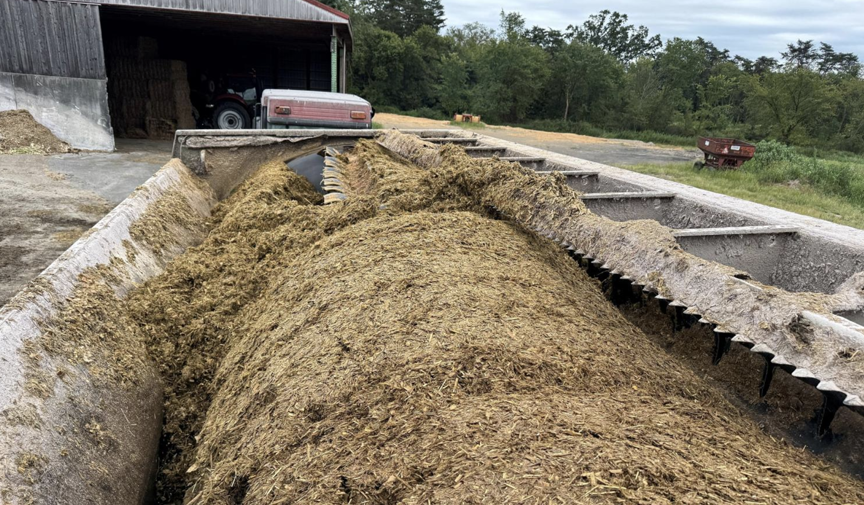
When milk fat levels began slipping at Seven Stars Dairy in Millerstown, the farm began looking for answers.
An on-farm visit by Penn State dairy experts helped pinpoint the problem and identify a few small adjustments. Those changes helped reverse the months-long decline without adding labor or increasing feed costs. If current prices and production levels hold, those changes could generate nearly $200,000 in additional annual returns, according to the Penn State experts.
The issue began in March, when Seven Stars Dairy noticed the butterfat percentage in its milk beginning to decline. Butterfat, the fat component of milk that contributes to a creamy taste and texture, also plays an important role in determining the value of milk. By late spring and summer, the farm’s butterfat level was hovering around 3.6%. A further drop in early July prompted the farm to contact Penn State Extension.
Jim Lawhead, dairy science associate with Penn State Extension, and Leoni Martins, assistant clinical professor of precision dairy nutrition in Penn State’s College of Agricultural Sciences, visited the farm to investigate.
They talked extensively with herdsman Dan Witmer about the farm’s feeding practices and examined the forages, grains and total mixed ration, or TMR, being fed to the cows.
Lawhead explained that a TMR combines a cow’s feed ingredients, including forage, grain, minerals and vitamins, into one mixture. When it is mixed properly, each mouthful should provide roughly the same balance of nutrients.
During the visit, Lawhead and Martins identified two issues that could be contributing to the decline in butterfat.
The first involved roasted soybeans and high-moisture corn grain used in the ration. The beans had been ground into a fine powder. Traditionally, roasted soybeans are processed much more coarsely, with the beans broken into halves or quarters.
The second issue involved how evenly the TMR was being distributed along the feed bunk.
Using the Penn State Particle Separator, a tool that measures the size and distribution of feed particles, Lawhead and Martins found that cows at different points along the bunk were not receiving the same mixture. Cows fed first were getting a ration with more grain, while those fed later were receiving more forage.
Neither mixture provided the intended balance of nutrients, and the ration inconsistency facilitated feed sorting.
“The farm visit was essential in this situation,” Lawhead said. “We were able to establish a working relationship with the farm and obtain a thorough history of its procedures and management.”
Seeing the feed firsthand also allowed the team to measure the soybean particle size and assess how consistently the ration was being delivered to the cows.
Following the visit, the farm standardized the order in which ingredients were added and how long they were mixed. The goal was to provide the cows with a more consistent feed blend.
After the existing supply of finely ground soybeans was used, the next batch was ground with a coarser screen. The change produced a measurable response.
The new batch was first fed Aug. 8. Over the following weeks, butterfat levels began to rise from a low of 3.3% to 3.9%.
Milk protein also increased, from about 3% to 3.2%. Lawhead explained that soybean particle size can affect not only fat metabolism but also how the cow breaks down and uses protein.
Using conservative assumptions, Lawhead and Martins estimated that the improvement could generate nearly $200,000 in additional returns over a year if milk prices stay the same.
Witmer said the visit also built a relationship between the farm and Penn State Extension.
“It has been nice to have contacts to reach out to when there have been other questions since that time,” he said.
For Lawhead, the case illustrates the importance of precision nutrition.
“Not only is the calculated ration critical, but the physical form and delivery are critical,” he said. “This was a situation where a relatively small change had a dramatic impact on the dairy’s income. The dairy economy is typically challenging, and this was a tremendous help to this farm. It also provides us with information on helping other farms in the future.”
The case is one example of how Penn State Extension works with producers to apply research and expertise to real-world challenges, Lawhead added.


Be the first to comment