
The T.C. Jacoby Weekly Market Report Week Ending November 13, 2026
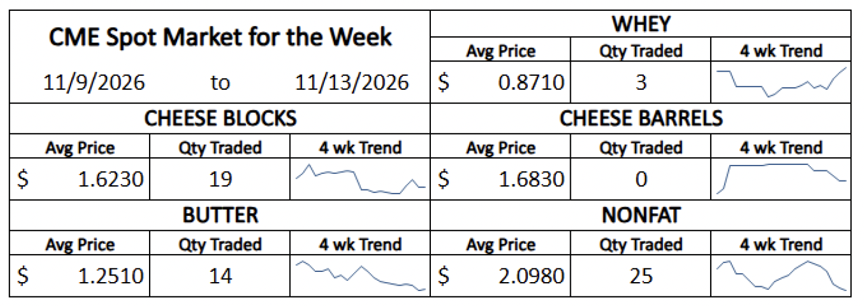
The protein bulls galivanted through LaSalle Street, and CME spot whey powder struck a new all-time high. Spot whey powder jumped 7ȼ this week to 91ȼ per pound. The 8% increase marked the whey market’s first foray into the 90s in its eight-year tenure at the spot market. 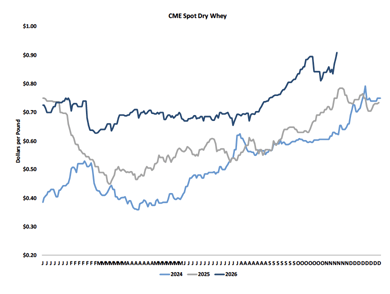 USDA’s Dairy Market News reports that whey powder demand is “steady to strong.” And some October processing downtime and production issues tightened supplies. Manufacturers continue to concentrate as much whey as possible, but there’s still plenty of raw whey leftover. Through September, whey powder production was up 7.8% year-over-year.
Americans clearly prefer their whey in premium, concentrated formats. Domestic demand for whey protein concentrates reached an 11-year high in the first nine months of this year, up 1% from a strong showing in 2025. But domestic demand for whey powders slumped to just 181 million pounds in January through September, down 45% year over year and the lowest domestic consumption since USDA began tracking the data in 1995. Higher whey powder production and lower domestic demand require very strong exports. For now, judging by both export volumes and whey powder prices, that’s working just fine. But the strong dollar and concerns about U.S. trade relationships and 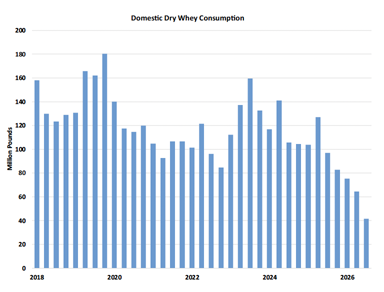 consumer purchasing power could provide some headwinds, especially with prices at record highs. The top markets for U.S. whey powder are China, Canada, Mexico, and Vietnam. Our trade relationships with China and Canada are rocky, to say the least. Mexico and Vietnam are attempting to renegotiate the punitive tariffs the Trump administration levied in the past 18 months.
Volatility reigns in the cheese market as it attempts to balance hefty production, tepid domestic demand, and booming exports. This week, spot Cheddar blocks jumped and then dropped, but the early-week strength outweighed the late-week selloff. Blocks closed at $1.6175, a nickel higher than where they stood last Friday.
It’s prime time for the butter market to shine with Thanksgiving right around the corner. Churns are running hard and retailers are stocking up on 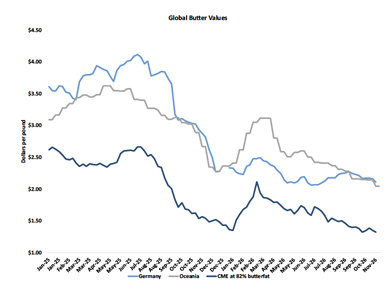 all the butter that holiday bakers might require. And international buyers are happy to purchase American butter, which looks like a bargain compared to European or Kiwi product. But all that demand is not enough to keep pace with the nation’s formidable butterfat output. CME spot butter fell 2.5ȼ this week to $1.24 and touched its lowest price since February 2021, when the restaurant industry was still struggling through pandemic restrictions.
Milk powder prices continued to climb at the Global Dairy Trade Pulse auction on Tuesday. But the modest gains were not enough to give any lift to a U.S. milk powder market that already stood well above international prices. As it seeks a price that will attract just a few more sales, the spot milk powder market is following nearly the exact path it took earlier this year, with a breathtaking rally, a partial selloff, a bounce, and then a sustained decline. CME spot nonfat dry 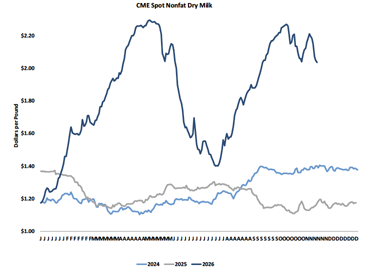 milk (NDM) plummeted 16.25ȼ this week to $2.035, its lowest price since mid-September.
The steep drop in U.S. powder prices and the feeble butter market weighed on the December Class IV contract. It fell 20ȼ this week to $19.80 per cwt. But the trade believes that the butter market will bounce back from its five-year low. 2027 Class IV futures posted double-digit gains. Most Class III futures finished a little higher than where they began the week, and the strength in the spot cheese and whey markets propelled December Class III to $17.30 per cwt., up 57ȼ.
Cattle values also climbed. Packers are no longer operating deep in the red, and they’re bidding 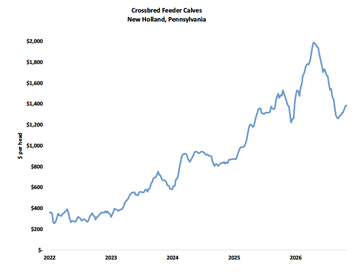 up for cattle. The recovery in live cattle and feeder cattle futures will translate almost immediately into greater revenues on the dairy with calf and cull cow values rising from the autumn lows. Milk prices and beef revenues continue to give dairy producers the market signals – and cash flow – that could fuel additional expansion.
Meanwhile, feed costs remain reasonable, although forage shortages and freight rates are starting to sting in the West. Both corn and soybean meal prices rallied this week on the heels of USDA’s latest report, which showed that corn yields were not quite as high as USDA projected in October. Still, corn is abundant and not expensive. December corn futures closed at $4.46 per bushel, up a nickel. December soybean meal rallied $11 to $330.20 per ton.
Original Report At: https://www.jacoby.com/market-report/spot-whey-powder-all-time-high/


Be the first to comment