

As it turns out, it will be the last market update Stephenson will present as he will be retiring from his post as director of Dairy Policy Analysis at the University of Wisconsin. Fortunately he was able to impart some good news to dairy farmers.
Strong milk prices
Looking at various economic and market factors, Stephenson said he foresees an All-Milk price into the fall of this year between $24 and $26 per cwt. The Class III (cheese milk) price is likely to hover between $22 and $24 per cwt.
“Record high milk prices will continue but they don’t necessarily bring record high profits. However, this is enough to show some level of profitability on traditional Wisconsin dairy farms,” he said.
The estimated cost of production per hundredweight for dairy farms in Wisconsin varies by as much as $10 from one farm to another. “This is huge. In California, dairy farmers have a hard time seeing cost of production figures below $25 per hundredweight. So, $26 is supportive.”

Stephenson noted that domestic demand for dairy has been good, and that’s one of several factors helping lift prices for U.S. dairy farmers. In 2020, the last year for which that data is available, the milk equivalent consumption – for all dairy products – was nearly 660 pounds per person per year.
However, fluid sales have returned to their disappointing pre-pandemic trend. Stephenson noted that during pandemic lockdowns when people were forced to prepare nearly all their meals at home, fluid milk sales experienced a brief uptick. It was a short-lived reversal of the consistent trend that has shown year over year losses in fluid milk sales for decades.
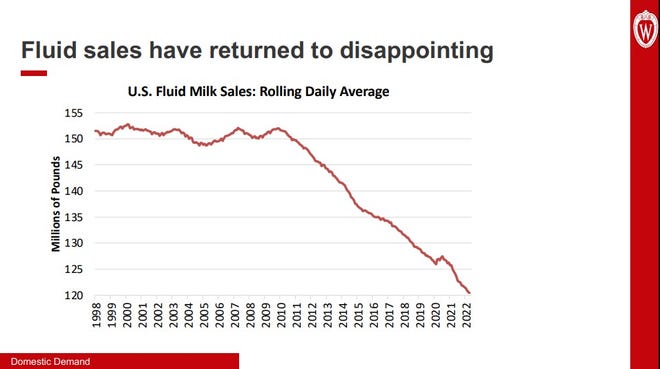
His chart goes back several decades, when people were buying 150 million pounds of milk on a rolling daily average. Now that current sales have retreated to the ten-year trend, sales are closer to 120 million pounds of fluid milk per day.
Another factor contributing to his prediction on milk prices is the number of dairy cows in the national herd. Dairy cow numbers retreated through 2021 but are holding steady right now. Through March, April and May of this year, dairy cow numbers have remained at about 9.4 million.
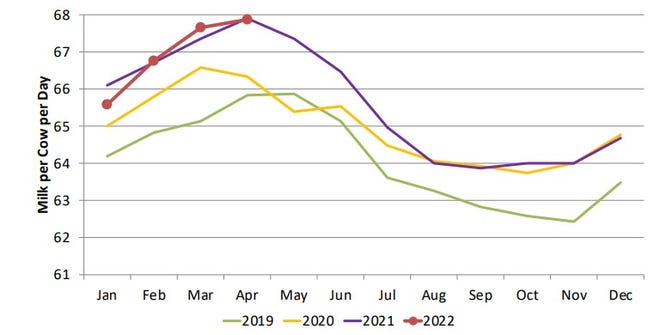
Generally, production per cow makes up for any loss in cow numbers, but this year milk production numbers per cow have been disappointing at about 69 pounds per cow per day, he said. “There has been no growth in milk per cow. That means that they are not producing as much milk as a year earlier and that is not normal in the United States,” he said.
There is a central swath of the United States where dairy farms were able to boost production. Wisconsin dairy producers had a slight growth in overall milk production in the first quarter of 2022, compared to the same time period last year – at 1.8%. A map Stephenson presented showed that Texas was up 2.7% and South Dakota was up 18% but those were the exceptions. California was up only 0.6% and New York was up only 0.2%. Many states were down double digits in production.
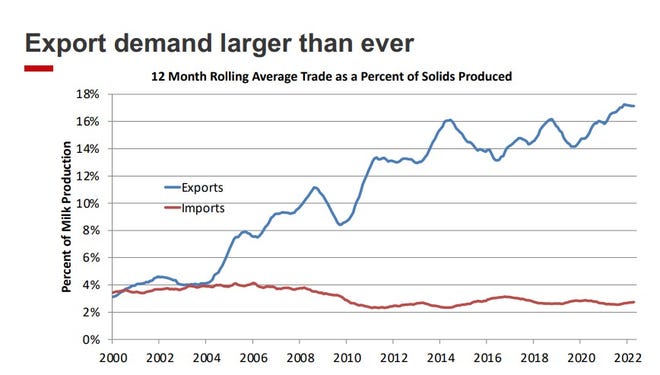
A lag in domestic production and strong export demand is helping lift the price of milk. The 12-month rolling average trade in exports, expressed as a percent of solids produced, was up to 17% in 2022 which is the highest ever, Stephenson said.
“With port congestion and other problems with exports, it was largely believed that those export sales would be down. But they are figuring a way to turn those ships around,” he said.
Gaining market share
Stephenson also noted that U.S. dairy exports are gaining market share over other major dairy export regions of the world (compared to last year.) That may not continue, he explained, if the U.S. dollar continues to gain strength. The dollar’s comparative value was lower in 2020 and 2021, but has begun to creep up over the last several fiscal quarters, which makes U.S. dairy products relatively more expensive.
On the other hand, international competitors in the dairy sector are experiencing their own supply-limiting conditions. New Zealand, normally a powerhouse dairy exporter, has experienced drought for the last year and a half. The industry there is grappling with this question – “do we have too many animals on too small a footprint,” he said.
In the Netherlands, a mainstay of European Union dairy production, farmers are dealing with manure handling issues where phosphorus loads in the soil are limiting manure spreading. “There’s not enough land to spread it all on,” he said.
Ireland, another EU dairy production leader, has been in a big growth mode for the past few years but farmers there are also facing some of the same questions as their New Zealand and Dutch counterparts – “do we have too many cows?” he said.
Also potentially affecting dairy sales in general domestically is the rate of inflation being experienced in the U.S. economy. It is the highest rate of inflation in four decades. In January 1980, inflation stood at a little over 14%. Today the Consumer Product Index (CPI) rate of inflation is a little over 8%.
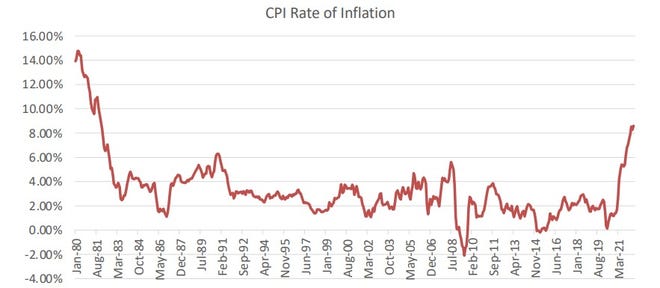
Stephenson said this inflation rate is likely to continue for a period of time and like many other economists, he fears we are going to be tumbled into a recession.
Consumers are now spending more at the dairy case because of inflation and figures show that this has contributed to a 4% loss of sales volume, he said.
Time to retire

Be the first to comment