
Farm Credit support helps nonprofit reduce costs and maximize participation
For more than 30 years, AgSafe has been a trusted source for safety training and compliance support for the agricultural community.
The Modesto-based nonprofit has cemented its place in ag training in California and increasingly in other parts of the country as well. Natalie Gupton, the group’s Vice President and Chief Operating Officer, said in just one year, AgSafe increased its training sessions by more than 35%, growing from 204 sessions reaching 3,667 people in 2022–23 to 278 sessions reaching 5,664 people in 2023–24.
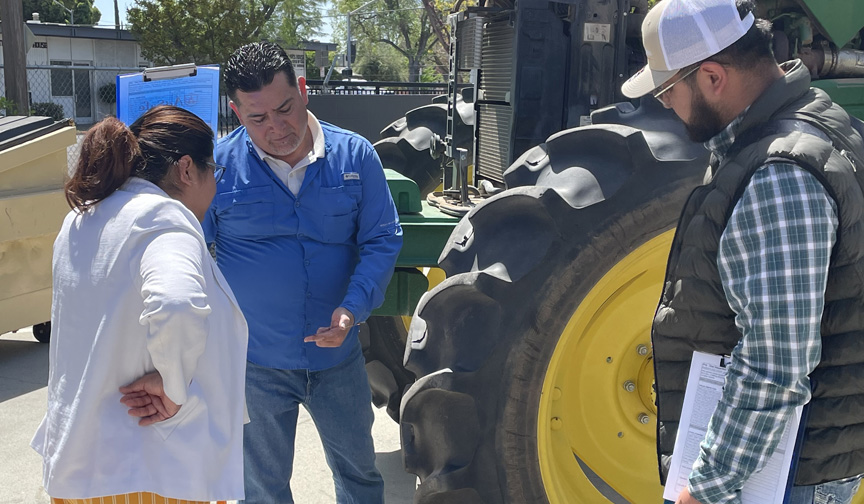
“We’ve spent the past five years really focusing on our supervisors because they are the ones that get so much done for our industry,” Kiehn said. “We are sponsoring classes on training the trainers, trying to help supervisors with everything from equipment safety – so tractor, forklift, ATV/UTV accident prevention – to HR topics like wage and hour and sexual harassment prevention.
“Many of us in our roles get regular professional development, so we’re working to make sure that our ag sector is getting that as well, especially those in supervisors’ roles. We’re making sure that we’re professionalizing our industry.”
Kiehn, who has been with AgSafe since 2009 and CEO since 2020, noted that the group has developed the Supervisors Development Academy, a five-section 20-hour program that talks about what it means to be a supervisor, how to lead teams, how to have difficult conversations and to work on people skills.
Keith Hesterberg, President and CEO of Fresno Madera Farm Credit, emphasized the critical importance of workforce education in promoting safe practices across agriculture.
“Safety remains a top priority in the ag industry, and AgSafe has demonstrated exceptional leadership over the past 34 years by training more than 150,000 people,” said Hesterberg. “Today’s agricultural workforce faces a broader range of challenges, making AgSafe’s expanded, holistic approach more vital than ever. These comprehensive programs are essential to meeting the evolving needs of our industry well into the future.”
Kevin Ralph, AgWest Farm Credit’s California President, said AgSafe’s signature safety conference, often held in Monterey, is also a great benefit.
“More than 500 people attend the conference, which features more than 50 classes focusing on health, safety, human resources and leadership development, in English and Spanish,” Ralph said. “AgSafe brings in Spanish-speaking experts from key regulatory agencies to discuss the top citations and how to prevent them, and to make sure everyone is up to date. Farm Credit is proud to have sponsored the conference for many years and to have been a longstanding AgSafe associate member.”
Farm Credit associations supporting AgSafe are AgWest Farm Credit, American AgCredit, CoBank, and Fresno Madera Farm Credit. These organizations are part of the nationwide Farm Credit System – the largest provider of credit to U.S. agriculture.
Kiehn said Farm Credit has been a great partner.
“We never want cost to be a barrier for folks to participate, and Farm Credit’s support has allowed us to reduce costs to ensure that we maximize participation. Farm Credit also has been one of the foundational partners that allows us to grow and maintain our helpline service. And finally, its information has been valuable to our network and whenever we’re able to share it we try to do so,” she said.
AgSafe was formed in 1990 as increasing state and federal regulations made an injury and illness prevention program necessary. At first a coalition, it earned its 501(c)3 status in 1991 and began transitioning to a professional membership-based organization in 1994.
But the organization isn’t content to rest on its laurels. It is developing two new program areas – stress management and making sure workers are safe around new and emerging technologies that are reshaping agriculture.
She added that the rapid growth of robotics and autonomous equipment requires the industry to carefully evaluate potential safety issues and develop training to address them.
“We’re seeing a rapid rise in robotics and autonomous equipment, and it’s essential to take a step back and evaluate their safety implications,” Gupton said. “Our goal is to develop proactive training to ensure these technologies can be adopted safely and effectively.”


Be the first to comment