
Last week USDA reported a new case of New World Screwworm (NWS) in the Mexican state of Nuevo Leon. Less than 70 miles from the U.S.-Mexican border, this is the closest detection since NWS infestation began spreading north from Panama in 2023.
This newest report ratcheted up already-intense concern among U.S. livestock owners. New bulletins and webpages from USDA, and an outstanding webinar hosted by NMPF, have provided critical information.
How is the pest most likely to cross the U.S. border?
Can the pest be passed from cow-to-cow?
Strictly speaking, screwworm infestation cannot be passed directly from cow-to-cow. Mature larvae can however drop out of livestock wounds, burrow into the ground and then pupate into adult flies. It’s these adult flies which can lay eggs in unaffected animals.
What can producers do to prevent screwworms from entering their herd?
The most effective action producers can take is to monitor USDA and CDFA alerts and limit animal traffic to and from affected areas. If there is a suspected NWS outbreak in your area, the herd veterinarian can be consulted about enhancing management practices related to processing, wound treatment and fly control. The NMPF has a fact sheet with more information.
What are the most likely sites producers would find screwworm infestation?
What should producers be looking for?
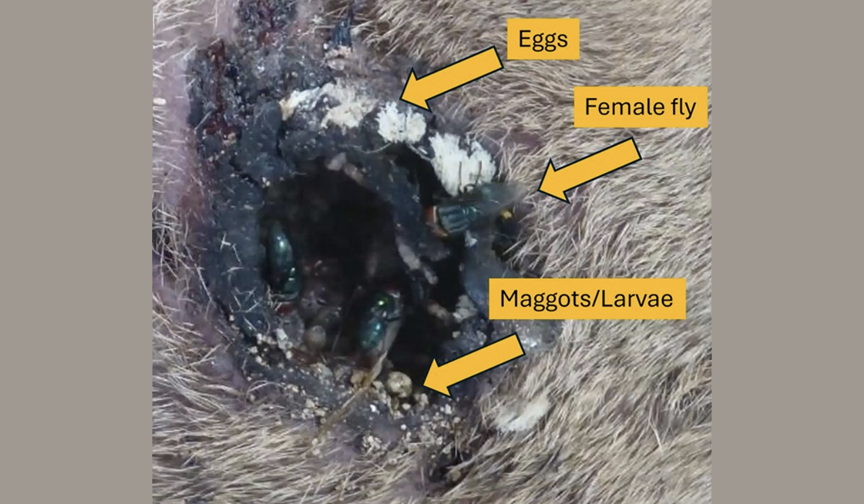
The most important clue is a wound that is not healing normally, one with a foul odor and a bloody discharge. There may be deep infested pockets under the skin. Various stages of the life-cycle may be seen at the wound including 1) the adult fly itself, roughly the size of a housefly, but with orange eyes and a blue/green body, 2) clusters of white eggs around wound edges, each smaller then a pinhead and 3) the mature maggot or larvae, each which may be about ¾ inches long. See the photo from USDA to the right.
What should producers do if they suspect they have infested cattle?
Producers should report suspect cases immediately. State or federal animal health officers will assist in eradicating the pest from your farm. For now, producers should not treat a maggot-infested wound without first consulting with their herd veterinarian. This USDA graphic describes additional actions you can take including stopping animal movement and collecting samples.
What will happen if the pest is detected in the U.S.?
Are there cattle treatments available to kill the NWS larvae?
There are currently no fully-approved FDA products for NWS. A variety of available regulatory pathways exist, which could permit off-label, veterinarian-directed treatment or prevention of NWS. Because some extra-label treatments have prolonged meat and milk withdrawal times, it is essential that producers consult their herd veterinarian before treating off-label. The FDA maintains a comprehensive Q&A webpage on the subject of NWS treatment.
What is USDA doing to keep the pest from entering the U.S.?
During the webinar hosted by NMPF, Christopher Needham, deputy Director for APHIS’s NWS unit, explained that the situation is “all hands-on deck,” and USDA is implementing a 5-Pronged Plan to address the outbreak. (USDA work related to NWS, HPAI, and other emergency programs will continue during government shutdown.) Highlights from the webinar include:
USDA personal on location working with Mexican animal health officials, which includes monitoring, updating, and auditing animal movement controls.
A detailed NWS response plan already exists (infestations in U.S. territories do occur), but a specific plan should NWS cross the border will be released shortly.
Sterile fly production: $21 million to convert Metapa, Mexico fruit fly facility to screwworm and an additional $370 million for a new facility in Edinburg, Texas.
Increasing fly trapping, to include some 200 screwworm traps placed in 8 border counties as well as monitoring for cross-border livestock incursions.
Making available up to $100 million for innovative screwworm research.

Be the first to comment