
As America celebrates its 250th birthday, two comments during a recent Senate Ag Committee hearing captured what many dairy farmers have been living for years. Sen. Jim Justice (R-W.Va.) said agriculture needs “a great big plan” to solve its fundamental riddle. Sen. Peter Welch (D-Vt.) summed up that riddle in one sentence: “Our farmers create an immense amount of wealth, they just don’t get any of it.”
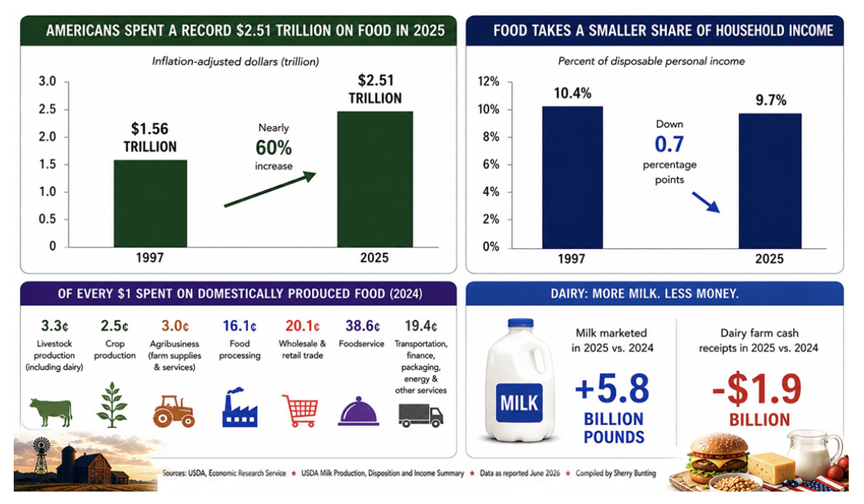
USDA’s Economic Research Service reported in June that Americans spent a record $2.51 trillion on food in 2025, yet food accounted for just 9.7% of disposable personal income, down from 10.4% in 1997. Consumers are spending more than ever on food, but it takes a smaller share of their household income vs. nearly three decades ago, and the USDA’s Food Dollar data show that just 3.3 cents of every consumer food dollar gets back to livestock productiion, including dairy, and 2.5 cents to crop production.
Dairy provides another example. According to USDA’s Milk Production, Disposition and Income Summary, dairy farmers marketed nearly 5.8 billion more pounds of milk in 2025 than the year before. Yet dairy farm cash receipts declined fell by $1.9 billion.
American farmers continue creating more wealth with every seed planted and every calf born and raised. The challenge is ensuring they can keep enough of it.
As we begin America’s next 250 years, American Dairy Coalition believes successful farm policy should not just provide opportunities for growth and innovation but strengthen profitability, competitiveness, and long-term viability of independent dairy farms. That same principle also applies to the value farmers create through their data—it should work for farmers, not simply flow downstream through the supply chain.
Our nation’s agrarian roots built America and are essential to keeping America fed and free. Securing our nation’s independence means ensuring independent farmers can continue producing food, strengthening rural communities, stewarding land and natural resources, and confidently passing their farms to the next generation.
Be the first to comment