
Now an associate professor in the MSU Department of Biosystems and Agricultural Engineering he’s focused on the development and implementation of waste management systems and waste-to-energy systems for dairy operations.
“The issues our work aims to address have always been near and dear to me as someone raised on a family dairy farm,” Kirk said.
“It’s important we continue to develop and enhance agricultural practices that maintain a good relationship with the environment. To do that we are seeking methods to better utilize all of our resources, and find ways to reinvest in those resources.”
Kirk routinely partners with government and commodity organizations, including Michigan Farm Bureau, to develop training and programming that supports manure management systems for dairy farms of all sizes. Kirk prioritizes applied research focused on responding to the emerging needs of dairy producers in Michigan and across the country.
“One of the biggest things we advocate for at Michigan Farm Bureau is the need, and the ability, of faculty at MSU to conduct research that’s important to the dairy industry,” said Laura Campbell, senior conservation and regulatory relations specialist with Michigan Farm Bureau.
“Dana is a great partner, because he not only conducts the research that responds to industry needs, but he’s also able to lead many of the educational programs and share information directly with farmers and with agricultural organizations like Farm Bureau.”
Kirk’s research on anaerobic digestion systems contributed greatly to the MSU Anaerobic Digestion Research and Education Center (ADREC), a project Kirk helped create, direct and manage.
Founded in 2008, ADREC provides research, professional development and outreach support for waste-to-energy systems, including bench top, pilot-scale and commercial anaerobic digestion systems.
Education and outreach activities that emphasize cost-effective and efficient technologies on small and medium-sized dairy farms, along with other biomass energy topics and environmental protection, are all part of the ADREC mission.
“Dana’s work with ADREC provides an invaluable resource for dairy farms, informing them on what they must consider when trying to incorporate a digester into their operations,” Campbell said.
“ADREC works with individual farmers to address their needs, provides a formalized structure for implementation and training on how digesters work, helps navigate regulatory issues and assists with training programs for farm workers to learn to operate digester technology.”
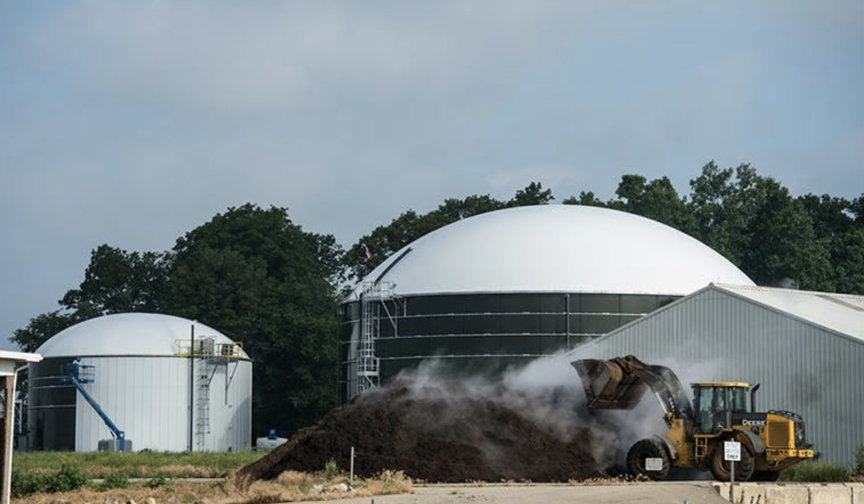
Kirk has overseen the design, construction and operation of three commercial scale digesters and numerous demonstration and pilot-scale systems, most notably MSU’s nationally awarded South Campus Anaerobic Digester (SCAD), a single-tank complete mixed anaerobic digester.
SCAD uses roughly 17,000 tons of organic waste generated from MSU culinary services, dining halls and on-campus farms, and the greater Lansing area community per year as feedstock to produce biogas used to generate more than 2.8 million kWh of electricity per year.
Kirk understands large-scale digesters are not viable waste-management solutions for most of Michigan’s dairy operations. Many financial, regulatory, training and logistical barriers prevent some small and medium-sized farms from adopting any of the various digester technologies that currently exist.
ADREC partners with state and national commodity and regulatory groups to meet these issues head-on with the goal of easing the burden of transitioning to digester systems.
“The partnership MDARD has with Dr. Kirk and his team allows us to better engage in conversations related to the implementation and regulation of digester systems with partnering state agencies,” said Laura Doud, licensed engineering specialist with MDARD’s Environmental Stewardship Division.
Specific collaborations have centered on data review from digesters, feasibility studies, infrastructure, and regulation of waste-to-energy projects mainly at dairy facilities. MDARD also partnered with Kirk on the Anaerobic Digester Operator Training program used to educate operators on ways to manage systems variability and optimize performance, Doud added.
MDARD’s Environmental Stewardship Division helps supports the state’s dairy producers through projects including the Michigan Agriculture Processing Act, Michigan Agriculture Environmental Assurance Program, Right to Farm, Fertilizer Bulk Storage program, and waste-to-energy projects. She said Kirk’s research and ability to share that with stakeholders and producers enhances the work MDARD conducts with Michigan’s dairy industry.
In an effort to provide dairy producers around the U.S. with resources necessary to adopt effective waste-to-energy systems on their own farms, Kirk worked with Dairy Management Inc. to develop a resource guide on digester technology options available commercially that provides comparative information to better guide farms on optimal systems for their individual needs.
Ultimately, Kirk hopes to continue breaking down barriers to adoption in Michigan and beyond.
“Digester technology really has a foothold and is no longer viewed as novel,” Kirk said. “I think it is the wave of the future, but it’s also a stepping-stone technology for the next wave, which would be improving how we manage nutrient separation that allows us to create value-added products.”

Be the first to comment