

This is not a Farm Bill discussion. The focus is on USDA and its responsibility to manage dairy pricing under the existing program. IDFA will continue to work in the best interest of our members and the full U.S. dairy industry to see this process through.
The U.S. dairy industry continues to go through a period of great evolution and transition that opens new opportunities for growth and exposes new challenges. Today’s U.S. dairy industry has evolved from one based on producing nutritious milk for drinking to an industry defined by a robust, innovative supply chain also making nutritious, value-added products like cheese, yogurt, dairy-based health beverages and powders, frozen treats, and so much more. As our industry continues to evolve, we must have policies in place to support our continued success and evolution. IDFA’s approach to milk pricing reflects a balanced, inclusive approach that is in the best interest of the full dairy supply chain.
IDFA proposals
IDFA is proud to stand behind these proposals because they represent a balanced approach that is based on sound data and is beneficial to both processors and dairy farmers.
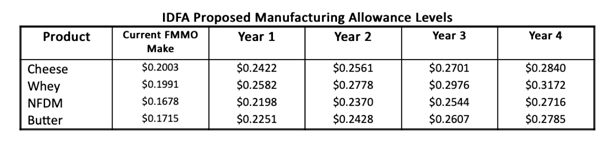
IDFA’s Make Allowance proposal would update the system to better reflect the cost of processing milk into dairy products – something that hasn’t been adjusted since 2008. The IDFA proposal increases the current 2008 make allowance levels to the simple average of the 2022 Scheik study results and the new Stephenson 2022 survey stepwise over time. Half of the difference would be applied when (and if) the order changes are initiated, and 1/6 of the difference would be added each year over the next three years until the full amount is reached. If an audited mandatory cost survey conducted by USDA becomes available during this time, the make allowance numbers from the new survey would be used instead. IDFA, NMPF, AFBF and other stakeholders are all asking Congress to provide USDA with the statutory
authority to conduct regular cost surveys, and IDFA members were in Washington, D.C., this summer urging Congress to include this authority in the upcoming Farm Bill.
In June, IDFA submitted a modification to the proposal at the request of USDA. The modification adds a $0.0015 adjustment to the Schiek and Stephenson studies for marketing fees, as is currently recognized by USDA. The chart below outlines the proposed make allowance changes.
IDFA’s Class I Mover proposal would provide dairy producers with milk check payments equal to or greater than what they would receive under the “Higher of” mover over time, while preserving the ability for producers, processors and their customers to hedge their costs. It would do so in a manner that:
· Preserves the ability of Class I market participants to manage price risk;
· Encourages increased sales of Class I products, which have been in steady decline for many years; and
· The proposal will put more dollars into the pockets of dairy farmers over time than either the current Class I mover or the “higher of” proposal.
In June, IDFA submitted a modification to the proposal at the request of USDA, further defining the proposed language and providing examples on how the proposal would work.
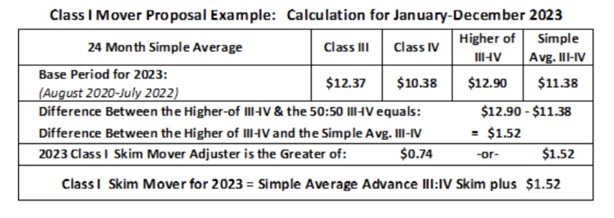
Under the IDFA proposal, the Class I skim milk mover for any given year would equal the Simple Average of the Class III & Class IV Advance Skim Milk Price, plus the higher of the following:
1. The 24-month simple average of the Advanced “Higher-Of” Skim Milk Price (rounded to two decimals) for the August-July of the two preceding years, minus the 24-month simple average of the III-IV Advanced Skim Milk Price (rounded to two decimals), or
2. 74 cents per cwt skim milk (71 cents per cwt 3.5% Milk).
An example for 2023 follows below:
Be the first to comment