
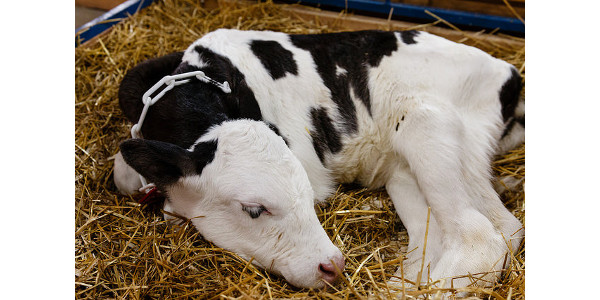
As cattle producers, I know you have all had experiences similar to this. You should never hesitate to contact your veterinarian if needed, but I am going to pass on some things that I have learned to help you feel more comfortable with calving assistance.
When to Intervene During Calving
You should provide assistance immediately if you notice an abnormal presentation of the calf (AKA back feet, only one leg, etc.) or when there is no progress after 30 minutes for a cow or 60 minutes for a heifer.
Performing an Obstetrical Examination
During the examination, use plenty of lubrication and stay as clean as possible. You are checking for complete dilation of the cervix and presentation of the calf. If the cervix is not dilated, you will feel a tight ring of tissue about wrist to mid-forearm deep.
Normal calf presentation is both front legs with the head between them. If you are unsure which legs are coming, check the joints. The first two joints of the front legs flex the same way, but the first two joints of the back legs flex the opposite way.
Navigating Common Malpresentations
Malpresentations of the calf will require manipulations to allow delivery. If you get nothing else from this article, please remember this: Do not be afraid to push the calf back in! If there is too much bulk in the birth canal, then it is nearly impossible to safely manipulate and get the legs pulled up.
Leg back: Push the calf deeper into the uterus to get the head out of the birth canal. When the cow strains against you, the calf’s head will want to pop right back into the pelvis, so I often turn the head to the side. Find the leg that is back and pull on the knee joint so you can get to the hoof. You must cup the hoof with your hand as you pull the leg into the pelvis, so the foot doesn’t poke through the uterus. With bigger calves, oftentimes you must push back on the shoulder or knee with one arm while the hand that is cupping the hoof is pulling it into the birth canal. When both legs are in the pelvis, straighten the head and deliver the calf.
Head back: If the shoulders are engaged in the birth canal, push the calf back to get the head turned. The easiest way to grip the head is by the nostrils or to hook the cheek. In my experience, a good percentage of calves that present this way are too big to be delivered safely, so if you are unable to keep the head engaged in the pelvis when you start pulling, the calf likely needs to be delivered by Cesarean.
Backwards: A backwards calf is one that is presented with back feet coming out. You can pull calves this way, but you have to pull them fast so they don’t inhale fluid or asphyxiate. I always use a mechanical calf puller for backwards calves to ensure as fast a delivery as possible. Make sure the tail is tucked down between the back legs before pulling.
Breech: A breech presentation is when the calf is coming tail first and both back legs are down. These can be exceptionally difficult to get the back legs up; I would advise seeking the help of your veterinarian for these. If you must try this on your own, you have to get the calf pushed forward out of the birth canal. Then, with one hand you need to push the hock or the rump forward while your other hand cups the foot and flexes the leg into the pelvis. The fun part is having to do it again for the other leg.
Once you have the calf coming the right way, it is time for delivery! Stay tuned for Part 2, where we will discuss safely pulling and delivering a calf. Refer back to my last piece, “3 Tips to Keep in Mind This Calving Season,” for best practices to consider. Continue learning and readying for calving season, at ValleyVet.com.
About the author: Valley Vet Supply Technical Service Veterinarian, Tony Hawkins, DVM, attended Kansas State University’s College of Veterinary Medicine, where he placed focus on mixed-animal practice. Before joining the Technical Service veterinarian team at Valley Vet Supply, Dr. Hawkins practiced veterinary medicine in Marysville, Kansas, where he was greatly involved in cattle health, including processing, obstetrical work, and servicing the local sale barn. He also is treasured by the community for his care of horses and pets, through wellness appointments and surgery.
Valley Vet Supply was founded in 1985 by veterinarians to provide customers with the very best animal health solutions. Building on over half a century of experience in veterinary medicine, Valley Vet Supply serves equine, pet and livestock owners with thousands of products and medications hand-selected by Valley Vet Supply Technical Service veterinarians and team of industry professionals. With an in-house pharmacy that is licensed in all 50 states, and verified through the National Association of Boards of Pharmacy (NABP), Valley Vet Supply is the dedicated source for all things horse, livestock and pet. For more information, please visit ValleyVet.com.


Be the first to comment