
In modern dairy production, two periods consistently test the resilience of even the best‑managed herds: the onset of lactation and the summer heat. Both challenges place intense pressure on cows’ energy metabolism, often limiting milk yield at precisely the time when producers aim for peak output. As feed intake declines or fails to meet rapidly rising demands, the cow’s ability to convert nutrients into milk becomes constrained—leaving valuable production potential unrealized.
A Natural Approach for Better Feed Digestibility
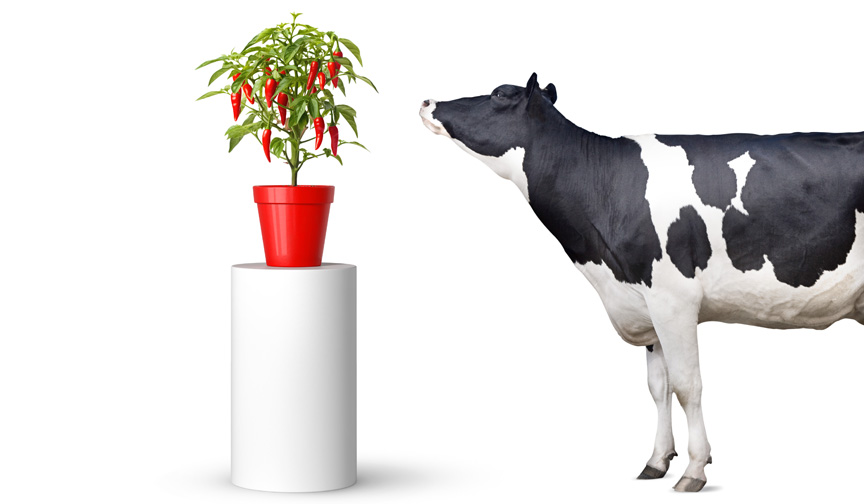
BoruCare® Capsin helps bridge this nutritional gap using a simple but powerful concept: naturally occurring capsaicinoids from whole chili peppers. The peppers are finely ground and then protected within a fat matrix, creating a standardized product with consistent capsaicinoid levels and mild handling characteristics. Because no solvent extraction is used at any stage, the full spectrum of plant compounds is retained.
Capsaicinoids have been shown to improve nutrient digestibility and absorption, contributing to better overall performance by allowing cows to make more efficient use of the feed they consume. Under conditions like early lactation or heat stress—when intake is often restricted—this improved nutrient availability becomes especially valuable.
Supporting Milk Yield in Heat Stress and Early Lactation
Heat stress is one of the biggest challenges in dairy farming. As temperature and humidity rise, cows eat less, insulin levels climb, and glucose is diverted away from milk production. The result can be significant losses in yield.
By improving how glucose is allocated within the body, BoruCare® Capsin helps counteract these effects. More glucose is made available for milk synthesis, supporting sustained performance even when environmental conditions become difficult. Farmers using the product typically supplement 1 g per cow per day—and trials show this can increase milk yield by around 1.0 kg/day on average, with responses of up to 2.6 kg/day reported under heat stress. The strongest effects appear in early‑lactation cows, who are already in a negative energy balance and benefit most from improved nutrient utilization.
Easy Handling, Sustainable Process
The way BoruCare® Capsin is produced contributes to both practicality and sustainability. Using whole chili peppers avoids the need for extractive processes and keeps the manufacturing approach straightforward and environmentally conscious. The encapsulated granules flow easily, resist dust formation, and remain stable during storage and feed processing, including pelleting. The active ingredient, capsaicin, has a high stability even at high temperature and pressure, hence resisting the production process if included in pelletized feed. This makes day‑to‑day use simple and reliable, whether the product is added to a concentrate or blended into a Total Mixed Ration (TMR).
How to use BoruCare® Capsin?
Farmers will see the greatest benefit from BoruCare® Capsin when it is incorporated into the ration during the first 100 days of lactation, a period when cows experience their highest energy demands. The product is also especially effective in hot, humid conditions, when heat stress further reduces feed intake and nutrient availability. A daily inclusion rate of around 1.0–1.5 grams per cow is typically recommended. For consistent intake and ease of use, BoruCare® Capsin can be mixed directly into the concentrate or added to a small portion of the TMR to ensure every cow consumes the full amount.
A Practical Step for More Resilient Milk Production
BoruCare® Capsin offers a natural, science‑backed way to support performance during critical periods. With benefits for handling and milk production, it provides farmers with a simple tool to help cows stay productive—even in adverse conditions.
Find out more about BoruCare® Capsin here: https://www.evonik.com/en/products/an/pr_52058347.html


Be the first to comment