
Nearly 41% of the California lactating cow ration is composed of byproducts. That number was calculated from responses to a 2022 survey of California dairy nutritionists. The data set represents approximately 936,700 lactating cows (26 returned surveys); 87.5% of those cows were housed in the San Joaquin Valley. Only 4% of lactating cows (38,100 cows) did not consume byproducts. In this article, we will present the data collected on dry cow and heifer rations in the State. Lactating cow ration data were presented in the April (2023) newsletter.
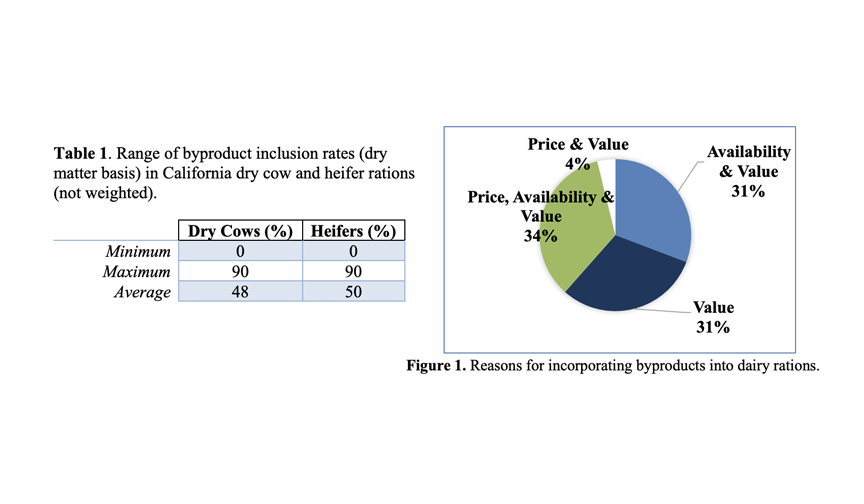
Byproduct inclusion rate. In the survey, we asked a series of questions about ration byproduct inclusion rates of nutritionists’ herds. The values for dry cow and heifer rations are presented in Table 1 above. The range in byproduct feeding amounts was large. On average, California dry cow rations include 48% byproducts and heifer rations include 50% byproducts.
Reasons to use byproducts. In a “select all that apply” question, every nutritionist selected value (worth the price) as a reason for including byproducts (Figure 1). Less chose price (they’re cheap; 38%) and availability (65%).
Determination of nutrient composition. Nutritionists fed 63 unique byproducts. Most nutritionists (58%) reported using a commercial laboratory to determine the nutritional composition of all byproducts, whereas 42% analyzed only some byproducts.
Byproduct feeding is not a new practice. The wide range in feeding levels suggests it is possible to feed more byproducts on some dairies. Water regulation and reduced water availability will impact California’s ability to produce forages. Byproduct feeding strategies may help mitigate feedstuff disruptions while contributing to the sustainability and resiliency of the California feeding program.
Thank you to the California dairy nutritionists who participated in the survey and to the California Dairy Research Foundation for funding this project.
Jennifer Heguy – UCCE Stanislaus, Merced & San Joaquin, Rúbia Branco-Lopes – UCCE Tulare & Kern, Noelia Silva-del-Río – UC Davis Veterinary Medicine/UC ANR & Ed DePeters – UC Davis Animal Science

Be the first to comment