
Time budgets of a dairy calves
A study done with nine Holstein calves at two months of age that recorded their behavior during a 12-hour period showed they spend most of their time lying down (70%), followed by standing idle (28%) and walking or running (2%)5. Similarly, one-month-old veal calves housed in groups spend roughly 68% of the day lying down (16.3 hours) distributed in approximately 20 bouts (i.e., transition from standing to lying) per day1. As calves age, total lying time decreases while step count increases6-7. Goharshahi et al. (2021) reported lying, inactive and active times of 20.3 hours, 19.2 hours and 4.6 hours, respectively, in the first day of life and 15.2 hours, 11.9 hours and 10.6 hours, respectively, on day 29 of age. However, this report included diseased calves and calves that did not have a health event. Similarly, a study done with group housed dairy calves showed their average daily lying time is 16.7 hours, with a total of 19.6 lying bouts averaging 56 minutes per bout8. In addition, total milk feeding time of 19.4 minutes distributed between 3.2 visits to an automated milk feeder8.
The effect of health events on dairy calf behavior
A recent study of veal calves aged 1 to 3 months investigated whether behavior could be an early predictor of sickness1. Each sick calf (n = 33) was matched by age, weight, date and season with three healthy calves (n = 99). At 10 days prior to the disease diagnosis (i.e., “day 0”), sick calves had significantly fewer step count and a decreased frequency of meals for most days compared to healthy
Current research being done at Texas A&M
Ongoing research at Texas A&M University aims to characterize behavioral metrics of pre-weaned, pair-housed dairy calves. Accelerometers were placed on a rear leg of two-day old calves (IceQube, IceRobotics, Edinburgh, UK) to assess their behavioral activity9.
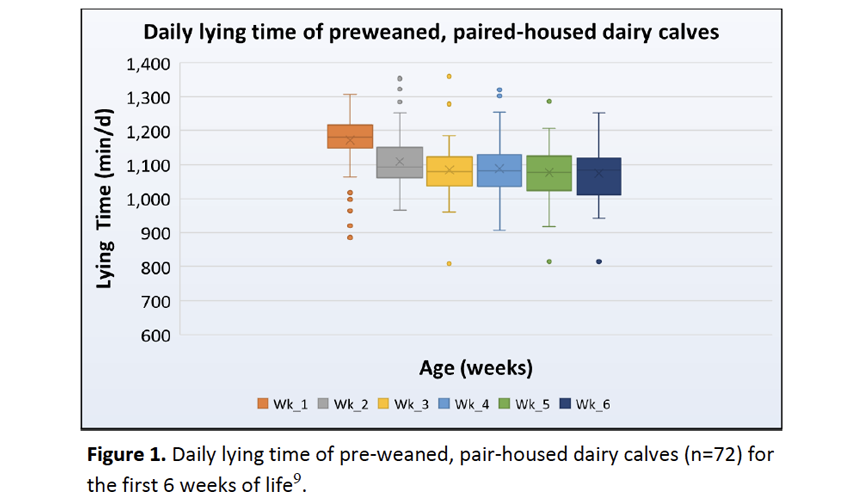
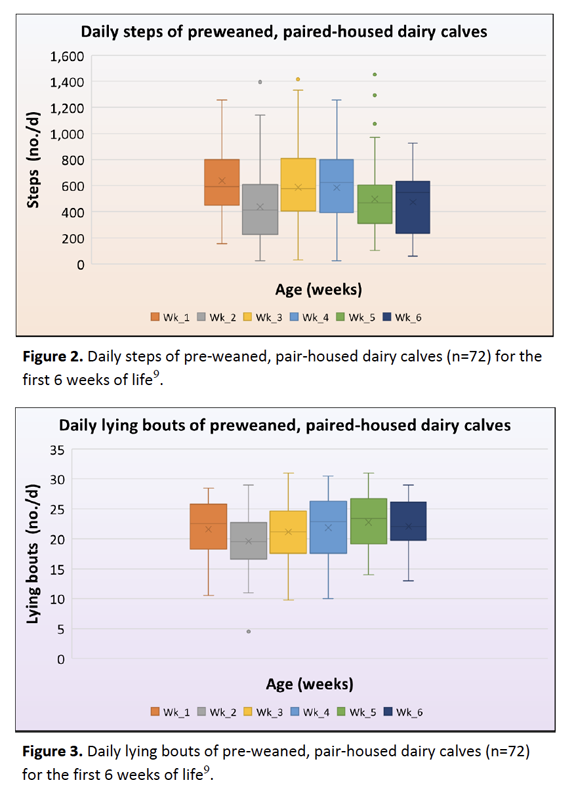
Daily lying time, number of steps and number of lying bouts were recorded, and the weekly average for the first six weeks of life was calculated. Calves were pair-housed in adjacent hutches with a shared outdoor area of 140 square feet and were fed three times daily with a total of 2.25 gallons of milk by nipple bottle. On average, pair-housed calves laid down 18.5 ± 1.6 hours/day, walked 510 ± 296 steps/day, and had 22 ± 5 lying bouts/day (Figure 1, 2 and 3).
Conclusions and future directions
Preliminary data from our ongoing research suggest pre-weaned, pair-housed calves spent lying down 50% more time, walk less and have roughly double the amount of lying bouts compared to lactating dairy cows. Future research will assess the effect of disease on these behavioral metrics.
References
- Belaid, M.A., M. Rodríguez-Prado, D.V. Rodríguez-Prado, E. Chevaux, and S. Calsamiglia. 2020. Using behavior as an early predictor of sickness in veal calves. J. Dairy Sci. 103:1874- 1883.
- Sutherland, M.A., G.L. Lowe, F.J. Huddart, J.R. Waas and M. Stewart. 2018. Measurement of dairy calf behavior prior to onset of clinical disease and in response to disbudding using automated calf feeders and accelerometers. J. Dairy Sci. 101:8208-8216.
- Gomez, A. and N.B. Cook. 2010. Time budgets of lactating dairy cattle in commercial freestall herds. J of Dairy Sci. 93:5772-5781.
- Piñeiro, J.M., B.T. Menichetti, A.A. Barragan, A.E. Relling, W.P. Weiss, S. Bas and G.M. Schuenemann. 2019. Associations of postpartum lying time with culling, milk yield, cyclicity, and reproductive performance of lactating dairy cows. J. Dairy Sci. 102:3362-3375.
- Trénel, P., M.B. Jensen, E.L. Decker, and F. Skjøth. 2009. Technical note: Quantifying and characterizing behavior in dairy calves using the IceTag automatic recording device. J. Dairy Sci. 92:3397–401.
- Knauer, W.A., S. M. Godden, A.K. Rendahl, M.I. Endres and B.A. Crooker. 2021. The effect of individual versus pair housing of dairy heifer calves during the preweaning period on measures of health, performance, and behavior up to 16 weeks of age. J. Dairy Sci. 104:3495-3507.
- Goharshahi, M., M. Azizzadeh, L. Lidauer, A. Steininger, F. Kickinger, M. Öhlschuster, W. Auer, D. Klein-Jöbstl, M. Drillich, and M. Iwersen. 2021. Monitoring selected behaviors of calves by use of an ear-attached accelerometer for detecting early indicators of diarrhea. J. Dairy Sci. 104:6013-6019.
- Duthie, C.A., J.M. Boween, , D.J. Bell, , G.A. Miller, , C. Mason and M.J. Haskell. 2021. Feeding behaviour and activity as early indicators of disease in pre-weaned dairy calves. The International Journal of Animal Biosciences. 15:100150.
- Piñeiro, J.M., S. Paudyal, B. Newcomer, B.W. Jones, G.M. Schuenemann, D. Duhatschek. Characterizing behavioral metrics of pre-weaned, paired-housed dairy calves. J. Dairy Sci. (accepted for publication).



Be the first to comment